

I've been living and doing research in New Zealand for a few years now, and if there's one thing that's changed since I first went through the international student visa process myself, it's this: the rules aren't quiet anymore. 2026 has been a genuinely unusual year to be applying to study abroad. The US tightened its F-1 visa rules in ways that change how long you can stay and how much certainty you have while you're there. New Zealand, almost in the same breath, loosened its post-study work visa rules and opened a pathway that simply didn't exist twelve months ago.
I get asked about this a lot, by students back home and by people I've supervised who are weighing the same decision I once had to make. So I want to walk through what actually changed on both sides in 2026, as plainly as I can, so you can work out what it means for your own situation instead of relying on forum panic or an agency's sales pitch.
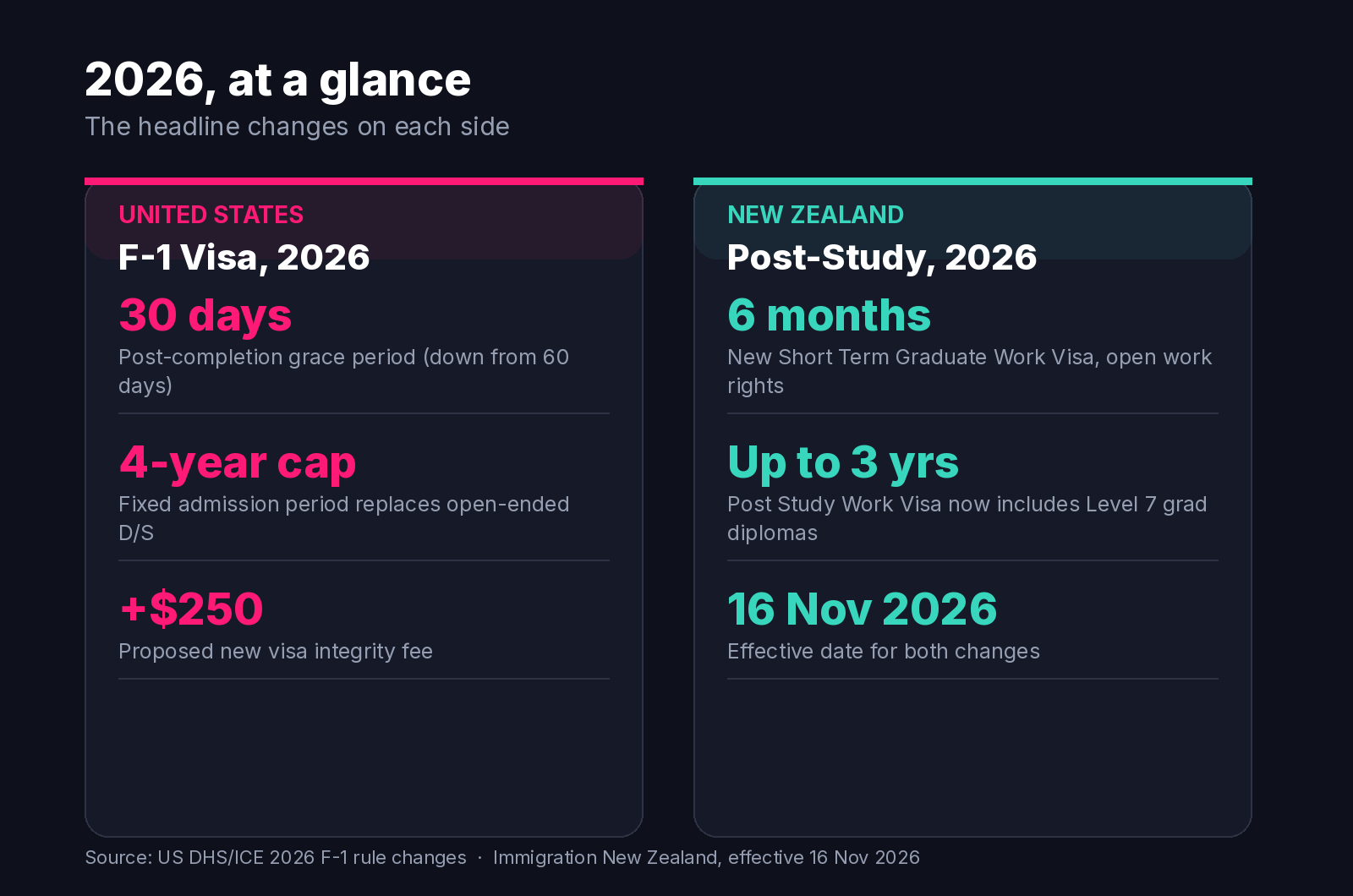
The US cut its student visa grace period to 30 days and capped admission at 4 years. New Zealand did the opposite: a brand-new visa gives graduates 6 months of open work rights, effective 16 Nov 2026. Neither country is objectively "better" — it depends on your program length and field.
What actually changed for US student visas in 2026
The headline change is that the US is moving away from Duration of Status (D/S) — the long-standing rule that let F-1 students stay for as long as their program legitimately required, with no hard expiry date. In its place is a fixed four-year admission period tied to what's listed on your I-20.
A few things follow from that:
- Programs running past four years — a fair number of PhDs and some combined degrees fall into this — now need a formal Extension of Stay (EOS) approved by USCIS, instead of a quick extension your school's international office used to be able to handle directly. That means biometrics appointments, filing fees, and processing delays that simply didn't exist before.
- The post-completion grace period has been cut in half, from 60 days down to 30. That's 30 days to leave the country, start OPT, or transition to another status after your program ends.
- Screening has gotten heavier, including broader social media vetting and the removal of interview waivers, so more applicants are being asked to attend in-person interviews.
- A proposed $250 "visa integrity fee" adds to the upfront cost of applying.
- Core OPT rules haven't changed — still 12 months standard, 24 months with the STEM extension — but stricter monitoring and possible future restrictions are being discussed, and CPT is facing more scrutiny too.
None of this makes a US degree a bad idea — it's still home to some of the best programs in the world in plenty of fields. But it does mean less flexibility if your timeline shifts, and a much smaller margin for error after you graduate. If your field practically requires four-plus years, that EOS requirement is worth planning around from day one, not discovering in year three.
What actually changed for New Zealand student visas in 2026
New Zealand went the other direction, and this is the part I can speak to firsthand, since I'm on this side of it. Two changes take effect on 16 November 2026, and together they meaningfully widen who qualifies for work rights after graduating.
A brand-new Short Term Graduate Work Visa is aimed at students who don't qualify for the existing Post Study Work Visa. It grants six months of open work rights and applies to NZQCF Level 5–7 qualifications — certificates, diplomas, and bachelor's degrees — completed full-time over a minimum of 24 weeks in New Zealand. English language, foundation, and bridging courses don't count. It's a shorter runway than the main post-study visa, but it's an option that simply didn't exist before for a lot of graduates who previously had nothing.
The existing Post Study Work Visa got wider too. Level 7 graduate diplomas are now eligible, on top of bachelor's degrees, as long as you'd already completed a bachelor's degree — in New Zealand or elsewhere — before starting the diploma. This visa still runs up to three years depending on qualification level, and unlike the new short-term visa, it lets you sponsor a partner and dependent children.
There's a policy reason behind this: New Zealand has publicly said it wants to grow international enrollment to 119,000 students by 2034, and easing the path from "graduate" to "working here for a few years" is a direct lever for that.
Worth being precise here: the Short Term Graduate Work Visa is genuinely useful, but it's not a green light to assume permanent residency. Six months of open work rights is a foothold, not a guarantee — what you do with that window still determines the outcome.
Side by side: what the two systems now ask of you
Strip away the headlines and here's the comparison that actually matters when you're the one filling out the forms.
Certainty of timeline. New Zealand's post-study options come with fixed, known durations attached at the time you apply. The US now technically has a fixed four-year admission period too, but anyone in a longer program is stepping into an EOS process that's newer, less predictable, and adds real delay risk.
Cost of entry. Both systems have visa fees, but the US route now layers on a proposed integrity fee and, for many, in-person interview requirements that add time and sometimes travel cost. New Zealand's process is comparatively lighter, though tuition and living costs are their own separate comparison worth doing on their own terms.
Work rights after graduating. The US still offers OPT (12 months, 24 with STEM) with no signal it's disappearing, and if you land an H-1B eventually, the US labour market and salaries in tech, finance, and research remain hard to match. New Zealand now offers a guaranteed six months minimum for a wider pool of graduates, up to three years for bachelor's and eligible graduate diploma holders — a smaller ceiling, but a lower bar to clear and less bureaucratic risk along the way.
Bringing family. New Zealand's Post Study Work Visa lets you sponsor a partner and children. The new Short Term Graduate Work Visa doesn't — families would need to apply for their own visitor visas. This is a real factor if you're not studying alone, and it's one people underweight until it's actually their situation.
Field and career trajectory. This is the one no chart can answer for you. If you're heading into a field where the US has an outsized concentration of top employers and research — a lot of AI, deep tech, and finance roles fall into this bucket — the visa friction may still be worth it. If your field is more evenly distributed globally, or long-term flexibility and a shorter path to settling matter more to you than working at the single biggest name in the industry, the calculus shifts toward New Zealand, Australia, Canada, or similar markets.
How I'd actually think about this decision
Instead of trying to declare one country objectively "better" — which is the trap most of these comparisons fall into — I'd run your own situation through three questions.
- How long is your program, realistically? If it's four years or under, the US D/S change barely touches you. If it's likely to run longer, as many research doctorates do, budget time and money for the EOS process, or weigh whether a country with a more predictable timeline suits you better.
- What's your tolerance for a tight post-graduation window? A 30-day US grace period is workable if you plan ahead and have your OPT paperwork ready before you finish. If your plans tend to be fluid, New Zealand's structure gives you more breathing room.
- Does your field genuinely benefit from being physically in the US, or is that a default assumption? For some fields, yes, unambiguously. For a lot of others, it's worth actually checking rather than assuming — I've watched people import that assumption without testing it against their actual industry.
None of this is a reason to panic-cancel an application you've already got in motion. It's a reason to go in with your eyes open about what each visa route now actually requires of you, and to have a genuine backup plan if you're still deciding.
Where I'd start if I were you
If you're early in the decision process, the most useful next step isn't reading more opinion pieces, mine included — it's checking the primary sources for your specific situation: your target university's international student office for US timelines, and Immigration New Zealand's official post-study work visa page for the exact criteria that apply to your qualification level. Rules like these get refined even after the headline changes land, so treat this as your starting map, not your final answer.
If you found this useful, I write about migration, higher studies, and student visas fairly regularly here on ReadClub — have a look at the other posts in that space. And if you're weighing a specific program or country pair, drop it in the comments. I'm happy to dig into it with you.
This article is general information only, based on publicly available sources as of August 2026. It is not immigration, visa, or legal advice, and it isn't tailored to your individual circumstances. Visa rules and eligibility criteria change, and only Immigration New Zealand, U.S. Citizenship and Immigration Services (USCIS), your university's international office, or a licensed immigration adviser/attorney can confirm what currently applies to your situation. Please verify everything here against official sources before making any decisions.