

A few months ago, a family friend's daughter in Colombo sent me an offer letter and asked, "Aiya, is this a good college?" It was a one-year "Graduate Diploma" from a private institute in Auckland, priced at close to four million rupees once you added the agent's "processing fee," and the offer letter itself didn't once use the word "postgraduate." Her parents believed it was one, because that's what the agent had called it in every conversation. It wasn't. It was a Level 7 qualification — the same academic level as a bachelor's degree — and nobody had explained that to them before the deposit went in.
I work in New Zealand's tertiary education and research sector, and I get messages like that a lot — Sri Lankan students, and just as often their parents, asking me to sanity-check an offer letter, a course brochure, or an agent's promise before they commit a family's savings to it. So this is the article I wish I could just forward every time. It's long, because the decision is bigger than the ten-minute conversation most students get with an agent before signing, and because "trust me, it's a good college" is not a verification method.
I want to be upfront about the tone: this is meant to make you a little uneasy. Not about New Zealand as a study destination — it remains a genuinely good one, with real universities doing real research and a functioning quality assurance system. What should make you uneasy is how many Sri Lankan students are arriving at that system through an agent relationship where nobody checked the basics, at the exact moment Sri Lankan enrolments in New Zealand are growing faster than almost anywhere else. Growth and scrutiny don't automatically move at the same speed. This article exists to close that gap for you personally, using New Zealand's own official tools — NZQA's qualification framework, its provider quality ratings, and its official checklist for choosing a provider — rather than asking you to just trust me, or anyone else, either.
Sri Lankan enrolment in New Zealand grew 44.7% in a single year — four times faster than the market overall. Roughly 1 in 5 non-university providers don’t get NZQA’s top quality rating. And a “Graduate Diploma” is not the same as a postgraduate qualification on New Zealand’s own framework, whatever your agent calls it. This guide shows you exactly how to check all of it yourself, for free, before you pay anyone.
Why this matters right now, not eventually
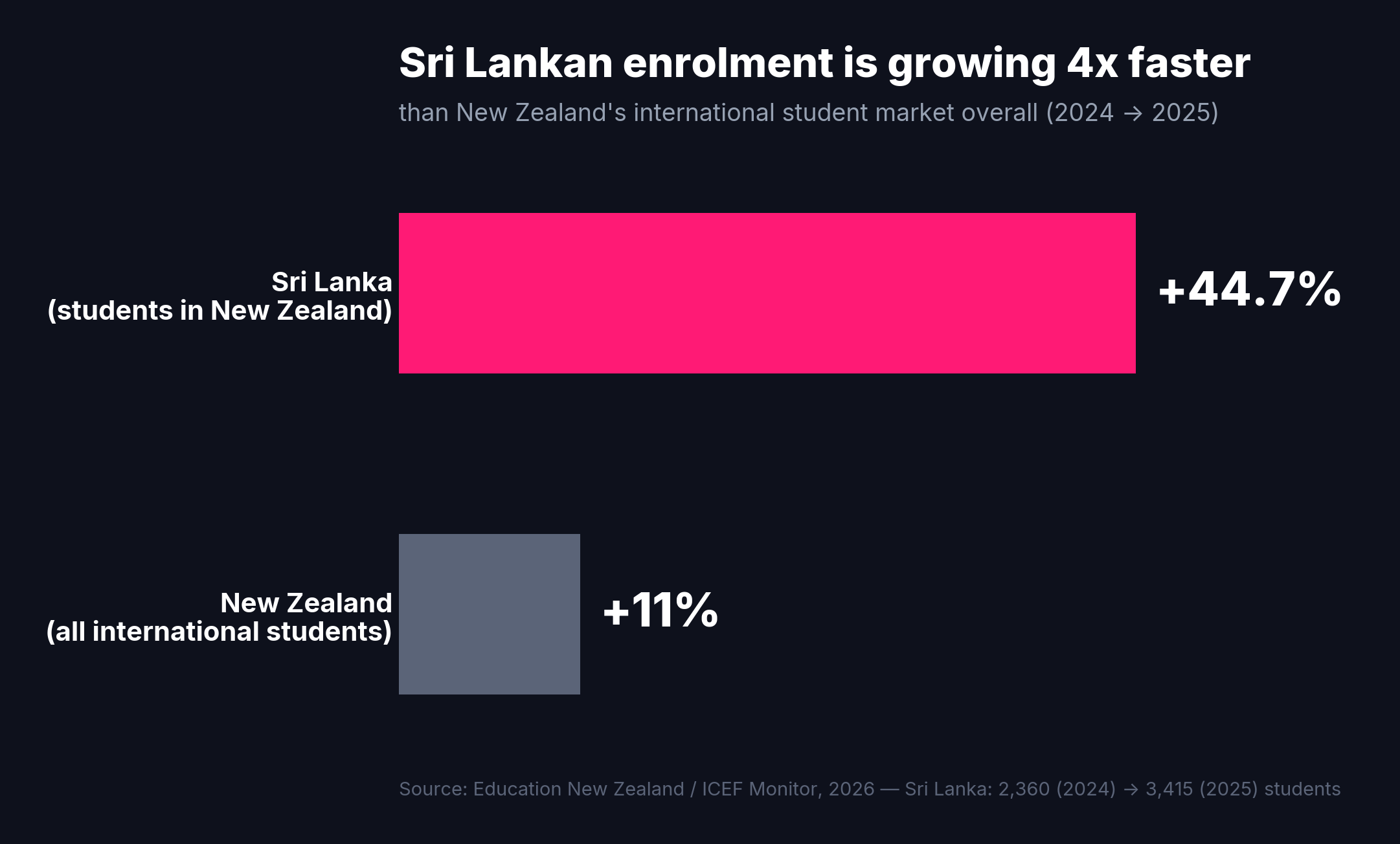
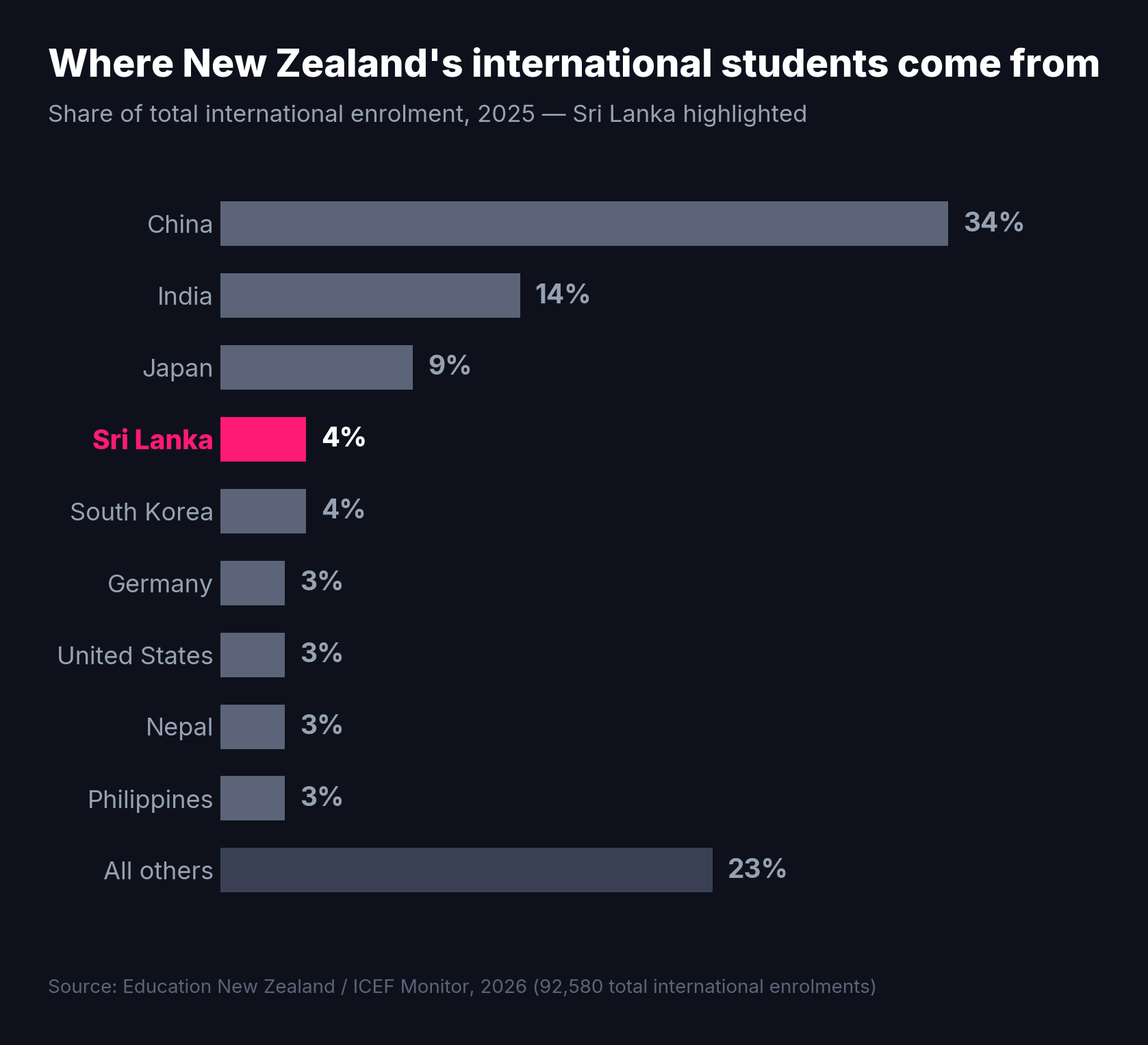
Here's the part that should get your attention. In 2025, New Zealand's international student numbers grew by 11% overall, reaching 92,580 enrolments. Sri Lanka's numbers didn't just grow with that trend — they grew four times faster than it. Sri Lankan enrolments jumped from 2,360 students in 2024 to 3,415 in 2025, a 44.7% increase in a single year, and Sri Lanka is now New Zealand's fifth-largest source of international students, tied with South Korea at 4% of the total intake, behind only China, India, and Japan.
That growth isn't happening in a vacuum. Sri Lanka's own higher education system is badly capacity-constrained: in 2022, only around 42,000 of the roughly 172,000 students who qualified for a place at one of the country's 18 state universities actually got in. Youth unemployment has sat near 25% in recent years, and the economic instability since 2022 has pushed a generation of families toward the calculation that a foreign qualification, and the work rights that can come with it, is a safer bet than waiting out the domestic job market. That's a completely rational response to a genuinely difficult situation. It's also exactly the kind of pressure that a small number of opportunistic agents and low-quality providers are set up to exploit — not because New Zealand's system is broken, but because urgency is bad for due diligence, and due diligence is exactly what gets skipped when a family feels like they can't afford to wait.
None of this means you should be paranoid about studying in New Zealand. It means you should be systematic about it, in a way that doesn't depend on how persuasive your agent sounds on a phone call.
The uncomfortable truth about education agents
Let's talk about agents directly, because most guides tiptoe around this and I don't think that serves you.
The dominant business model for education agents is commission-based: the institution pays the agent a percentage of your tuition fee once you enrol. This isn't inherently corrupt — it's how a large part of the international education industry works everywhere, and plenty of agents are honest, competent, and genuinely trying to match you with something suitable. But it does mean the agent's income is tied to you enrolling somewhere, not to you enrolling somewhere good, and definitely not to you enrolling somewhere that's the right academic fit if a different, lower-commission option would actually serve you better. An agent who only represents a handful of providers has a structural incentive to steer you toward whichever of those providers pays best, or accepts you fastest, rather than running an honest comparison across everything New Zealand actually offers.
There's also a legal distinction that almost nobody explains clearly, and it matters enormously: education advice and immigration advice are two different things, regulated by two different bodies, and most education agents are licensed for neither in any meaningful sense. In New Zealand, giving immigration advice for a fee is restricted by law to people licensed by the Immigration Advisers Authority (IAA) — it is a criminal offence for anyone else to charge for it. The IAA's own guidance is explicit that educators, employers, recruiters, and travel or education agents are not automatically authorised to give you immigration advice, even if they talk about visas constantly and sound completely confident doing it. If your agent is telling you what your post-study work visa will look like, whether you'll qualify for residence, or how to structure your application to maximise your immigration outcome, ask them directly: are you a licensed immigration adviser, and what is your licence number? You can verify any answer in under a minute on the IAA's public register. If they can't produce a licence number, or get evasive about it, that is not a small technicality — it's a sign that the advice you're relying on for one of the biggest decisions of your life may not be legally accountable to anyone.
It's also worth understanding how agent networks actually work in the Sri Lankan market specifically, because it changes what a recommendation is really telling you. Many agents operating out of Colombo and other cities are sub-agents or franchise partners of larger regional networks, representing a fixed panel of partner institutions rather than the full range of what New Zealand offers. When an agent tells you a provider is "one of our best partners," that's frequently true and also, structurally, a description of the commission relationship rather than an independent academic judgement — the agent may simply not represent the university or higher-rated PTE that would have been a better fit, because it isn't on their panel. Asking an agent "what other options exist outside what you represent" is a fair, reasonable question, and how they respond to it tells you a great deal.
I'm not telling you to fire your agent or refuse all agent help. I'm telling you that "my agent recommended it" is not a verification step. It's a starting point that then needs to survive contact with the same public tools New Zealand gives its own citizens to check a provider — which is the rest of this article.
Understanding who actually checks quality in New Zealand
Here's something that surprises a lot of students: not every tertiary provider in New Zealand is quality-checked the same way, by the same body, on the same schedule. This isn't a loophole — it's a deliberate structure — but if you don't know it exists, you can't use it to protect yourself.
New Zealand has eight universities, and they are reviewed academically by a body called the Academic Quality Agency (AQA), not by NZQA's External Evaluation and Review process. Every other tertiary provider — every private training establishment (PTE), and every institute of technology and polytechnic (ITP) — is reviewed directly by NZQA through External Evaluation and Review, or EER, on a cycle of at least once every four years, more often if NZQA isn't confident in what it finds. This matters because a lot of marketing material, and a lot of agents, will use words like "accredited," "approved," and "recognised" as if they're interchangeable, comforting synonyms. They're not. Which body reviews a specific provider, how recently, and what it found, are three separate, checkable facts.
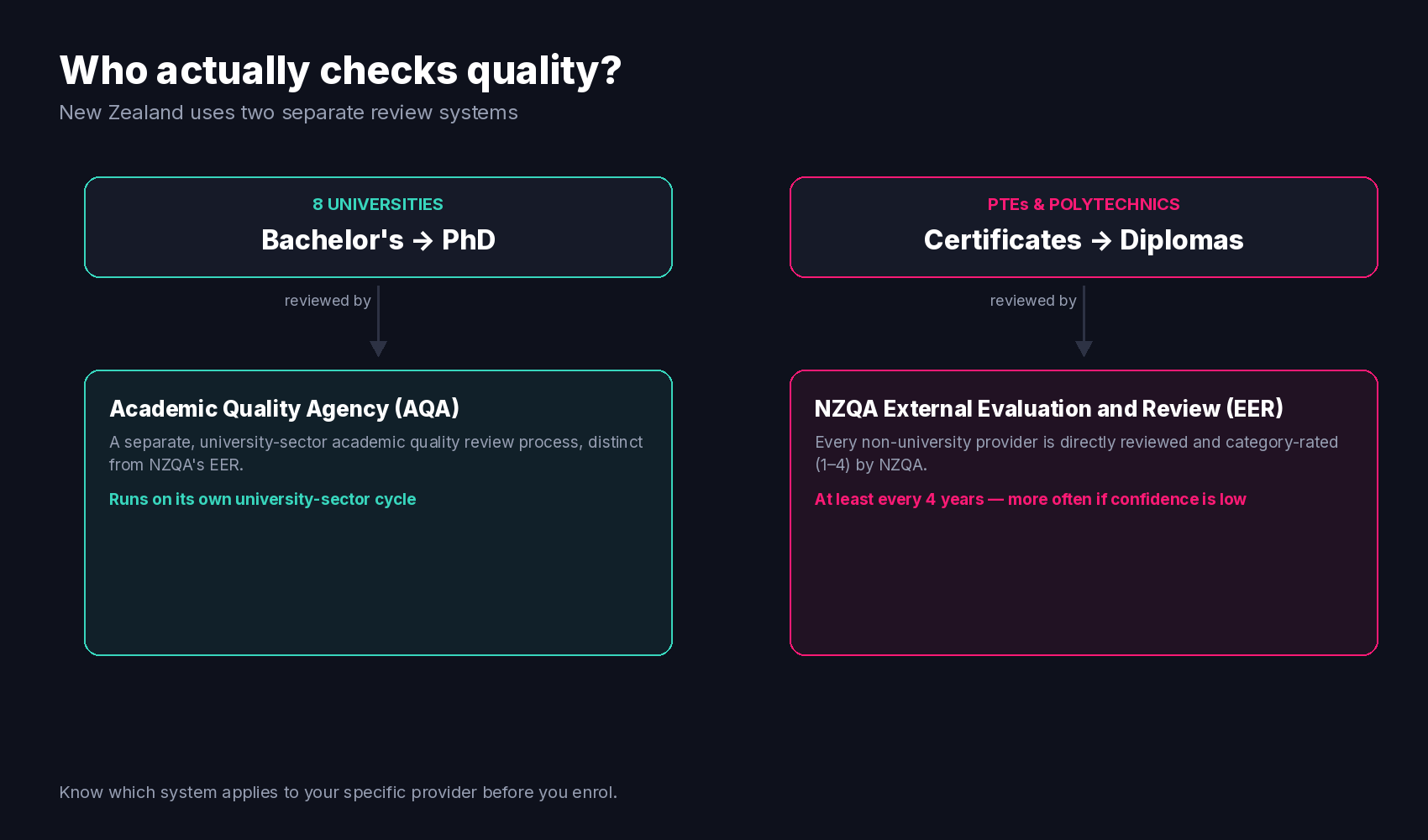
It's worth sitting with why New Zealand structures things this way rather than assuming it's a gap. Universities have historically been treated as capable of a high degree of academic self-governance, with peer-based review through the Academic Quality Agency reflecting international norms for university-sector quality assurance. PTEs and ITPs, as a more varied and commercially diverse sector — ranging from large, well-established polytechnics to small, single-campus operators — get a more standardised, externally-driven review specifically because that variety is wider and the commercial pressure to cut corners is, realistically, higher in parts of that sector. Neither structure is inherently worse; they're calibrated to different risk profiles. What matters for you is simply knowing which one applies to the specific provider in front of you, so you check the right register for the right reasons.
One more piece of context that's specifically relevant to 2026: New Zealand's polytechnic sector is mid-restructure. The previous government merged the country's sixteen polytechnics into a single mega-institution called Te Pūkenga in 2020; the current government is unwinding that. Ten polytechnics returned to independent, regionally governed status from 1 January 2026, while four others remain inside Te Pūkenga temporarily while their financial viability is assessed, with final decisions expected in the first half of 2026. If you're looking at an offer from any New Zealand polytechnic right now, this transition is directly relevant to you — ask explicitly which entity your qualification will actually be issued by, and whether that institution's status is settled or still "temporarily retained" pending a decision. This is exactly the kind of detail that a rushed agent conversation glosses over and that can matter enormously two years into a programme.
NZQA registration, accreditation, and EER: three different checks, not one
NZQA itself publishes a short, official checklist for choosing a tertiary provider, and I want to walk through it properly because most "how to choose a college in NZ" content online paraphrases it badly. There are four distinct things to verify, and they are not the same check performed four times — they're four different failure points, and a provider can pass some while failing others.
1. Is the provider registered with NZQA? Registration means NZQA considers the organisation itself capable of providing "a sound and stable learning environment" — it's a baseline check on the institution as a legal and operational entity, not a judgement on any specific course. An unregistered training provider in New Zealand cannot legally enrol students in NZQA-recognised qualifications, so this is step zero, not an advanced check.
2. Is the specific programme approved? A programme (the actual course you'd be enrolled in) needs to be approved as having "clear and consistent aims or purposes, content, outcomes and assessment practices" and needs to lead to an NZQA-recognised qualification. Here's the trap: a provider can be a legitimate, registered organisation while running one or two programmes that were approved years ago, have never been updated, and no longer reflect what's actually being taught. Programme approval is course-specific, not organisation-wide.
3. Is the provider accredited to teach that specific programme? This is the step almost everyone skips, and it's arguably the most important one. Accreditation to deliver a programme is separate from having registered as a PTE and separate from the programme itself being approved. A provider can be Category 1 (NZQA's highest confidence rating) for its overall operations while still not holding accreditation for a newer or niche programme it's aggressively marketing to international students. If a course was launched recently, or sounds unusually specific ("Graduate Diploma in Digital Marketing and Import-Export Management," for instance), this is the check that catches a provider that's expanded faster than its accreditation has kept up.
4. Has the provider signed the Code of Practice? For any provider enrolling international students, signing the Education (Pastoral Care of Tertiary and International Learners) Code of Practice is what obligates them to specific standards of student support, accommodation information, complaint handling, and — critically — what happens to your fees if the provider closes down while you're mid-course. A provider that hasn't signed the Code of Practice should not be enrolling international students at all, full stop.
All four of these are checkable, for free, before you pay anyone anything, using NZQA's own searchable directory of education organisations. It takes longer than trusting a brochure. It takes a lot less time than finding out six months into a programme that something was wrong.
Decoding the EER rating: what "Category 1" through "Category 4" actually mean
Once you find a provider on NZQA's directory, you'll usually see a category rating from its most recent External Evaluation and Review — a number from 1 to 4. This single number is doing a lot of compressed work, so it's worth understanding what actually produces it.
NZQA's review assesses two separate things and rates NZQA's confidence in each as one of four levels — Highly Confident, Confident, Not Yet Confident, or Not Confident:
- Educational performance — are students actually learning, achieving, and being well supported, in practice?
- Self-assessment capability — does the provider honestly and accurately evaluate its own performance and act on what it finds, rather than marking its own homework generously?
These two confidence ratings are then cross-referenced to produce the final category:
- Category 1 or 2 — NZQA is confident enough in the provider's quality and self-awareness that it applies lighter-touch, more flexible oversight going forward.
- Category 3 or 4 — NZQA isn't yet confident, which triggers increased monitoring, restrictions on the provider's activities, and a mandatory improvement plan the provider must complete before its next review.
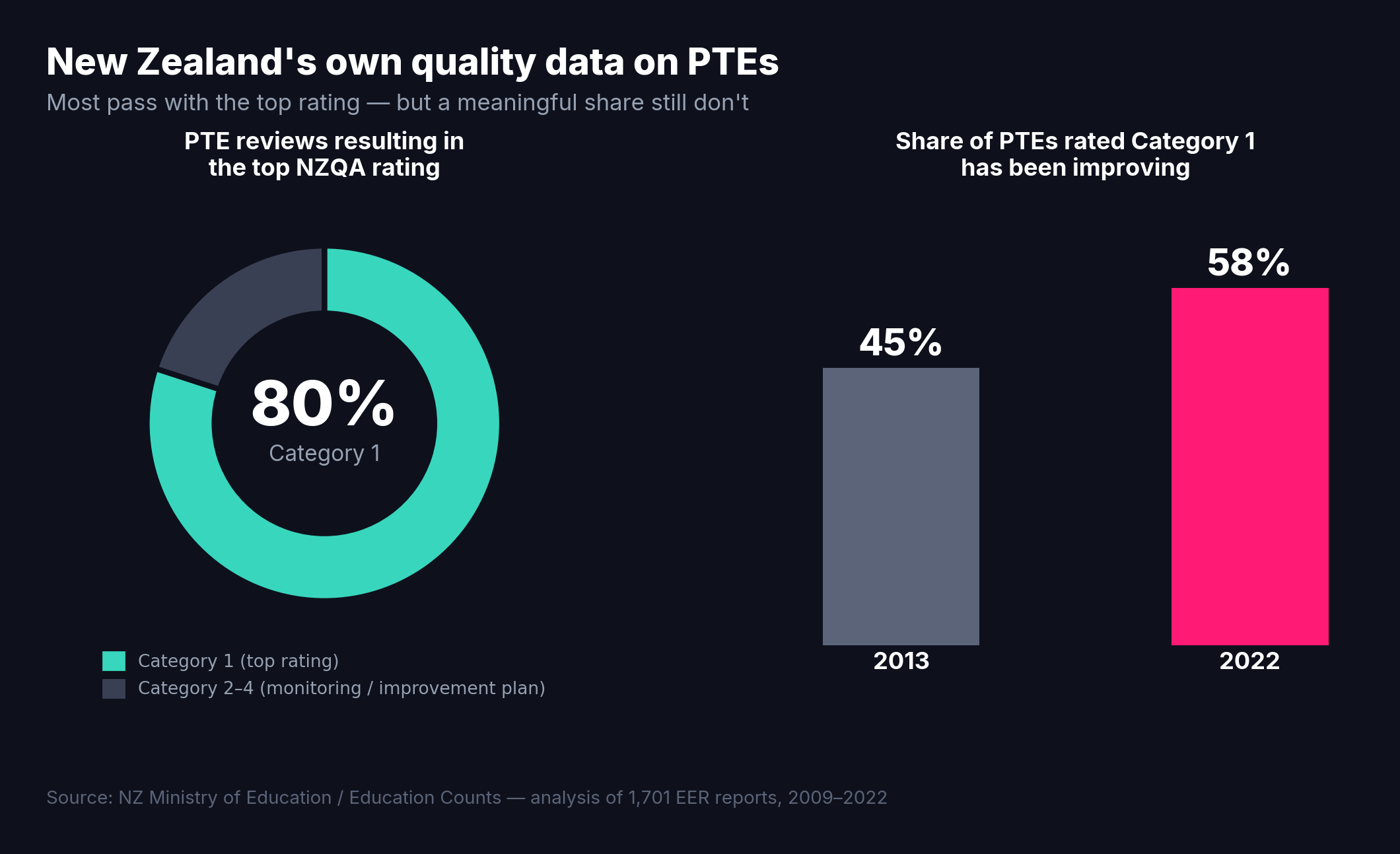
Here's why this number is worth your attention rather than a footnote: New Zealand's Ministry of Education analysed 1,701 EER reports issued between 2009 and 2022, across the entire PTE sector. About 80% resulted in Category 1 — the top rating, with no improvement plan required. That's a genuinely reassuring headline number, and it's improved over time: the share of PTEs rated Category 1 rose from 45% in 2013 to 58% in 2022. But flip that around and it means roughly one in five EER reviews across that period did not produce the top rating — the provider needed an improvement plan, faced tighter monitoring, or in the more serious cases, faced restrictions on enrolling new students at all. "New Zealand has good quality assurance" is true at the system level and is not the same claim as "this specific provider you're looking at is fine." You have to check the specific number for the specific provider.
One more nuance: EER reports and category ratings are published publicly. You can read the actual report, not just the headline number — it will tell you, in the reviewers' own words, what they found strong and what concerned them. If a provider only ever quotes you its category number and nothing else, ask to see the full report, or find it yourself through NZQA's EER reports listing. A Category 1 rating from three years ago on a provider that has since tripled its international enrolment and launched five new programmes is a different situation than a Category 1 rating issued last year. Check the date.
The word "Graduate" is doing a lot of work — learn to read NZQF levels
This is, in my opinion, the single most important section of this article, because it's the one piece of information that would have saved that family friend's daughter from paying four million rupees for something that wasn't what she thought it was.
New Zealand qualifications sit on the New Zealand Qualifications Framework (NZQF), numbered from Level 1 to Level 10. The level tells you the actual academic depth of a qualification — far more reliably than its marketing name does. Here's the part of the framework you need memorised before you talk to any agent again:
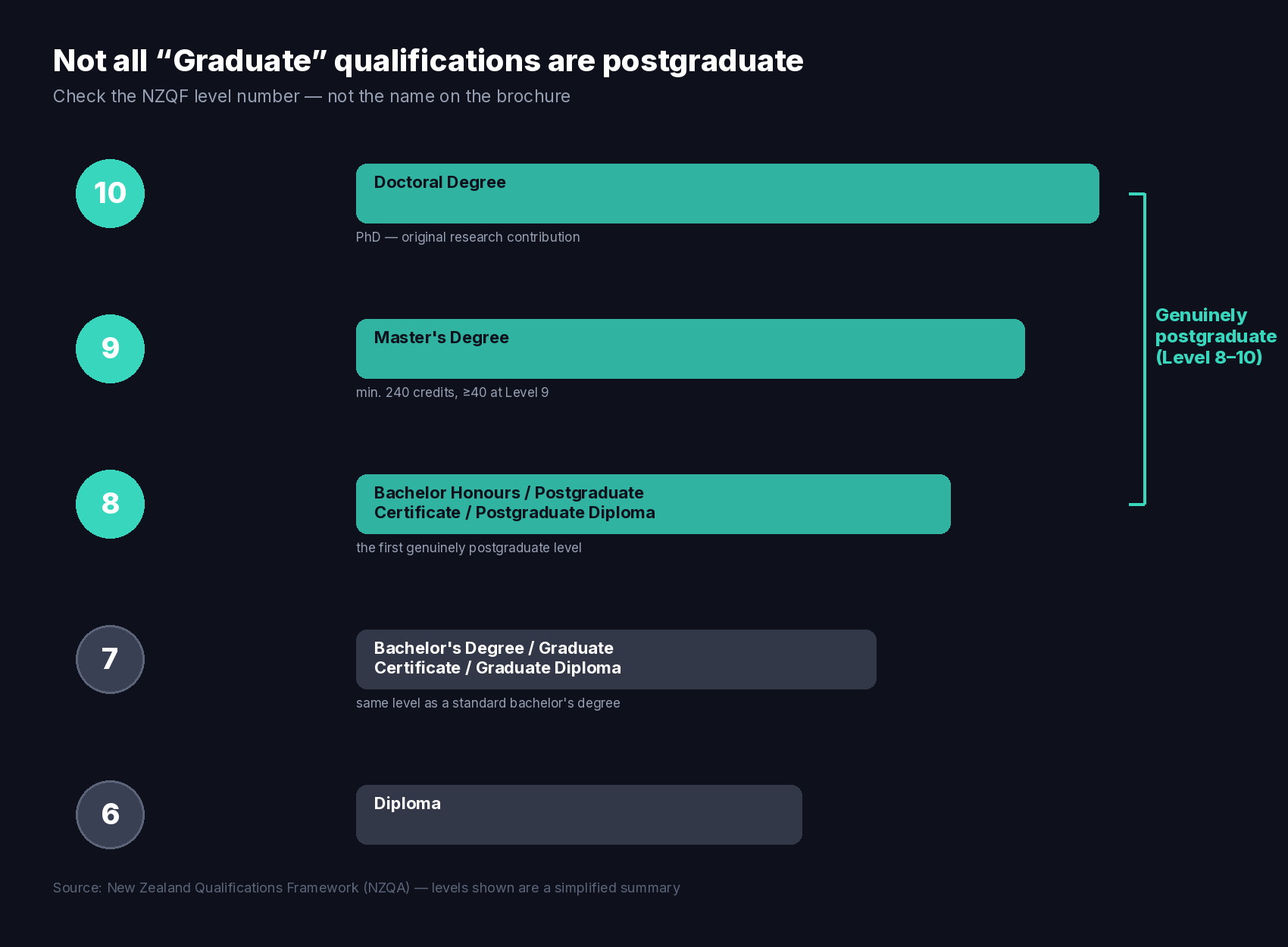
- Level 7 — Bachelor's degree, Graduate Certificate, and Graduate Diploma. This is the same academic level as a standard three-year bachelor's degree.
- Level 8 — Bachelor Honours degree, Postgraduate Certificate, and Postgraduate Diploma. This is genuinely one level above a bachelor's — the first rung that's actually "postgraduate" in the way the word is normally understood internationally.
- Level 9 — Master's degree, typically requiring at least 240 credits with a minimum 40 credits at Level 9, the rest at Level 8 or above.
- Level 10 — Doctoral degree, an original research contribution supervised toward increasing independence as a researcher.
Read that again slowly: a Graduate Diploma sits at Level 7. It is the same NZQF level as a bachelor's degree. It is not, on New Zealand's own official framework, a postgraduate qualification — despite the word "Graduate" in its name doing everything in its power to make you think otherwise. A Postgraduate Diploma, at Level 8, is a genuinely different, higher qualification, even though the two names look almost identical on a brochure and cost roughly the same to a family reading them from Colombo.
This is not a technicality. I have seen — and you will find, if you search — an enormous number of one-year "Graduate Diploma" programmes marketed heavily to South Asian students specifically because Level 7 entry requirements are lower than genuine postgraduate entry requirements, tuition is often cheaper, and — this is the part that makes it attractive to agents and providers rather than to your actual education — a Graduate Diploma can still open a path to post-study work rights. If what you or your family actually wants is a genuine postgraduate qualification — for the academic content, for how it will be read by employers back home or internationally, for eligibility into a Master's programme afterward — you need to be explicitly checking for Level 8, 9, or 10 on NZQA's own qualification listing for that exact course, not trusting that "Graduate" in the title means what it sounds like it means.
Ask your agent, in writing, for the NZQF level of any qualification they recommend. Then check that level yourself against the qualification's listing on NZQA's Directory of Assessment Standards or the provider's NZQA-published programme approval. If the number doesn't match what you were told verbally, that's not a misunderstanding you should let slide.
Why "cheap and fast" business diplomas deserve extra scrutiny
There's a pattern in the same Ministry of Education analysis of EER outcomes that I think deserves to be said plainly, because it maps directly onto the courses most heavily marketed to international students on tight budgets and tight timelines.
Quality outcomes are not evenly distributed across subject areas. In the 2022 EER data, Level 7–10 Creative Arts programmes had the strongest results of any field, with 88% rated "excellent" on educational performance. Level 6 Management and Commerce programmes sat at the opposite end, with 40% of provisions rated only adequate, marginal, or poor on the same measure. I'm not telling you to avoid business qualifications in New Zealand — some are genuinely excellent, including at the universities and top-tier polytechnics. I'm telling you that "Graduate Diploma in Business" or "Diploma in Business Management" is one of the single most heavily marketed, most commoditised qualification categories sold to international students in New Zealand, precisely because it's cheap to run, doesn't require expensive lab or studio infrastructure, and can be delivered by any provider with a few classrooms and a business-studies textbook — and the data suggests that volume and quality don't always move together in this particular category.
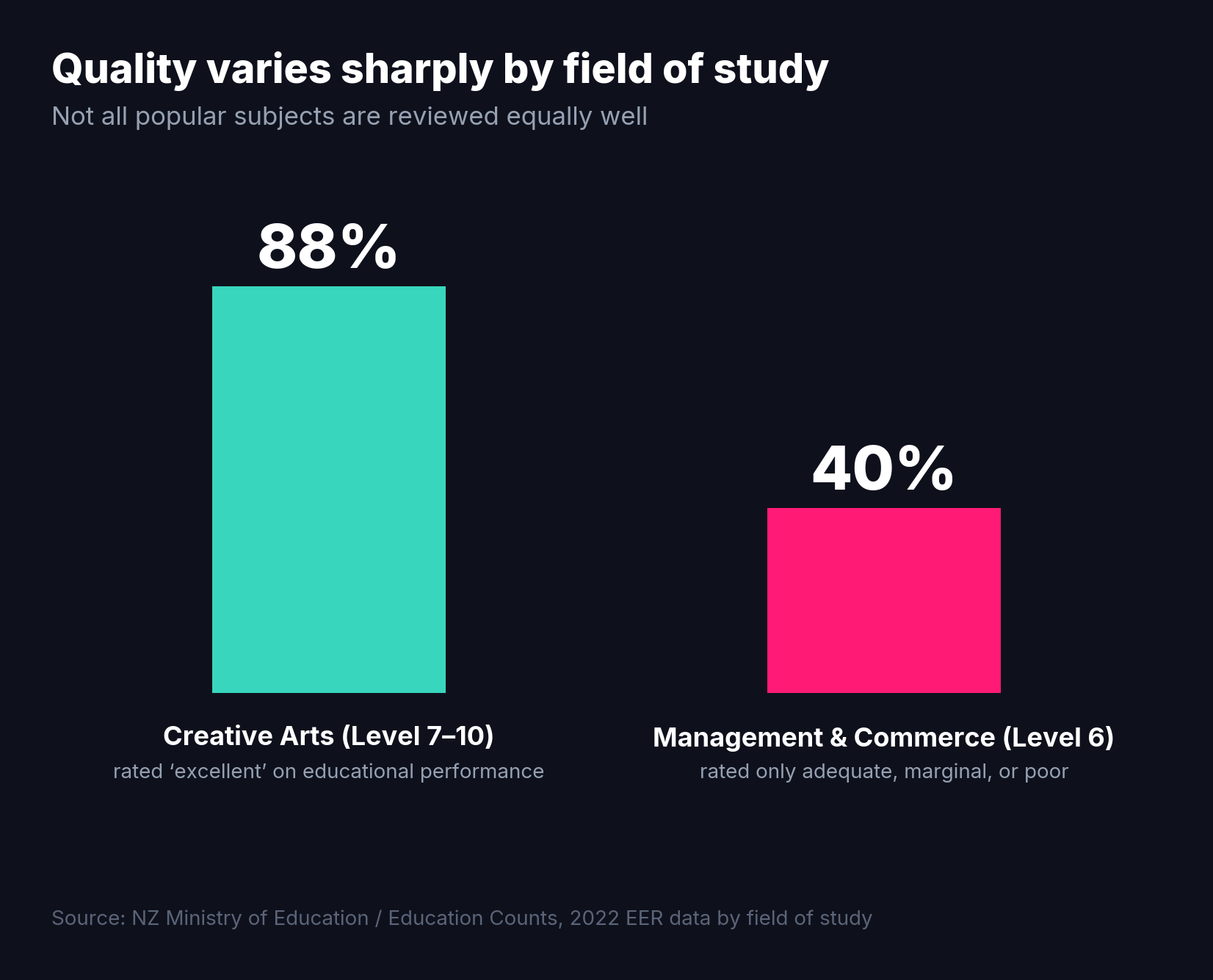
If a business or management qualification is what genuinely fits your goals, that's a completely legitimate choice — just apply extra scrutiny to that specific provider's EER report, specifically the educational performance rating, rather than assuming the subject area is automatically safe because so many providers offer it.
Red flags: patterns worth pausing on
None of the following, on its own, automatically means a provider or agent is dishonest. Taken together, or even two or three at once, they're worth pausing on rather than pushing through because a deadline feels urgent.
Let me expand on a few of these, because the short version doesn't always convey why they matter.
Guaranteed outcomes. No honest agent or institution can guarantee you a visa, a job, or residence — those decisions sit with Immigration New Zealand and, eventually, employers, not with an education provider or its agent. "Guaranteed PR pathway" is not a phrase a compliant, honest operator uses, because it isn't true for anyone, and it's specifically the kind of claim the IAA and Immigration New Zealand have repeatedly warned migrants about in their public scam guidance.
Entry requirements that seem too easy for the qualification level. A genuine Postgraduate Diploma or Master's programme should have entry requirements that reflect Level 8 or 9 academic depth — typically a relevant bachelor's degree, often with a minimum GPA, and usually an English language requirement in line with what the level demands. If a "postgraduate" programme is accepting students with weak or unrelated academic backgrounds and minimal English requirements, ask directly why, and cross-check the programme's actual NZQF level rather than its marketing name.
Heavy emphasis on work rights over academic content. If your first, second, and third conversation with an agent about a specific programme is about the post-study work visa it unlocks, and you have to ask directly to find out who actually teaches the programme, what the assessment structure looks like, or what facilities you'd have access to, that's a signal about what's actually being sold to you.
Reluctance to name the exact NZQF level or EER category. A legitimate provider or agent will give you this information immediately and precisely, because it's public information anyway. Vagueness, deflection, or "don't worry about that, it's all approved" in response to a direct question about level or category is a signal worth taking seriously.
Pressure to pay quickly, especially outside normal banking channels. Genuine intake deadlines exist, but a legitimate provider does not need you to wire an "agent processing fee" to a personal account, in cash, or through an unofficial channel, before you've seen an official, provider-issued offer letter. Immigration New Zealand's own scam warnings specifically flag pressure tactics and non-standard payment requests as common fraud indicators.
An address that doesn't match the promise. A provider advertising "state-of-the-art campus facilities" that turns out, on a Google Maps street-view check, to be a single floor of a commercial office building is not automatically fraudulent — plenty of legitimate small PTEs operate from modest premises — but it should prompt you to look harder at exactly what facilities, library access, and research support are actually available for a genuine postgraduate qualification, rather than taking the brochure photos at face value.
If you're already enrolled and something feels off
Everything above is written for the decision point before you've paid anything, because that's where you have the most leverage. But if you're reading this after you've already started — and I know some of you are, because these are the messages I get most often — the situation isn't hopeless, and panicking doesn't help.
Start by getting the facts, calmly and in writing: request your programme's current NZQF level and accreditation status directly from the provider's academic office, not the agent who enrolled you, and check it yourself against NZQA's directory. If there's a genuine discrepancy between what you were told and what's actually registered, document it — save the marketing material, the offer letter, and any written promises, since these matter if you need to escalate a complaint later. NZQA has a formal complaints process for concerns about a provider's compliance, and the Commerce Commission handles consumer protection complaints, including misleading conduct, under New Zealand's Fair Trading Act. If your specific concern touches on visa status or immigration consequences of changing providers or programmes, that's exactly the moment to consult a licensed immigration adviser — verified on the IAA register — rather than continuing to rely on the same agent relationship that may be part of the problem. Changing providers partway through is genuinely possible in many cases and doesn't automatically jeopardise your visa, but the specific process depends on your circumstances, which is precisely why independent, licensed advice matters here rather than another assumption.
How to verify a provider yourself, step by step
This is the practical core of this article. It should take you under an hour, and every tool involved is free and official.
Walk through this before you sign anything, before you pay any deposit, and ideally before you get emotionally attached to a specific offer. It's much harder to look at a red flag honestly once you've already told your family "I got in."
What genuine postgraduate study should look like
If your goal is specifically a Postgraduate Diploma, Master's, or Doctorate — Level 8, 9, or 10 on the NZQF — there are additional, discipline-specific things worth checking that a general "is this provider legitimate" check won't necessarily catch, because a provider can be entirely legitimate and registered while still running a thin, under-resourced version of a postgraduate programme.
Is there an actual research or thesis component, and does it match the level? A genuine Master's degree at Level 9 typically includes either a substantial research thesis or a significant research-informed project component — that's part of what distinguishes it from a taught diploma. If a "Master's" programme is entirely coursework with no independent research component at all, ask directly how that squares with Level 9 requirements, and check the programme's official structure on its NZQA-approved documentation rather than the marketing page.
Who's actually supervising or teaching? For research-based postgraduate study specifically, ask who your supervisor would be, what their own qualifications and research background are, and how many other students they're currently supervising. A university or well-established polytechnic will be able to answer this specifically, often before you enrol. If nobody can tell you who would supervise your research until after you've paid and arrived, that's a legitimate concern for a research-intensive qualification.
What library, database, and research infrastructure do you actually get access to? Postgraduate work — even taught postgraduate diplomas — usually requires access to academic journal databases, interlibrary loan systems, and reasonable library resources. This is worth asking about concretely: which databases, physical or remote library access, and whether it's shared with a larger institution's library system or is something the provider maintains entirely on its own with a much smaller collection.
Class sizes and the domestic-to-international ratio. This isn't published as a formal metric anywhere, but it's a fair question to ask directly, and a provider confident in its offering will usually answer it. A postgraduate class that is close to entirely international students, with few or no domestic students choosing the same programme, is not automatically a red flag — some legitimate specialist programmes are genuinely popular with international cohorts — but it's worth understanding why, especially compared with the same subject taught at a university.
Financial protections you should actually know about
Two mechanisms exist specifically to protect you if something goes wrong, and very few students know about either before they need them.
Student fee protection. Registered PTEs are required to have arrangements in place — typically through an approved trust account or an equivalent scheme — so that if the provider closes down, your prepaid tuition fees for the portion of the course you haven't yet received are protected rather than simply lost. Before you pay a full year or full programme of fees upfront, ask specifically how your fees are protected, and confirm the provider is actually registered and current, not just claiming to be.
Course and provider closures. NZQA maintains a public process and information for situations where a course or provider closes partway through a student's study, covering what happens to students already enrolled — whether that's transfer arrangements to another provider, fee refunds, or credit recognition for study already completed. Knowing this process exists before you need it means you're not learning your rights for the first time in a moment of crisis, in a foreign country, potentially with your visa status also suddenly in question.
A composite scenario — because abstract advice is easy to ignore
I'm not going to name any real institution here — that's deliberate, and it's not because I don't have specific ones in mind. Naming individual providers turns this into a "avoid X, choose Y" list that goes stale the moment a provider improves, or gets worse, or gets bought out and rebranded, which happens more often in this sector than you'd think. What I want to give you instead is a composite pattern, built from the kinds of situations that repeat themselves across the messages I get, so you can recognise the shape of it rather than memorising a name.
A student is contacted by an agent — sometimes the agent reaches out first, through social media, rather than the other way around. The agent recommends a "postgraduate" programme at a provider the student has never independently heard of. The offer letter arrives fast, often within days, with entry requirements that feel surprisingly achievable given the student's academic background. The tuition is meaningfully cheaper than the equivalent programme at a university, and the agent frames this as a good deal rather than a signal to look closer. Conversations focus heavily on the post-study work visa the qualification unlocks, and only briefly, if at all, on the actual curriculum, teaching staff, or assessment structure. The student and their family, under real time pressure and genuinely trying to make a good decision with imperfect information, pay a deposit based substantially on the agent's reassurance and the student's own hope that it will work out.
Sometimes it does work out fine — plenty of PTEs and smaller providers are entirely legitimate, deliver exactly what they promise, and this pattern ends with a satisfied graduate. But when it doesn't work out, the failure point is almost never something exotic. It's one of the four NZQA checks this article has already walked through: the programme turns out to be Level 7, not the postgraduate level the family believed they were paying for; or the specific programme wasn't actually accredited yet when the student enrolled; or the provider's most recent EER report, which nobody checked, flagged serious concerns about educational performance. Every one of these is checkable, in advance, for free, in under an hour. The scenario above doesn't fail because New Zealand's system has no safeguards. It fails because the safeguards that exist were never actually used.
What it actually costs, and how to budget without fooling yourself
Cost deserves its own honest section, because I think a lot of the pressure toward lower-quality providers comes from families doing the maths under stress rather than doing it early and calmly.
Postgraduate tuition at New Zealand's eight universities for international students commonly runs from roughly NZD 30,000 to NZD 45,000 per year depending on the field, with laboratory-based and specialist programmes at the higher end. PTE-delivered postgraduate and graduate-level programmes are frequently cheaper — sometimes substantially so — which is part of their appeal and is not automatically a problem. But "cheaper" needs to be evaluated against what you calculated in the sections above: the actual NZQF level, the EER category, and the specific programme's accreditation status. A cheaper Level 8 Postgraduate Diploma from a Category 1 provider, with a solid EER report, can be an excellent, honest choice. A cheaper "Graduate Diploma" that turns out to be Level 7 is not a discount on postgraduate study — it's a different, lower qualification at a lower price, and you should only choose it knowingly, not by accident.
On top of tuition, budget realistically for living costs. Immigration New Zealand's student visa financial requirements are a useful floor, not a comfortable target — treat the official minimum as the absolute minimum, not as what you should actually plan to live on, especially in Auckland or Wellington where rents run well above the national average. Add upfront costs that families often underbudget for: the student visa application fee, the International Student Levy, health insurance (mandatory for most international students and not optional even if an agent doesn't mention it upfront), flights, and setup costs in the first month before you've found affordable long-term accommodation.
To make this concrete: at an illustrative rate of roughly 1 NZD to 197 LKR (rates move constantly, so treat this as a rough illustration as of mid-2026, not a number to plan around precisely), a NZD 35,000 annual university tuition fee is in the neighbourhood of 6.9 million LKR, before living costs, insurance, and flights are added. A NZD 18,000 PTE postgraduate programme is closer to 3.5 million LKR. That gap is real and it's exactly why cheaper options are so attractive — which is precisely why the NZQF level and EER checks matter more, not less, when the price is low enough to feel like an easy decision.
| Cost item | Typical range (NZD, per year) | Notes |
|---|---|---|
| University postgraduate tuition | 30,000 – 45,000 | Varies by field; lab-based and specialist programmes trend higher |
| PTE / polytechnic postgraduate tuition | 14,000 – 24,000 | Verify NZQF level and EER category before treating the lower cost as a straightforward saving |
| Living costs (Immigration NZ minimum) | Check current INZ figures | Treat as an absolute floor, not a realistic budget, especially in Auckland or Wellington |
| Mandatory health insurance | ~600 – 1,200 | Often not mentioned upfront by agents; confirm it's included in your budget, not an add-on surprise |
| International Student Levy + visa fees | Several hundred | One-off, paid as part of the visa and enrolment process |
| Flights + initial settling-in costs | Varies | Budget for at least a month of accommodation and living costs before your first pay, if working |
On work rights: most New Zealand student visas allow up to 20 hours of work per week during the academic term, and full-time work during scheduled breaks, for eligible levels of study — but the details depend on your specific qualification level and visa conditions, and this is exactly the kind of thing worth confirming against Immigration New Zealand's own current rules for your specific visa category, not an agent's general assurance that "you can work while you study." Treat part-time work as a way to manage living costs, not as a financial plan that makes an otherwise unaffordable programme suddenly affordable — the numbers rarely work out that generously once you account for the hours you're realistically able to work alongside a genuine full-time postgraduate workload.
How to read your offer letter like you mean it
An offer letter is not just a formality to forward to your visa application — it's the single densest piece of evidence you have about what you're actually buying, and most students read it once, quickly, looking only for the start date and the fee amount. Read it properly instead. A legitimate, complete offer letter from a New Zealand provider should let you find each of the following without having to ask:
- The provider's full legal name and NZQA registration number, exactly as it appears on NZQA's own directory — not a trading name or brand name that differs from the registered entity.
- The exact qualification title and its NZQF level, stated as a number, not implied by a word like "Graduate" or "Advanced." If the level isn't printed anywhere on the offer letter, that's worth querying directly before you accept anything.
- The programme or course code, which you can cross-reference against NZQA's approved programme listing for that provider — confirming the specific programme is the one that's actually approved and accredited, not a similarly-named one.
- A full fee breakdown, separating tuition, compulsory fees (student levy, materials, insurance if bundled), and any optional costs — not a single lump figure that makes it hard to see what you're actually paying for.
- The refund and withdrawal policy, stated in plain terms: what you get back, and when, if you withdraw before the course starts, shortly after it starts, or partway through.
- Confirmation of Code of Practice registration, usually as an explicit statement or reference number, confirming the provider is signed up to the pastoral care code covering international students.
- Named contact details for the institution directly — a provider email address and phone number that isn't only your agent's contact information. If every communication channel back to "the institution" actually routes through your agent, you have no independent way to verify anything they've told you.
If any of these are missing, ask for them in writing before you pay anything. A legitimate provider will not find this an unreasonable request — producing this information is a normal, everyday part of enrolling international students, not a special favour.
A realistic timeline: how far ahead to start
Rushed decisions are where most of the mistakes in this article actually happen, so it's worth planning backwards from your intended start date rather than starting the process only once you feel pressure to.
New Zealand's main intakes are typically in February and July, with some providers — more commonly PTEs — offering additional intakes throughout the year. Working backwards from a February start, a realistic timeline looks something like this: research and shortlist providers and run the verification checks in this article, ideally starting eight to ten months out; sit any required English language test (IELTS, PTE Academic, or equivalent) with enough buffer to retake it if needed, six to eight months out, since test slots and results can take weeks and a disappointing score is common enough that you shouldn't assume you'll pass on the first attempt; submit your application and receive your offer letter, verified against the checklist above, four to six months out; apply for your student visa allowing for processing time that varies by season and your specific circumstances, at least two to three months out; and finalise accommodation, insurance, and travel in the final month or two.
Compressing this timeline into six or eight weeks — which is exactly the pressure a lot of families feel when an agent presents an offer as urgent — is precisely when the checks in this article get skipped. If an agent is pushing you toward a decision on a timeline that doesn't leave room to verify anything, that pressure itself is worth treating as information, not just as a deadline to meet.
Questions to put to your agent, in writing
I'd suggest sending these by email or written message rather than asking verbally, for a simple reason: a written answer is a written answer. Vague verbal reassurance evaporates the moment there's a problem; a written claim from an agent or provider is something you can hold them to, and something you can show someone else — a parent, a friend already in New Zealand, or a licensed immigration adviser — before you commit.
How I'd actually approach this decision
If it were me sitting across the table from that family friend's daughter again, before any offer letter existed, here's the order I'd actually work through it in.
First, I'd get honest about what I actually wanted out of the qualification — genuine postgraduate academic content and credibility, a faster and cheaper pathway to New Zealand work rights, or realistically some mix of both — because that shapes which trade-offs are reasonable. There's nothing dishonest about prioritising work rights and affordability over academic prestige, as long as you're choosing that deliberately, with your eyes open about the NZQF level you're actually purchasing, rather than being sold a Level 7 diploma while believing you're purchasing Level 8 postgraduate study.
Second, I'd build a shortlist of three to five specific programmes — by name, not just by provider — across a genuine mix: at least one university option, even if it feels like a stretch financially or academically, because it gives you an honest benchmark for cost and content; and any PTE or polytechnic options your agent has proposed. Then I'd run every single one through the four NZQA checks, the EER category check, and the NZQF level check in this article, before comparing prices at all. Price comparison before quality comparison gets the priority order backwards.
Third, I'd verify the agent itself — not just the provider. Are they a member of a recognised industry body? Does the New Zealand provider they're recommending actually list them as an authorised representative on the provider's own official website, independent of what the agent's own marketing claims? A discrepancy here — where a provider's own site doesn't list an agent claiming to represent it — is worth a direct, calm question, not an accusation, but a question you actually want answered before money moves.
Fourth, and this one is uncomfortable to write but I think it matters: I'd get a second, independent opinion from someone with no financial stake in my decision — not a different agent, since agents share the same structural incentive regardless of which one you ask, but a friend, relative, or online community of current Sri Lankan students already studying in New Zealand who can tell you honestly what a specific provider or programme is actually like day to day. Lived experience from someone with nothing to sell you is worth more than another glossy brochure.
Frequently asked questions
Is a New Zealand Graduate Diploma the same as a postgraduate qualification?
No, and this is the single most common point of confusion this article is trying to fix. On the New Zealand Qualifications Framework, a Graduate Diploma sits at Level 7 — the same level as a bachelor's degree. A Postgraduate Diploma, at Level 8, is genuinely one level higher and is what most people internationally mean when they say "postgraduate." Always check the NZQF level number of the specific qualification, not just its name.
How do I check if a New Zealand institute is NZQA registered and what its rating is?
Use NZQA's own searchable directory of education organisations, freely available on the NZQA website. Search the provider's exact legal name, confirm its registration status, check its most recent EER category (1 to 4), and check the date of that review. You can also search NZQA's EER reports listing to read the full written report behind the number, not just the category itself.
Are all private training establishments (PTEs) in New Zealand low quality?
No — that would be an unfair and inaccurate generalisation. Ministry of Education analysis of 1,701 EER reports between 2009 and 2022 found around 80% resulted in the top Category 1 rating, and that share has been improving over time. The point of this article isn't that PTEs are untrustworthy as a category — it's that quality varies meaningfully between individual providers, and the only way to know where a specific one sits is to check its specific, current EER rating rather than assuming based on the sector as a whole.
Do New Zealand's universities go through NZQA's EER process too?
No. New Zealand's eight universities are reviewed academically by the Academic Quality Agency (AQA), a separate process from NZQA's External Evaluation and Review, which applies to non-university providers — PTEs and institutes of technology and polytechnics. Both systems exist to assure quality, but they're different processes run by different bodies, which is worth knowing so you check the right one for the right type of provider.
Can my education agent also give me immigration advice?
Only if they are separately and specifically licensed by the Immigration Advisers Authority (IAA) to do so, or are otherwise legally exempt (such as a New Zealand-based lawyer). Being an education agent does not, by itself, authorise someone to give immigration advice for a fee — doing so without a licence is a criminal offence in New Zealand. Ask directly for a licence number and verify it on the IAA's free public register before relying on any immigration-specific guidance.
What is an EER report, and how do I read one?
An External Evaluation and Review report is NZQA's published assessment of a non-university provider, covering its educational performance and its self-assessment capability, each rated as Highly Confident, Confident, Not Yet Confident, or Not Confident. These combine into an overall category from 1 (highest) to 4 (lowest). The full report — not just the category number — explains specifically what reviewers found strong and what concerned them, and is worth reading in full for any provider you're seriously considering.
Is it normal to pay my agent directly instead of paying the institution?
Be cautious here. Legitimate tuition payments should ultimately go to the institution, through its official, verifiable payment channels — even when an agent facilitates or coordinates the process. Being asked to pay a substantial sum directly to an agent's personal account, in cash, or through an informal channel, before receiving an official offer letter from the institution itself, is a pattern Immigration New Zealand and consumer protection guidance both flag as a common fraud indicator. When in doubt, ask the institution directly to confirm its official payment process, independent of what the agent tells you.
What happens to my fees if my institute closes down while I'm studying?
Registered PTEs are required to have fee protection arrangements in place, typically through an approved trust structure, so that prepaid fees for study you haven't yet received are protected if the provider closes. NZQA also has a public process for handling provider and course closures, covering things like transfer arrangements to another provider and recognition of study already completed. Ask any provider directly, before you pay, exactly how your fees would be protected — and confirm their registration is current, since an unregistered or lapsed provider may not have these protections in force.
What NZQF level counts as genuinely "postgraduate" in New Zealand?
Level 8 and above. Level 8 covers Postgraduate Certificates, Postgraduate Diplomas, and Bachelor Honours degrees. Level 9 covers Master's degrees. Level 10 covers Doctoral degrees. Level 7 — which includes Graduate Certificates and Graduate Diplomas, despite the similar-sounding name — is equivalent to bachelor's-level study, not postgraduate study.
How much does postgraduate study in New Zealand cost for Sri Lankan students?
University postgraduate tuition for international students commonly runs from roughly NZD 30,000 to NZD 45,000 per year depending on the field, with laboratory-based or highly specialised programmes at the upper end. PTE-delivered graduate and postgraduate programmes are frequently cheaper. On top of tuition, budget realistically for living costs above Immigration New Zealand's stated minimum financial requirement (treat that figure as a floor, not a target), mandatory health insurance, the International Student Levy, visa fees, and setup costs in your first month.
Can I work part-time while doing a postgraduate qualification in New Zealand?
Most student visas allow up to 20 hours of work per week during the academic term and full-time work during scheduled breaks, for eligible levels and types of study — but the specific conditions depend on your exact visa category and qualification level. Confirm the current rules for your specific situation directly against Immigration New Zealand's official guidance rather than relying on a general assurance from an agent, and treat part-time work as a way to help manage living costs rather than as a substitute for having adequate funds before you arrive.
What is the Code of Practice, and why does it matter for international students?
The Education (Pastoral Care of Tertiary and International Learners) Code of Practice sets mandatory standards for how providers support international students — covering areas like accommodation information, orientation, complaint handling, and student wellbeing. Any provider enrolling international students in New Zealand is required to have signed up to it. If a provider can't confirm they've signed the Code, that's a serious concern, not a minor omission.
Is a cheaper New Zealand institute automatically a worse choice?
No — price alone doesn't tell you quality. Some excellent, well-rated PTEs charge meaningfully less than university equivalents, and that can be a genuinely good, honest choice, particularly if the qualification level and EER rating both check out. The mistake isn't choosing something cheaper — it's choosing something cheaper without first confirming its NZQF level, accreditation, and EER category, and assuming the price gap must be explained by efficiency rather than possibly by quality.
What's happening with New Zealand's polytechnics and Te Pūkenga in 2026?
New Zealand is unwinding the 2020 merger of 16 polytechnics into a single entity called Te Pūkenga. Ten polytechnics returned to independent, regional governance from 1 January 2026, while four others remained temporarily inside Te Pūkenga pending financial viability decisions expected in the first half of 2026. If you're considering any New Zealand polytechnic right now, ask specifically which entity will actually issue your qualification and whether that institution's governance status is settled.
Does a Category 1 NZQA rating guarantee a good experience?
It's a strong positive signal, not a guarantee. A Category 1 rating reflects NZQA's confidence at the time of that specific review — check how recent it is, and be aware that a provider can expand rapidly, launch new programmes, or change management after a good review in ways the rating doesn't yet reflect. Category 1 is a meaningfully positive starting point, and it's still worth reading the underlying report and checking programme-specific accreditation on top of it.
Should I always choose a university over a PTE for postgraduate study?
Not necessarily. Universities offer research depth, global name recognition, and a separate, well-established academic quality review process, which matters a great deal for some goals. But a well-rated PTE or polytechnic offering a genuinely accredited Level 8 or 9 qualification, with a strong EER report, can be an entirely legitimate and more affordable path for other goals — particularly vocationally-focused postgraduate study. The right choice depends on what you specifically need the qualification to do for you, verified against the checks in this article rather than against prestige alone.
I've already paid a deposit and now have doubts — what should I do?
Don't panic, and don't assume it's too late to ask questions. Request your provider's current EER report and confirm the exact NZQF level and accreditation status of your specific programme in writing. If you're genuinely concerned about fraud or serious misrepresentation, New Zealand's Commerce Commission handles consumer protection complaints, and NZQA has its own complaints process for education-specific concerns. If immigration-specific advice is involved, consult a licensed immigration adviser — verified on the IAA's public register — rather than the same agent who sold you the original offer.
How long does an NZQA EER review actually take, and can a provider hide a bad one?
A full EER visit and reporting cycle typically runs several months from notification to published report, and results are published on NZQA's website as a matter of public record — a provider cannot legally suppress or selectively hide an unfavourable published report, though it can certainly choose not to mention it to you proactively. This is exactly why checking the report yourself, rather than waiting to be told about it, matters: silence about a rating is not the same as a good rating.
Is it worth paying for an independent education consultant instead of a free agent?
It can be, particularly a consultant who charges you directly (rather than being paid commission by an institution) since that at least removes the institution-side incentive problem discussed earlier in this article — though it doesn't automatically make them a licensed immigration adviser, so the same verification steps still apply. Whether you use a free commission-based agent, a paid independent consultant, or no intermediary at all, the checks in this article — NZQA registration, programme accreditation, EER category, and NZQF level — are the same checks, and they're free regardless of who you're paying for guidance around them.
Does New Zealand have anything similar to Sri Lanka's UGC or TVEC?
Functionally, yes. NZQA plays a role that overlaps with both bodies: it registers and quality-assures non-university providers similarly to how TVEC registers vocational training providers, and it maintains the national qualifications framework that gives every qualification a comparable, checkable level, similarly to how the UGC oversees Sri Lanka's university degree-awarding landscape. New Zealand's universities sit outside NZQA's EER process specifically, reviewed instead by the Academic Quality Agency, which is broadly analogous to how Sri Lanka's own public universities operate under UGC oversight distinct from vocational and private-provider regulation.
My agent says a provider is "government approved" — does that mean the same as NZQA registered?
Not necessarily, and this is worth pinning down precisely rather than accepting as a comforting phrase. "Government approved," "internationally recognised," and "fully accredited" are marketing phrases without a single fixed legal meaning in every context they're used. NZQA registration, specific programme approval, and specific programme accreditation are the precise, checkable facts underneath those phrases. Ask which of those three specific things the provider actually holds, and verify each one independently on NZQA's directory rather than accepting the general phrase at face value.
Where can Sri Lankan students get independent, free advice before committing?
Start with the official sources this article has pointed to throughout: NZQA's own directory and EER reports for provider and qualification checks, the Immigration Advisers Authority's public register for verifying immigration advisers, and Immigration New Zealand's official visa guidance for current rules on work rights and financial requirements. None of these charge a fee, none of them have a commission riding on your decision, and all of them are more current and more accountable than a single agent's word.
This isn't unfamiliar — you already do a version of this at home
If checking a foreign qualification framework feels like an alien exercise, it isn't, not really. Sri Lanka runs its own version of exactly this system. The University Grants Commission (UGC) oversees and recognises Sri Lanka's public universities and degree-awarding status, while the Tertiary and Vocational Education Commission (TVEC) registers and accredits vocational and technical training providers — and Sri Lanka has, in recent years, been actively working on tightening standards specifically for private degree-awarding institutions, precisely because the same pattern of degree mills and unrecognised "degrees" has been a live problem domestically, not just abroad. If you or your family would think to check whether a private Sri Lankan campus is UGC-recognised before enrolling a sibling there, you already understand the logic this entire article is asking you to apply to New Zealand. NZQA's registration, EER category, and NZQF level are simply the New Zealand equivalents of the same due-diligence questions you'd already know to ask at home.
What it looks like when it's actually going right
I've spent most of this article on what can go wrong, because that's the gap nobody else is filling for you — but it would be dishonest to leave you thinking every agent relationship or every PTE is a trap. Most aren't. A good agent will answer every question in this article without flinching, because they already know the answers and have nothing to hide behind. They'll tell you upfront which providers pay them commission and won't pretend that's irrelevant to their recommendation. They'll be comfortable with you getting a second opinion, rather than pressuring you to decide before you've had time to check anything independently. And critically, a good agent will draw a clear line around immigration advice — either holding an IAA licence themselves and telling you their licence number unprompted, or explicitly telling you "that's an immigration question, you should talk to a licensed adviser," rather than answering visa questions with confident guesses.
A good provider behaves the same way. Its NZQA registration, its most recent EER category, and the specific accreditation for the programme you're asking about are things it can produce for you immediately, usually with a direct link to the public record rather than just its own claim. It will connect you with current or former students — ideally without curating exactly who you're allowed to talk to. Its staff and supervisors will have visible, checkable academic profiles, not just first names on a website. None of this is exotic or hard to find in New Zealand's tertiary sector; it's the norm at the great majority of providers, university and non-university alike. The entire point of this article is to help you tell that majority apart from the minority quickly, using the same public tools New Zealand already provides, rather than relying on how confident someone sounds on a phone call from Colombo to Auckland.
How New Zealand compares with other destinations Sri Lankan students weigh
It's worth situating New Zealand honestly against the other places Sri Lankan families are actively considering right now, because "which country" and "which institute" are really two layers of the same decision, and getting the first layer right doesn't protect you from getting the second one wrong.
The UK has become Sri Lanka's fastest-growing major destination in percentage terms, with enrolments up sharply and Sri Lanka now ranking among the UK's top source countries for transnational education partnerships specifically — meaning a large share of Sri Lankan students study toward UK qualifications without ever leaving South Asia, through collaborative arrangements with local institutions. Canada saw extraordinary growth in the years before its recent policy tightening, and Australia remains a large, established destination with its own separate quality assurance body and its own, separate set of provider-quality issues that Australian regulators have had to actively police in the private college sector — this isn't a problem unique to New Zealand. The United States has grown more modestly for Sri Lankan students and, as covered in a different piece on this site, has recently tightened its own student visa rules in ways that add cost and reduce flexibility.
New Zealand's specific advantage in this comparison isn't that its quality assurance system is unique — most comparable destinations have some equivalent body doing similar work. Its advantage is that its system is unusually transparent and freely searchable by anyone, anywhere, without needing an account, a subscription, or a formal request. That transparency is only useful to you if you actually use it. A perfectly good regulatory system that nobody checks protects nobody.
A last word, from one Sri Lankan family's experience to the next
I'll tell you what I told that family friend, once we'd gone through her offer letter together: the Level 7 Graduate Diploma she'd been sold wasn't a scam in the legal sense — the provider was genuinely registered, the programme was genuinely approved, and on paper, nothing about it was illegal. It just wasn't what she and her parents believed they were buying, and nobody along the way had a strong incentive to correct that belief before the money moved. She ended up choosing a different, genuinely postgraduate programme, at a slightly higher cost, after we spent an evening going through exactly the checks in this article. I don't know how her story ends yet — she's still partway through it. But she started it with her eyes open, which is really all any of us can control from four thousand kilometres away.
If you take one thing from everything above, let it be this: every single check in this article is free, official, and takes minutes, not weeks. The only real cost is the discomfort of asking your agent a direct question they might not want to answer, before you've paid them anything. That discomfort is a lot cheaper than finding out the answer two years and several million rupees later.
This article is general information only, based on publicly available NZQA, Immigration New Zealand, Immigration Advisers Authority, and NZ Ministry of Education sources as of August 2026. It is not immigration, visa, education-agent, or legal advice, and it isn't tailored to your individual circumstances. No specific institution, agent, or agency is named, referenced, or implied anywhere in this article, and nothing here should be read as an accusation against any specific provider. Rules, ratings, and registration statuses change — always verify current information directly with NZQA, Immigration New Zealand, the Immigration Advisers Authority, or a licensed immigration adviser before making any decisions.
If you're weighing a specific programme or provider type and want a second pair of eyes on how to read an offer letter or an EER report, drop the details — provider type, qualification level, and what's confusing you — in the comments. I read them, and I'd rather you ask a "silly" question here for free than pay to find out the hard way.


