

🌐 Read this article in English click here · මෙය ඉංග්රීසියෙන් කියවීමට ඉහත link එක click කරන්න
කෙටි පිළිතුර: Z-score එකෙන් සුදුසුකම් ලබන සිසුන් 4කින් 1කට විතරයි කිසියම් රාජ්ය විශ්වවිද්යාල ආසනයක් ලැබෙන්නේ. Computer Science හෝ IT උපාධියක් නම් ලැබෙන්නේ ඊටත් වඩා කුඩා ප්රතිශතයකට. මේ ලිපියෙන් A/L ICT කරාට පස්සේ තියෙන හැම real path එකක්ම — රාජ්ය උපාධි, පෞද්ගලික උපාධි, degree එකකින් තොරව යන පාරවල්, career outcomes, සහ විදේශයන්හි funded postgraduate study — නිල, දින සටහන් කළ දත්ත පමණක් පාවිච්චි කරලා පැහැදිලි කරනවා.
A/L ICT සිසුන් කීදෙනෙක් රාජ්ය IT ආසන කීයක් වෙනුවෙන් තරඟ කරනවාද?
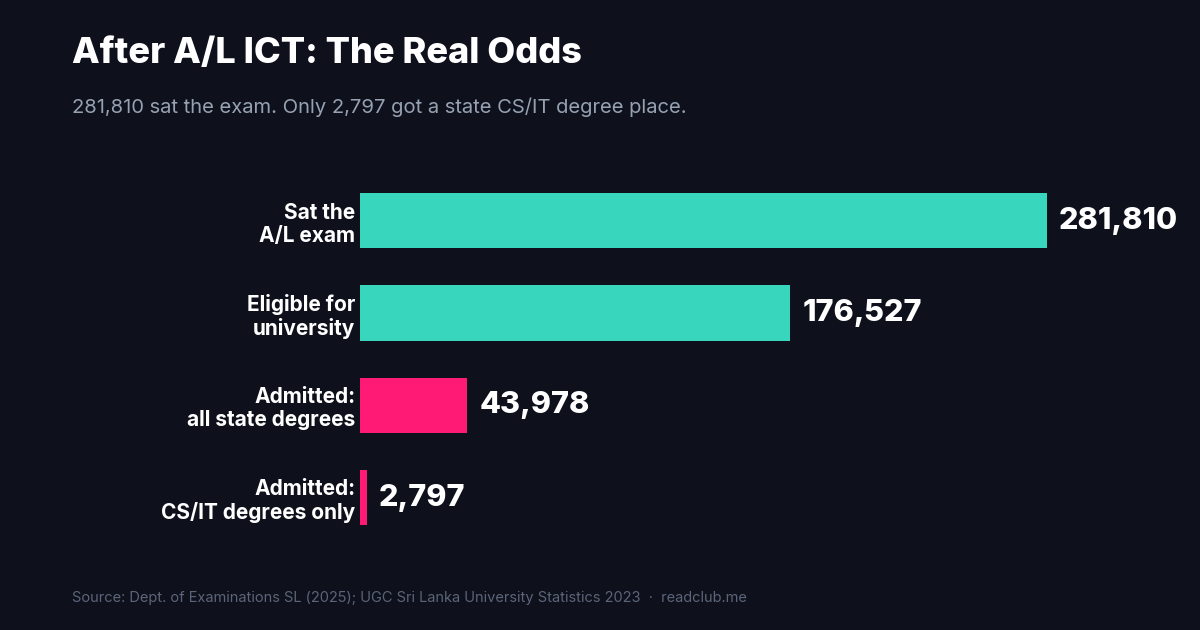
ඉස්කෝලේදී කවුරුත් කියලා නැති ගාණකින් පටන් ගමු. 2025 G.C.E. Advanced Level විභාගයට streams ඔක්කොම එකතු කරලා සිසුන් 281,810ක් පෙනී සිටියා. ඉන් 176,527ක් — 62.64%ක් — විශ්වවිද්යාල ප්රවේශයට සුදුසුකම් ලැබුවා. ඒක තමයි පළවෙනි filter එක.
දෙවෙනි filter එක ඊටත් වඩා තදින් adjust වෙනවා. University Grants Commission එකේම Sri Lanka University Statistics 2023 වාර්තාවට අනුව, 2022/2023 academic year එකේදී සුදුසුකම් ලැබූ අයගෙන් 166,967ක් අතරින් 43,978ක් විතරයි — 26.34%ක්, එහෙමත් නැත්තං 4කින් 1ක් විතරයි — stream එකක්වත් degree එකක්වත් තෝරාගත්තාට කමක් නෑ, කිසියම් රාජ්ය විශ්වවිද්යාල ආසනයක් ඇත්තටම ලැබුවේ. Engineering Technology stream එකේ අයට තත්වය ඊටත් වඩා අමාරුයි: 10,634ක් සුදුසුකම් ලැබුවත් 2,333ක් (21.94%) විතරයි ඇතුළත් වුණේ.
දැන් ඒක Computer Science සහ IT වලට විතරක් narrow කරලා බලමු. ඒම UGC දත්ත වලට අනුව, "Computer Science/IT" කියන bundled category එකට ඇතුළත් වුණේ සිසුන් 2,797ක් විතරයි — Computer Science (709), Information Technology (251), Software Engineering (176), සහ තව නම් කරපු ස්මාල් programmes කිහිපයක් ඇතුළුව. A/L විභාගයට පෙනී සිටි ආසන්න 282,000ක සිසුන් අතරින්, රාජ්ය-funded IT හෝ CS උපාධියක් ලැබුවේ 3,000කටත් අඩු ගාණයි. "මට university එකේ IT කරන්න ඕන" කියන එකේ ඇත්තම arithmetic එක තමයි ඒක.
තව එක number එකක් දැනගන්න වටිනවා, මොකද ICT subject එක stream ගණනාවක සිසුන් ගන්නවා, Technology stream එකට විතරක් සීමා වෙලා නෑ: 2025දී, සිසුන් 56,538ක් ICT subject එකට පෙනී සිට 40,884ක් pass වුණා (72.31%), 2024දී තිබ්බ 78.30% pass rate එකට වඩා අඩුවෙන් (50,629ක් sit කරලා). ICT well pass කරන එක අවශ්යයි. ඒත් ඒක තනියම ප්රමාණවත් නෑ.
Z-score (සී-අගය) කියන්නේ මොකක්ද, එකම ලකුණට දිස්ත්රික්කයෙන් දිස්ත්රික්කයට වෙනස් outcome එකක් ලැබෙන්නේ ඇයි?
Z-score කියන්නේ ඔයා subject එකම ලියපු අනිත් හැමෝටම සාපේක්ෂව ඔයාගේ performance එක standardize කරපු measure එකක් — ඔයාගේ raw marks එක නෙවෙයි, එකම විදිහට වසර අතරත් compare කරන්න බෑ. ඊට පස්සේ ශ්රී ලංකාව ඔයාගේ Z-score එක දිස්ත්රික් quota system එකක් ඇතුළේ apply කරනවා: දිස්ත්රික්ක 25න් එකින් එකට degree එකකට ආසන ගාණක් allocate කරලා තියෙනවා, ඔයා competition එකට එන්නේ island එකේ ඉන්න ඔක්කොම අයත් එක්ක නෙවෙයි, ඔයාගේම දිස්ත්රික්කයේ අයත් එක්ක විතරයි.
ඒකෙන් ලැබෙන්නේ බොහෝ සිසුන් expect කරන්නේ නැති result එකක්: ඉහළ population එකක් නැති දිස්ත්රික්කයක quota එක අඩු නිසා, cutoff එක කොළඹටත් වඩා ඉහළට යනවා, පහළට නෙවෙයි. University of Colombo School of Computing එකේ Computer Science programme එකේ 2025/2026 intake එකට බලමු, UGC නිල Cut-Off document එකෙන්ම:
කොළඹ cutoff එක 1.6565. බදුල්ල cutoff එක 2.0124 — 0.36ක් සම්පූර්ණයෙන්ම ඉහළින්, එකම programme එක, එකම වසර. සමහර කුඩා හෝ ගැටුම්කාරී දිස්ත්රික්කවල "NQC" (No Qualified Candidates) පේනවා, ඒ කියන්නේ ඒ දිස්ත්රික්කයට allocate කරපු ආසනය හිස්ව ම ඉතුරු වුණා — bar එක අඩුයි කියලා නෙවෙයි, ඒ දිස්ත්රික්කයේ threshold එකක්වත් clear කරපු අය ප්රමාණවත් නොවීම. ඔයාගේ ability එකට අමතරව, ඔයා ජීවත් වෙන දිස්ත්රික්කයත් ඔයාගේ chances ටිකට sensible විදිහට බලපානවා.
මෙතනදී killed කරන්න ඕන myth එකක් තියෙනවා: SLIIT මේ system එකේ කොටසක් නෙවෙයි. ඒක private, independent degree-awarding institute එකක්, UGC-administered රාජ්ය විශ්වවිද්යාලයක් නෙවෙයි. එකට Z-score cutoff එකක් හෝ දිස්ත්රික් quota එකක් නෑ — admission එක ලැබෙන්නේ ඔවුන්ගේම criteria එකකින් සහ fee එකකින්, Z-score එකකින් නෙවෙයි. මේ දෙක confuse කරගන්න එක A/L සිසුන්ට තියෙන වඩාත්ම common සහ costly misunderstanding එකක්.
Path A — රාජ්ය විශ්වවිද්යාල: ඇත්තටම තියෙන්නේ මොනවාද?
ඔයාගේ දිස්ත්රික්කයේ cutoff එක clear කළොත්, UGC actually admissions track කරන programmes අනුව, රාජ්ය system එකේ IT/CS-adjacent degrees වශයෙන් roughly තියෙන්නේ මේවා:
| උපාධිය | නිදසුන් institutions | ප්රධාන focus එක |
|---|---|---|
| BSc Computer Science | University of Colombo School of Computing, Peradeniya, Ruhuna | Theory-heavy: algorithms, systems, mathematics foundations |
| BSc Information Technology | University of Moratuwa, University of Kelaniya | Applied IT, systems development, business context ටිකක් |
| BSc Software Engineering | Sri Jayewardenepura, Kelaniya, Sabaragamuwa | Software design, engineering process, project-based work |
| BSc ICT (Information & Communication Technology) | Rajarata University (Vavuniya campus) සහ තවත් | Broader ICT, networks, communications systems |
රාජ්ය degree එකක් ගන්න cost එක practically zero කියලයි කියන්න පුළුවන් — nominal administrative fee එකක් විතරයි. UGC ගේම 2025/2026 admission notice එකේ Z-score-admitted සිසුන් සඳහා Rs. 50ක් online registration fee එකක් listed වෙලා තියෙනවා. Cutoff එක clear කරගන්න වෙහෙසෙන්න තියෙන biggest financial reason එක ඒකයි, ඒක default විදිහට private option එකකට යනවා වෙනුවට.
Path B — Private සහ foreign-affiliated degrees: ඇත්තටම ගෙවන්නේ මොකටද?
Z-score work out වුණේ නැත්තං, හෝ දිස්ත්රික් lottery එකකට depend නොවෙන route එකක් ඕන නම්, private සහ foreign-affiliated degrees real options. ඒත් costs ටික expect කරනවාට වඩා distinct විදිහට variable, fee structures ටිකත් ඇත්තටම එකින් එක වෙනස්. එක් එක් institution එකේම current fee pages වලින් actually publish වෙලා තියෙන්නේ මේවා:
| Institution සහ programme | Total fee (LKR) | කාලසීමාව |
|---|---|---|
| SLIIT — BSc (Hons) Information Technology | 2,800,000 | වසර 4 |
| SLIIT — BSc (Hons) Computer Science | 2,960,000 | වසර 4 |
| NSBM Green University — BSc (Hons) Software Engineering | 2,815,000 (registration & library ඇතුළුව) | වසර 4 |
| ESOFT — HND in Computing + BSc (Hons) Computing Top-Up (London Met, UK) | ~532,000–682,000 (HND) + 780,000 (top-up) ≈ 1.3M–1.5M ඒකාබද්ධව | Fee pages වල publicly සඳහන් නැත |
IIT (Informatics Institute of Technology, Robert Gordon University affiliated) සහ APIIT වල fee figures මං හොයුවා — දෙකෙන්ම public figure එකක් හම්බුනේ නෑ. Private-degree page එකක් upfront cost එක show කරන්නේ නැත්තං, ඒක commit කරන්න කලින් directly ඇහුවට ඕන question එකක් විදිහට treat කරන්න, assume කරන්න එපා.
මම 99X Technology එකේ technical lead විදිහට engineers hire කරද්දී, CV එකේ තියෙන degree name එකට වඩා candidate කෙනෙක්ට actually build කරලා explain කරන්න පුළුවන් දේට වැඩි importance එකක් තිබුණා. මම strong graduates hire කරලා තියෙනවා රාජ්ය universities වලින්, SLIIT එකෙන්, සහ traditional degree එකක්වත් complete කරලා නැති අයගෙනුත්. Shortlist වුණේ මට බලන්න පුළුවන් working project එකක් තිබුණ අයයි, certificate එකේ තිබ්බ crest එක නෙවෙයි.
Path C — Degree එකෙන්ම skip කිරීම: Certifications වලින් ලැබෙන්නේ මොනවාද, ලැබෙන්නේ නැත්තේ මොනවාද?
ශ්රී ලංකාවේ tech work එකට entry point එකක් විදිහට degree එකක් විතරක්ම නෑ, ඒක දෙපැත්තෙන්ම honest වෙන්න වටිනවා. Industry-recognised certifications — cloud platforms (AWS, Microsoft Azure, Google Cloud), specific frameworks, හෝ strong public portfolio එකක් real projects වල — interview එකකට ගන්න පුළුවන්, විශේෂයෙන් credentials වලට වඩා demonstrated ability එකට වැඩි importance දෙන smaller companies සහ startups වලදී.
Certifications වලින් generally ලැබෙන්නේ නැති දේ: recognised degree එකක් formal qualification එකක් විදිහට explicitly require කරන larger multinational employers සහ specific visa/migration pathways. ඔයාගේ long-term plan එකේ ideally foreign work එකක් හෝ postgraduate study එකක් ඇතුළත් නම්, specific requirement එක early check කරන්න — degree එකක් later retrofit කරන එක possible වුණත්, plan කරගෙන ඉන්න එකට වඩා slow සහ expensive.
A/L ICT syllabus එක ඇත්තටම map වෙන්නේ මොනවාටද?
Teach කරලා, hire කරලා, professionally software build කරලා තියෙන අත්දැකීම අනුව, A/L ICT syllabus එකේ real degree එකකට හෝ job එකකට weight එකක් carry කරන parts මොනවාද, ඒත් exam artefacts විදිහට ඉතුරු වෙන parts මොනවාද කියලා honest mapping එකක් මෙන්න:
| A/L ICT topic area | මතුවෙන්නේ කොහෙදද... |
|---|---|
| Programming logic සහ algorithms | Directly, ම නැවත නැවතත් — මුළු syllabus එකේම වඩාත්ම transferable skill එක |
| Database concepts (normalisation, ER diagrams) | Directly — ඔයා build කරන ඕනෑම real system එකක් database එකක් touch කරනවා |
| Networking fundamentals | Partially — useful conceptual grounding එකක්, real degree එකකදී ඊටත් වඩා deep යනවා |
| SDLC theory (Systems Development Life Cycle) | Concepts survive වෙනවා; ඔයා memorize කරපු exact diagrams සහ terminology ටික largely survive වෙන්නේ නෑ |
| ICT සහ සමාජය / legal & ethical issues | Conceptually useful, later data-protection සහ professional-ethics topics විදිහට resurface වෙනවා |
University of Moratuwa එකට මම help කරලා build කරපු platform එක, open.uom.lk — university එකේම figures වලට අනුව learners 150,000කට වඩා reach කරලා තියෙනවා — exist වෙන්නේ exam technique strong ඒත් practical grounding shaky විදිහට degree එකකට එන සිසුන් ගාණ නිසාමයි, ඒ ටිකම ඉහත areas වලින්. Degree එකක් start කරන්න කලින් over-practice කරන්න වටින එකක් තියෙනවා නම්, ඒ තමයි actually code ලියලා debug කරන එක, diagram formats තව memorize කරන එක නෙවෙයි.
|
🎓 මූලික දැනුම කලින්ම ගන්න CS/IT උපාධියක් හදාරන්න බලාපොරොත්තුද? විශ්වවිද්යාලයට පෙර fundamentals ටිකක් ඉගෙන ගන්න. Computer Organization and Architecture කියන්නේ ශ්රී ලංකාවේ සහ විදේශයේ බොහෝ CS/SE උපාධි වල පළමු හෝ දෙවන වසරේ විෂයයක්. මගේ Udemy Masterclass එකෙන් විශ්වවිද්යාලයට පෙර clear, practical head start එකක් හෝ දැනටමත් හදාරන අයට හොඳ refresher එකක් ලැබෙනවා. Enroll Now — Use Code PROMO26 →ReadClub පාඨකයන්ට විශේෂ, කාලසීමිත වට්ටමක්. |
ශ්රී ලංකාවේ ICT careers වලින් ඇත්තටම ලැබෙන්නේ කීයද?
මෙතනදී මට straight වෙන්න වෙනවා: ශ්රී ලංකාවේ software engineers ට experience-level එකෙන් granular විදිහට genuine, reliable, public salary survey එකක් exist වෙන්නේ නෑ. SLASSCOM Compensation & Benefits Report එකක් run කරනවා ඇත්තටම, ඒත් actual figures ටික members-only. Publicly available (Glassdoor වගේ self-reported listings) ඒවා article එකකට authoritative විදිහට print කරන්න තරම් precise නෑ, ඉතින් authoritative look එකක් තියෙන ඒත් නැති number එකක් මම invent කරන්නේ නෑ.
Real ම, publish වෙච්ච දේ තමයි opportunity එකේ scale එක. Export Development Board එකට අනුව, ශ්රී ලංකාවේ ICT/BPM sector එක 2024දී USD million 1,512ක් export කළා, previous වසරට වඩා 23.1%කින් වැඩි. SLASSCOM ගේම 2026 figures (Daily FT හරහා report වුණු) අනුව, industry එක දැන් roughly professionals 175,000ක් employ කරනවා, වාර්ෂිකව new graduates 17,000ක් විතර absorb කරනවා. Honestly flag කරන්න ඕන දෙයක්: recent partial-year Central Bank data (2025 ජනවාරි–ඔක්තෝබර්) පෙන්නුවේ export earnings actually 3.8%කින් අඩු වුණා කියලා — sector එක uninterrupted upward line එකක නෑ, ඕනෑම එක් වසරක growth number එකක් snapshot එකක් විදිහට treat කරන්න, guarantee එකක් විදිහට නෙවෙයි.
Precise published figure එකක් නැතුවත් conceptually understand කරගන්න වටින real earnings distinction එකක් තියෙනවා: local-market ශ්රී ලංකා salaries සහ export-oriented roles (foreign client එකක් වෙනුවෙන්, remote-first company එකක, හෝ dollars වලින් bill කරන ශ්රී ලංකා firm එකක work කරන එක) genuinely different scales වල operate කරන්නේ, දෙවෙනි එක local cost of living එකට නෙවෙයි, international cost of living එකට priced වෙන නිසා. මේකයි ගොඩක් graduates specifically export-facing companies target කරන major reason එක. Coming years වලදී AI-driven disruption එකෙන් actually protect වෙන degree එක මොකක්ද කියලාත් හිතන්න වටිනවා — ඒ question එක ගැන current data ටික මම වෙනම AI era එකේ postgraduate degree එකක් worth ද කියලා ලිපියේ discuss කරලා තියෙනවා.
කිසිම A/L සිසුවෙකුට කියලා නැති postgraduate routes
මේ section එකයි 18 වයස අවුරුද්දේදී කවුරුහරි මට explain කරන්න ඕන කියලා වඩාත්ම feel කරන එක, මොකද මම ඒ ගොඩක් දේවල් දැනගත්තේ years ගාණකට පස්සේ.
ශ්රී ලංකාව ඇතුළේම, published, moderate fees සහිත real MSc programmes Computer Science වල රාජ්ය universities වල තියෙනවා: University of Colombo School of Computing එකේ MSc in Computer Science එකට Rs. 565,000ක් (හෝ Master of Computer Science එකට Rs. 510,000ක්), දෙකම part-time වසර 2ක programmes. University of Sri Jayewardenepura ගේ MSc in Computer Science එක Rs. 650,000ක්, වසර 2ක්. University of Moratuwa එකේත් MSc/PG Diploma in Computer Science එකක් run වෙනවා, ඒත් current fee එක online publicly listed නෑ.
Genuinely interesting වෙන්නේ විදේශයේ, A/L සිසුවෙකුටත් almost visibility එකක් නැති තැන: funded PhD එකක්. මේක myth එකක් හෝ rare fluke එකක් නෙවෙයි — research universities වල standard, published mechanism එකක්, ඔයාට living stipend එකක් pay කරලා tuition එකත් cover කරන්නේ research එක කරන්න, අනිත් අතට නෙවෙයි. New Zealand specifically ඔයාගේ radar එකේ තියෙනවා නම් postgraduate study එකට, මම වෙනම, detailed NZQA-based guide එකක් ශ්රී ලංකා සිසුන් වෙනුවෙන් ලියලා තියෙනවා, provider එකක real academic standing එක commit කරන්න කලින් check කරගන්නේ කොහොමද කියලා.
මම ම exactly මේක කළා. New Zealand එකේ University of Canterbury එකේ Human Interface Technology විෂයයේ මගේම PhD එකට University of Canterbury Doctoral Scholarship එකක් ලැබුණා: 120 points 32,650කට NZ$ එකක්, plus standard three-year, 360-point doctorate එකට tuition ම fully covered. ඒක textbooks ගන්න pocket money නෙවෙයි — genuine, modest වුණත් living stipend එකක්, AR/VR, computer science, related fields වල world එකේ ගොඩක් real PhD students actually fund වෙන්නේ මේ විදිහටමයි. Australian National University ගේ equivalent Research Training Program stipend එක A$39,069ක් වසරකට (tuition එක වෙනම scholarship component එකකින් cover වෙනවා), UK doctoral stipends UKRI හරහා £20,780ක්, 2026 ඔක්තෝබර් සිට £21,805 දක්වා වැඩි වෙනවා.
මේකෙන් කිසිම එකක් easy නෑ, ශ්රී ලංකා applicants ට specifically ඒක කොච්චර competitive ද කියලා honest වෙන්නත් ඕන. 2025 Commonwealth Scholarships round එකේදී — Sri Lanka ඇතුළු Commonwealth countries වලට තියෙන established scholarship schemes වලින් එකක් — UK එකට scholarships ලැබුවේ ශ්රී ලංකා සිසුන් 10ක් විතරයි: Master's level එකට 9ක්, PhD scholarship එකකට 1ක් විතරයි, years ගාණාවකින් පස්සේ ශ්රී ලංකාවට ලැබුණු පළවෙනි එක. Funded PhD එකක් real එකක්, exist වෙනවා, ඒත් genuinely rare එකක්ම — ඒකයි ඒක ගැන early enough දැනගෙන ඉඳලා actually competitive application එකක් plan කරගන්න වටින්නේ, graduate වෙලා window එක largely close වෙච්චි ගමන් concept එක discover කරගන්නවා වෙනුවට.
ඒ වගේ research එකක් practice එකේ actually කොහොමද කියලා බලන්න ඕන නම්, abstract එකේ නෙවෙයි, මගේ PhD එක build වුණේ කුමන specific study එක වටේද කියලා detail එකෙන් ලියලා තියෙනවා — funded doctoral research project එකක් day to day actually involve කරන දේවල් plain language වලින්.
මගේම 18 හැවිරිදි කාලෙට කියන්න ඕන දේවල්
Z-score එක ඔයාගේ intelligence එකට verdict එකක් විදිහට treat කරන එක නවත්තන්න. ඒක ඔයාගේ දිස්ත්රික්කයේ quota එකේ සහ ඒ වසරේ ඔයාගේ දිස්ත්රික්කයේ අනිත් ඔක්කොම perform වුණේ කොහොමද කියන එකේ function එකක් — ඔයාගේ worth එකට හෝ ability එකට permanent measure එකක් නෙවෙයි.
ඔයා want කරපු රාජ්ය programme එකට cutoff එක clear කළේ නැත්තං, 18දී feel වෙන කතාවේ end එක ඒක නෙවෙයි. මේ ලිපියේ හැම path එකකින්ම — රාජ්ය, private, self-taught — genuinely good work කරන අය මම දැකලා තියෙනවා, "prestigious" programmes වලින් coast කරලා කොහෙවත් යන්නේ නැති අයත් දැකලා තියෙනවා. ඔයා actually build කරලා finish කරන දේ, ඒකට යන්න use කරපු door එකට වඩා matter වෙනවා.
Degree එක start වෙන්නත් කලින් real code ලියන්නත් debug කරන්නත් ඉගෙනගන්න, exam එකක් pass වෙන්න ඕන ප්රමාණයට විතරක් නෙවෙයි. Results එකෙන් university start වෙන ගමන අතරේ තියෙන gap එකේදී ඔයාට කරන්න පුළුවන් highest-leverage එකම දේ ඒකයි, ඒකෙන් degree එකේ හැම year එකක්ම easier කරනවා.
Postgraduate study එකත් vague someday එකක් නෙවෙයි, actual plan එකක් විදිහට seriously ගන්න. Funded PhD එකක් හෝ scholarship-backed Master's එකක් slightly හරි radar එකේ තියෙනවා නම්, preparation එක — research experience, strong references, genuine area of interest එකක් — application එකට years ගාණාවකට කලින් start වෙන්න ඕන, already graduate වෙලා scramble කරද්දී නෙවෙයි.
නිතර අසන ප්රශ්න
Computer Science උපාධියකට ශ්රී ලංකාවේ Z-score කීයක් ඕනද?
ඒක සම්පූර්ණයෙන්ම ඔයාගේ දිස්ත්රික්කය සහ වසර මත depend වෙනවා, දිස්ත්රික් quota system එක නිසා — single national cutoff එකක් නෑ. UCSC Computer Science එකට 2025/2026 round එකේදී cutoffs, කොළඹ 1.66 පමණේ ඉඳලා බදුල්ල 2.0ට වඩා අතර variable වුණා. ඔයාගේ specific දිස්ත්රික්කයට current year එකේ නිල UGC cut-off document එක check කරන්න.
SLIIT ගවර්මන්ට් universityද?
නෑ. SLIIT private, independent degree-awarding institute එකක්. ඒක UGC ගේ Z-score/දිස්ත්රික් quota admission system එකේ කොටසක් නෙවෙයි, එකට එකේම admission criteria තියෙනවා, tuition charge කරනවා — currently 4-year BSc එකකට Rs. 2.8–2.96 million පමණ.
Private degrees ශ්රී ලංකාවේ jobs වලට accept වෙනවාද?
ඔව්, widely. Most employers ට matter වෙන්නේ demonstrated ability එකයි — ඔයාට show කරන්න පුළුවන් projects, solve කරන්න පුළුවන් problems — specific institution එකක් degree එක issue කළාද කියන එකට වඩා, ඒත් සමහර multinational employers සහ specific migration pathways වලට early check කරන්න වටින formal degree-recognition requirements තියෙනවා.
විදේශයට යාමකින් තොරව ශ්රී ලංකාවේ Computer Science Master's එකක් කරන්න පුළුවන්ද?
ඔව්. UCSC, University of Sri Jayewardenepura, University of Moratuwa ඇතුළු රාජ්ය universities part-time MSc programmes Computer Science වල run කරනවා, generally වසර 2ක් පුරා, UCSC සහ SJP වල Rs. 510,000–650,000 range එකේ published fees සමඟ.
Funded PhD එකක් කියන්නේ මොකක්ද, ශ්රී ලංකා සිසුවෙකුට ඒක realistic ද?
Funded PhD එකකින් ඔයාට living stipend එකක් pay කරලා, original research එකක් කරන්න වෙනුවට tuition එකත් cover කරනවා — ඒක ඔයා pay කරන දෙයක් නෙවෙයි. ඒක real එකක් exist වෙනවා, ඒත් genuinely competitive: 2025දී, UK PhD scholarship එකක් Commonwealth එකෙන් ලැබුවේ ශ්රී ලංකා සිසුවෙක් විතරයි, Master's level එකට 9ක් ලැබුණාට සාපේක්ෂව. ඒකට early preparation ඕන, last-minute application එකක් නෙවෙයි.
Choice එකක් තියෙනවා නම් IT ද Computer Science ද තෝරගන්නේ?
Computer Science generally theory- සහ mathematics-heavy (algorithms, systems foundations); Information Technology සහ Software Engineering programmes generally more applied. එකක්වත් objectively "better" නෑ — ඔයා attract වෙන්නේ underlying theory එකටද applied systems build කිරීමටද කියන එක මත depend වෙනවා, දෙකෙන්ම real careers වලට යනවා.
ශ්රී ලංකාවේ software engineers ට ඇත්තටම ලැබෙන්නේ කීයද?
Honestly, confidence එකෙන් point කරන්න reliable public salary survey එකක් නෑ — SLASSCOM ගේ compensation data members-only, public listings self-reported සහ imprecise. Verifiable දේ තමයි ICT/BPM export sector එකම 2024දී USD billion 1.5ක් generate කළා කියන එකයි, roughly 175,000ක් employ කරනවා කියන එකයි, export-oriented, foreign-client roles generally purely local-market roles වලට වඩා meaningfully වැඩිපුර pay කරනවා කියන එකයි.

Dr. Yasas Sri Wickramasinghe University of Moratuwa එකෙන් Information Technology BSc එකක් සහ New Zealand University of Canterbury එකෙන් Human Interface Technology PhD එකක් හදාරා තිබෙනවා. ඔහු ශ්රී ලංකා tech industry එකේ software engineer සහ technical lead කෙනෙක් විදිහට, HIT Lab NZ එකේ postdoctoral researcher කෙනෙක් විදිහට වැඩ කරලා තියෙනවා, IEEE VR සහ ACM SUI වගේ venues වල peer-reviewed research publish කරලා තියෙනවා. ඔහු technology සහ education ගැන yasassri.me එකේ ලියනවා.
මූලාශ්ර (Sources)
- Department of Examinations Sri Lanka — G.C.E.(A.L.) Examination 2025 — Performance of Candidates (2026 අගෝස්තු access කළා)
- University Grants Commission Sri Lanka — Sri Lanka University Statistics 2023, Chapter 2 (2026 අගෝස්තු access කළා)
- University Grants Commission Sri Lanka — Student Handbook 2024/25 (2026 අගෝස්තු access කළා)
- University Grants Commission Sri Lanka — University Admission Cut-Off Values 2025/2026 (2026 අගෝස්තු access කළා)
- University Grants Commission Sri Lanka — 2025/2026 Admission Notice (Rs. 50 registration fee) (2026 අගෝස්තු access කළා)
- SLIIT — BSc (Hons) Information Technology fees සහ BSc (Hons) Computer Science fees (2026 අගෝස්තු access කළා)
- NSBM Green University — BSc (Hons) Software Engineering fees (2026 අගෝස්තු access කළා)
- ESOFT Metro Campus — BSc (Hons) Computing Top-Up fees සහ HND in Computing fees (2026 අගෝස්තු access කළා)
- Sri Lanka Export Development Board — Export Performance Indicators 2024 (ICT/BPM sector) (2026 අගෝස්තු access කළා)
- Daily FT — SLASSCOM workforce and export sector coverage, 2026 ජූලි 15 (2026 අගෝස්තු access කළා)
- University of Colombo School of Computing — MCS / MSc in Computer Science fees (2026 අගෝස්තු access කළා)
- University of Sri Jayewardenepura, Dept. of Computer Science — MSc in Computer Science (2026 අගෝස්තු access කළා)
- University of Canterbury — UC Doctoral Scholarships (2026 අගෝස්තු access කළා)
- Australian National University — RTP Stipend (2026 අගෝස්තු access කළා)
- UK Research and Innovation — Doctoral studentship minimum stipend (2026 අගෝස්තු access කළා)
- The Island (Sri Lanka) — Sri Lanka's 10 Commonwealth Scholars, 2025 (2026 අගෝස්තු access කළා)


