

🌐 මෙම ලිපිය සිංහලෙන් කියවීමට මෙතන ක්ලික් කරන්න · Also available in Sinhala (සිංහල)
Short answer: Roughly 1 in 4 Z-score-qualified Sri Lankan students get any state university place at all, and only a small slice of those get into Computer Science or IT specifically. This guide walks through every real path after A/L ICT — state degrees, private degrees, skills routes, careers, and funded postgraduate study abroad — using only official, dated data.
How many A/L ICT students are actually chasing how few university IT seats?
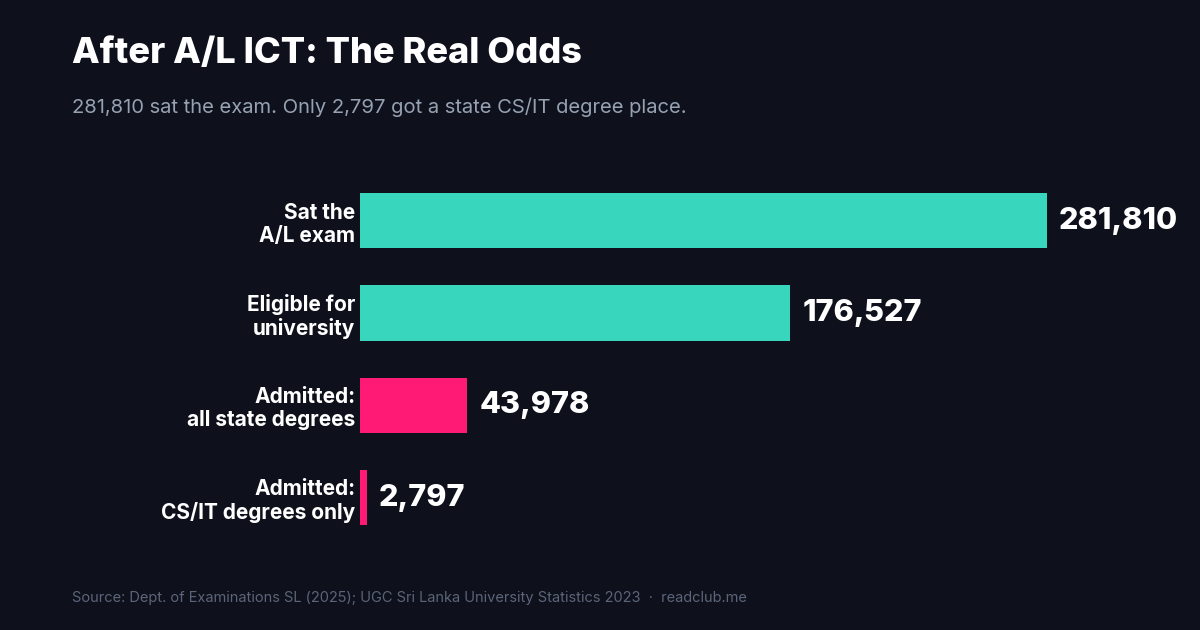
Let's start with the number nobody tells you in school. In the 2025 G.C.E. Advanced Level exam, 281,810 students sat the exam across all streams, and 176,527 — 62.64% — became eligible for university entrance. That's the first filter.
The second filter is brutal. According to the University Grants Commission's own Sri Lanka University Statistics 2023 report, of the students who qualified for admission in the 2022/2023 academic year, only 43,978 out of 166,967 qualified applicants — 26.34%, roughly 1 in 4 — actually got a state university place, across every stream and every degree combined. Engineering Technology stream students fared worse than average: 10,634 qualified, only 2,333 (21.94%) got in.
Now narrow it to Computer Science and IT specifically. That same UGC data shows only 2,797 students were admitted into the bundled "Computer Science/IT" category of degree programmes that year — spread across Computer Science (709), Information Technology (251), Software Engineering (176), and several smaller named programmes. Out of nearly 282,000 students who sat the A/L exam that cycle, fewer than 3,000 got a state-funded IT or CS degree place. That's the real arithmetic behind "I want to do IT at university."
One more number worth knowing, since ICT as a subject is taken across multiple streams, not only Technology: in 2025, 56,538 students sat the ICT subject and 40,884 passed (72.31%), down from a 78.30% pass rate in 2024 on 50,629 sitters. Passing ICT well is necessary. It is nowhere near sufficient on its own.
What is the Z-score (සී-අගය), and why does the same score get a different outcome by district?
The Z-score is a standardised measure of how you performed relative to everyone else who sat the same subjects in the same year — it is not your raw marks, and it is not comparable across years by itself. Sri Lanka then applies your Z-score inside a district quota system: each of the 25 districts is allocated a set number of seats per degree programme, and you compete against other applicants from your own district, not the whole island.
This produces a result most students never expect: a lower district quota can push the cutoff above Colombo's, not below it. Look at the University of Colombo School of Computing's Computer Science programme for the 2025/2026 intake, straight from UGC's official cut-off document:
Colombo's cutoff was 1.6565. Badulla's was 2.0124 — a full 0.36 higher, in the same programme, the same year. Several smaller or conflict-affected districts show "NQC" (No Qualified Candidates) for that round, meaning the seat allocated to that district simply went unfilled — not that the bar was low, but that too few applicants in that district cleared any threshold at all. Your district of residence, not just your ability, materially changes your odds.
One myth worth killing directly here: SLIIT is not part of this system. It's a private, independent degree-awarding institute, not a UGC-administered state university. It has no Z-score cutoff and no district quota — admission is by its own criteria and a fee, not a Z-score. Confusing the two is one of the most common and costly misunderstandings A/L students have.
Path A — State universities: what's actually on offer
If you clear your district's cutoff, here's roughly what exists in the state system for IT/CS-adjacent degrees, based on the programmes UGC actually tracks admissions for:
| Degree | Example institutions | What it emphasises |
|---|---|---|
| BSc Computer Science | University of Colombo School of Computing, University of Peradeniya, University of Ruhuna | Theory-heavy: algorithms, systems, mathematics foundations |
| BSc Information Technology | University of Moratuwa, University of Kelaniya | Applied IT, systems development, some business context |
| BSc Software Engineering | University of Sri Jayewardenepura, University of Kelaniya, Sabaragamuwa University | Software design, engineering process, project-based work |
| BSc Information & Communication Technology | Rajarata University (Vavuniya campus) and others | Broader ICT, networks, communications systems |
State degrees cost, in effect, nothing beyond a nominal administrative fee — UGC's own 2025/2026 admission notice lists a Rs. 50 online registration fee for Z-score-admitted students. That is the single biggest financial argument for pushing hard to clear the cutoff rather than defaulting straight to a private option.
Path B — Private and foreign-affiliated degrees: what you're actually paying for
If the Z-score doesn't work out, or you want a route that doesn't depend on a district lottery, private and foreign-affiliated degrees are real options — but the costs vary far more than students expect, and the fee structures are genuinely different from each other. Here's what's actually published, directly from each institution's own current fee pages:
| Institution & programme | Total fee (LKR) | Duration |
|---|---|---|
| SLIIT — BSc (Hons) Information Technology | 2,800,000 | 4 years |
| SLIIT — BSc (Hons) Computer Science | 2,960,000 | 4 years |
| NSBM Green University — BSc (Hons) Software Engineering | 2,815,000 (incl. registration & library) | 4 years |
| ESOFT — HND in Computing + BSc (Hons) Computing Top-Up (London Met, UK) | ~532,000–682,000 (HND) + 780,000 (top-up) ≈ 1.3M–1.5M combined | Not publicly stated on the fee pages |
I looked for published fees for IIT (Informatics Institute of Technology, affiliated with Robert Gordon University) and APIIT — genuinely could not find a public figure on either institution's site. If a private-degree page won't show you the total cost upfront, treat that as a question to ask directly before you commit, not a detail to assume.
When I was hiring engineers as a technical lead at 99X Technology, the degree name on a CV mattered far less than what a candidate could actually build and explain. I've hired strong graduates from state universities, from SLIIT, and from people who never finished a traditional degree at all. What got someone shortlisted was a working project I could look at, not the crest on the certificate.
Path C — Skipping the degree entirely: what certifications can and can't get you
A degree is not the only entry point into tech work in Sri Lanka, and it's worth being honest about both sides of this. Industry-recognised certifications — cloud platforms (AWS, Microsoft Azure, Google Cloud), specific frameworks, or a strong public portfolio of real projects — can get you an interview, particularly at smaller companies and startups that care more about demonstrated ability than credentials.
What certifications generally cannot get you: some larger multinational employers and specific visa/migration pathways that explicitly require a recognised degree as a formal qualification. If your long-term plan includes working abroad or pursuing postgraduate study, check the specific requirement early — retrofitting a degree later is possible but slower and more expensive than planning for it from the start.
What the A/L ICT syllabus actually maps to later
Having taught, hired for, and built software professionally, here's an honest mapping of which parts of the A/L ICT syllabus carry weight in a real degree or job, and which are mostly exam artefacts you won't touch again:
| A/L ICT topic area | Shows up again in... |
|---|---|
| Programming logic & algorithms | Directly, and repeatedly — this is the single most transferable skill in the whole syllabus |
| Database concepts (normalisation, ER diagrams) | Directly — every real system you'll ever build touches a database |
| Networking fundamentals | Partially — useful conceptual grounding, gets far deeper in a real degree |
| Systems Development Life Cycle (SDLC) theory | The concepts survive; the exact diagrams and terminology you memorised mostly don't |
| ICT & society / legal & ethical issues | Conceptually useful, resurfaces as data-protection and professional-ethics topics later |
The platform I helped build for the University of Moratuwa, open.uom.lk — which by the university's own figures has reached more than 150,000 learners — exists precisely because so many students arrive at a degree with strong exam technique but shaky practical grounding in exactly the areas above. If there's one thing worth over-practising before you start a degree, it's actually writing and debugging code, not memorising more diagram formats.
|
🎓 Get a head start Choosing a CS/IT degree path? Get ahead on the fundamentals before you start. Computer Organization and Architecture is a first or second-year subject in nearly every CS/SE degree in Sri Lanka and abroad. My Udemy Masterclass gives you a clear, practical head start before university — or a solid refresher if you're already in it. Enroll Now — Use Code PROMO26 →Limited-time discount for ReadClub readers. |
What do ICT careers in Sri Lanka actually pay?
Here's where I have to be straight with you: a genuinely reliable, public, granular salary-by-experience-level survey for Sri Lankan software engineers does not exist. SLASSCOM does run a Compensation & Benefits Report, but its actual figures are members-only. What's publicly available (self-reported listings on sites like Glassdoor) isn't precise enough to responsibly print as fact in an article like this, so I'm not going to invent a number that looks authoritative but isn't.
What is real and published is the scale of the opportunity. Sri Lanka's ICT/BPM sector exported USD 1,512 million in 2024, up 23.1% year-on-year, according to the Export Development Board. The industry now employs roughly 175,000 professionals and absorbs around 17,000 new graduates a year, per SLASSCOM's own 2026 figures reported in the Daily FT. Worth flagging honestly, though: more recent partial-year Central Bank data (Jan–Oct 2025) shows export earnings actually fell 3.8% year-on-year — the sector isn't on an uninterrupted upward line, and you should treat any single year's growth number as a snapshot, not a guarantee.
The one earnings distinction that is real and worth understanding conceptually, even without a precise published figure: local-market Sri Lankan salaries and export-oriented roles (working for a foreign client, a remote-first company, or a Sri Lankan firm billing in dollars) operate on genuinely different scales, because the latter is priced against international, not local, cost of living. This is a major reason so many graduates target export-facing companies specifically. It's also worth thinking about which degree actually protects your career against AI-driven disruption in the coming years — I've dug into the current data on that question separately in whether a postgraduate degree is still worth it in the AI era.
The postgraduate routes almost no A/L student is told about
This is the section I most wish someone had explained to me at 18, because I didn't know most of it existed until years later.
Inside Sri Lanka, real MSc programmes in Computer Science exist at state universities with published, moderate fees: the University of Colombo School of Computing offers an MSc in Computer Science for Rs. 565,000 (or a Master of Computer Science for Rs. 510,000), both 2-year part-time programmes. The University of Sri Jayewardenepura's MSc in Computer Science runs at Rs. 650,000 over 2 years. The University of Moratuwa also runs an MSc/PG Diploma in Computer Science, though its exact current fee isn't published online.
Abroad is where it gets genuinely interesting, and where almost no A/L student has any visibility at all: a funded PhD. This isn't a myth or a rare fluke — it's a standard, published mechanism at research universities, where you're paid a living stipend and your tuition is covered to do the research, not the other way around. If New Zealand specifically is on your radar for postgraduate study, I've written a separate, detailed NZQA-based guide for Sri Lankan students planning postgraduate study there, covering how to check a provider's real academic standing before you commit to anything.
I did exactly this. My own PhD, in Human Interface Technology at the University of Canterbury in New Zealand, came with a University of Canterbury Doctoral Scholarship: NZ$32,650 per 120 points of study, plus tuition fully covered for the standard three-year, 360-point doctorate. That's not pocket money for textbooks — it's a genuine, if modest, living stipend, and it's how most real PhD students in AR/VR, computer science, and related fields around the world are actually funded. The Australian National University's equivalent Research Training Program stipend is A$39,069 a year (tuition there is covered by a separate scholarship component), and UK doctoral stipends through UKRI sit at £20,780 a year, rising to £21,805 from October 2026.
None of this is easy to get, and I want to be honest about how competitive it is specifically for Sri Lankan applicants. In the 2025 Commonwealth Scholarships round — one of the most established scholarship schemes for Commonwealth countries including Sri Lanka — only 10 Sri Lankan students were awarded scholarships to the UK: nine at Master's level, and just one PhD scholarship, the first Sri Lanka had received in that scheme after a gap of several years. A funded PhD is real, it exists, and it is genuinely rare — which makes it worth knowing about early enough to actually plan a competitive application, rather than discovering the concept exists only after the window to prepare for it has mostly closed.
If you want to see what that kind of research actually looks like in practice rather than in the abstract, I've written in detail about the specific study my PhD was built around — a plain-language walkthrough of what a funded doctoral research project actually involves day to day.
What I'd tell my 18-year-old self
Stop treating the Z-score as a verdict on your intelligence. It's a function of your district's quota and how everyone else in your district happened to perform that year — not a permanent measure of your worth or ability.
If you don't clear the cutoff for the state programme you wanted, that is not the end of the story it feels like at 18. I've watched people from every path in this article — state, private, self-taught — end up doing genuinely good work, and I've watched people from "prestigious" programmes coast and go nowhere. What you actually build and finish matters more than which door you walked through to get there.
Learn to write and debug real code before your degree even starts, not just enough to pass an exam. It is the single highest-leverage thing you can do in the gap between results and starting university, and it will make every year of your degree easier.
And take postgraduate study seriously as an actual plan, not a vague someday. If a funded PhD or a scholarship-backed Master's is even slightly on your radar, the preparation — research experience, strong references, a genuine area of interest — needs to start years before the application, not after you've already graduated and are scrambling.
Frequently asked questions
What Z-score do I need for a Computer Science degree in Sri Lanka?
It depends entirely on your district and the year, because of the district quota system — there is no single national cutoff. For UCSC Computer Science in the 2025/2026 round, cutoffs ranged from around 1.66 in Colombo to over 2.0 in Badulla. Always check the current year's official UGC cut-off document for your specific district.
Is SLIIT a government university?
No. SLIIT is a private, independent degree-awarding institute. It is not part of the UGC's Z-score/district-quota admission system, has its own admission criteria, and charges tuition — currently around Rs. 2.8–2.96 million for a 4-year BSc.
Do private degrees get accepted for jobs in Sri Lanka?
Yes, widely. What matters more to most employers is demonstrated ability — projects you can show, problems you can solve — than which specific institution issued the degree, though some multinational employers and specific migration pathways do have formal degree-recognition requirements worth checking early.
Can I do a Master's in Computer Science in Sri Lanka without going abroad?
Yes. State universities including UCSC, University of Sri Jayewardenepura, and University of Moratuwa all run part-time MSc programmes in Computer Science, generally over 2 years, with published fees in the Rs. 510,000–650,000 range at UCSC and SJP.
What is a funded PhD, and is it realistic for a Sri Lankan student?
A funded PhD pays you a living stipend and covers your tuition in exchange for doing original research — it is not something you pay for. It's real and it exists, but it is genuinely competitive: in 2025, only one Sri Lankan student received a Commonwealth PhD scholarship to the UK, compared to nine at Master's level. It requires early preparation, not a last-minute application.
Should I choose IT or Computer Science if I have a choice?
Computer Science tends to be more theory- and mathematics-heavy (algorithms, systems foundations); Information Technology and Software Engineering programmes tend to be more applied. Neither is objectively "better" — it depends on whether you're drawn to the underlying theory or to building applied systems, and both lead to real careers.
How much do software engineers actually earn in Sri Lanka?
Honestly, there's no reliable public salary survey to point you to with confidence — SLASSCOM's compensation data is members-only, and public listings are self-reported and imprecise. What is verifiable is that the ICT/BPM export sector alone generated USD 1.5 billion in 2024 and employs roughly 175,000 people, and that export-oriented, foreign-client roles generally pay meaningfully more than purely local-market roles.
Dr. Yasas Sri Wickramasinghe holds a BSc in Information Technology from the University of Moratuwa and a PhD in Human Interface Technology from the University of Canterbury, New Zealand. He has worked as a software engineer and technical lead in the Sri Lankan tech industry, as a postdoctoral researcher at HIT Lab NZ, and has published peer-reviewed research at venues including IEEE VR and ACM SUI. He writes about technology and education at yasassri.me.
Sources
- Department of Examinations Sri Lanka — G.C.E.(A.L.) Examination 2025 — Performance of Candidates (accessed August 2026)
- University Grants Commission Sri Lanka — Sri Lanka University Statistics 2023, Chapter 2 (accessed August 2026)
- University Grants Commission Sri Lanka — Student Handbook 2024/25 (accessed August 2026)
- University Grants Commission Sri Lanka — University Admission Cut-Off Values 2025/2026 (accessed August 2026)
- University Grants Commission Sri Lanka — 2025/2026 Admission Notice (Rs. 50 registration fee) (accessed August 2026)
- SLIIT — BSc (Hons) Information Technology fees and BSc (Hons) Computer Science fees (accessed August 2026)
- NSBM Green University — BSc (Hons) Software Engineering fees (accessed August 2026)
- ESOFT Metro Campus — BSc (Hons) Computing Top-Up fees and HND in Computing fees (accessed August 2026)
- Sri Lanka Export Development Board — Export Performance Indicators 2024 (ICT/BPM sector) (accessed August 2026)
- Daily FT — SLASSCOM workforce and export sector coverage, 15 July 2026 (accessed August 2026)
- University of Colombo School of Computing — MCS / MSc in Computer Science fees (accessed August 2026)
- University of Sri Jayewardenepura, Dept. of Computer Science — MSc in Computer Science (accessed August 2026)
- University of Canterbury — UC Doctoral Scholarships (accessed August 2026)
- Australian National University — RTP Stipend (accessed August 2026)
- UK Research and Innovation — Doctoral studentship minimum stipend (accessed August 2026)
- The Island (Sri Lanka) — Sri Lanka's 10 Commonwealth Scholars, 2025 (accessed August 2026)


