
Here's a question I've spent the last few years of my life trying to answer, and I promise it's more interesting than it sounds at first: what if you could hide a toy in your best friend's bedroom, right now, without leaving your own house — or even your own country?
That's not a trick question. It's the actual game my PhD research is built around, and I want to walk you through it properly, because "I did a doctorate in augmented reality" tends to make people's eyes glaze over right before the part that's actually fun.
My PhD research (HIT Lab NZ, University of Canterbury) builds augmented reality that lets two people genuinely share a real physical room from anywhere in the world — tested with a remote hide-and-seek game and 60 real participants. 44 of them preferred it over playing in person. The wildest part: the instant gravity stopped applying, people started hiding things on ceilings and in mid-air — spots nobody uses in the real game.
Let's start with the game, because it explains everything else
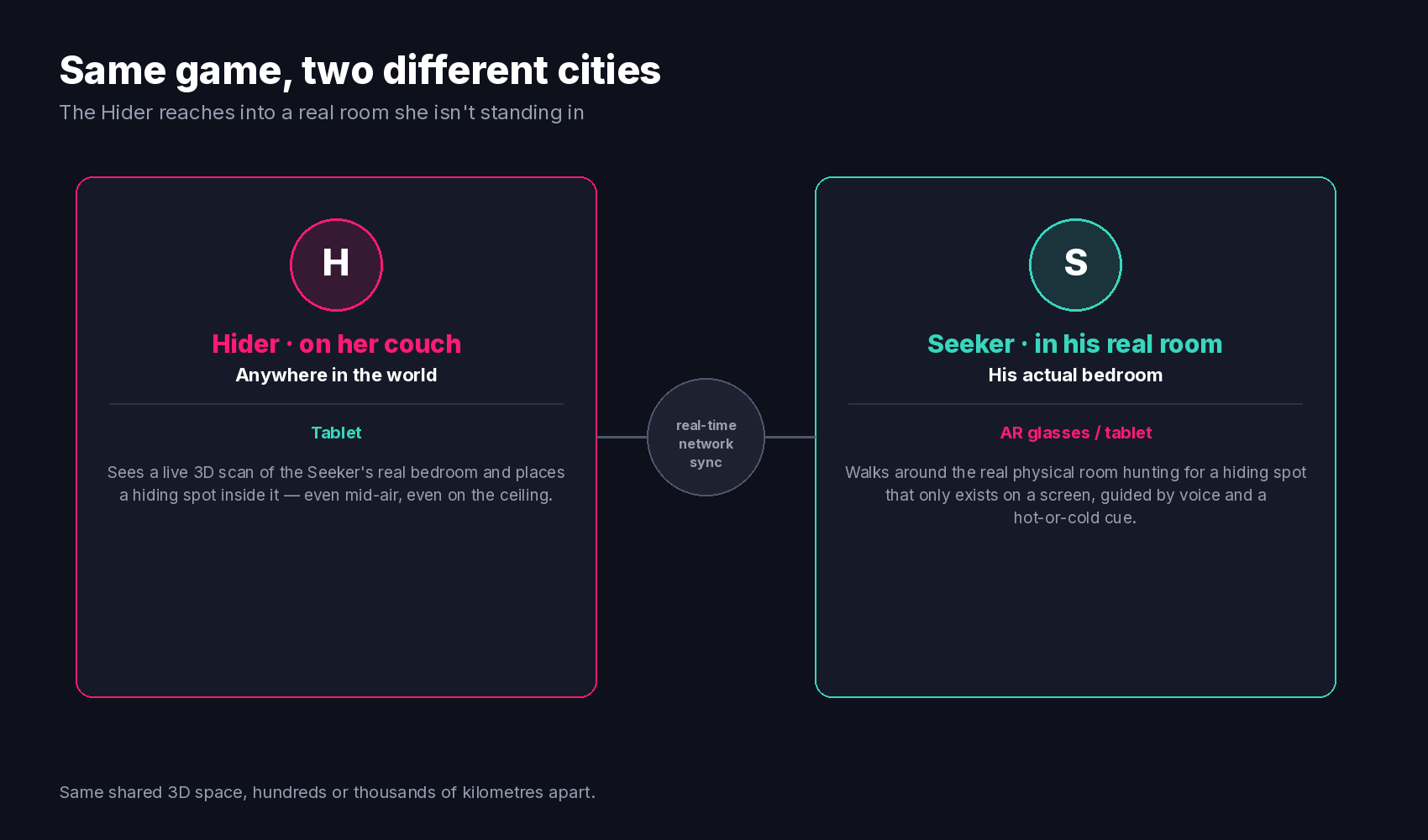
Picture two friends. One of them — let's call her the Hider — is sitting on her couch with a tablet. The other — the Seeker — is standing in his actual bedroom, on the other side of the city, wearing a pair of AR glasses or holding his own tablet up like a window into his room.
Here's the part that took real engineering to pull off: the Hider can see the Seeker's actual bedroom, in 3D, on her tablet — the real bed, the real desk, the real bookshelf — even though she's nowhere near it. She reaches into that virtual copy of his room and places a hiding spot: a floating cartoon character, tucked behind a pillow, or — because this is augmented reality and not real life — stuck to the ceiling. The Seeker then has five minutes to find it, guided only by her voice and a "hot or cold" game, walking around his own real bedroom hunting for something that only exists on a screen.
We built this, tested it with 60 real people, and the results genuinely surprised me — not because AR made the game more fun (it did, but that was the easy prediction), but because of how differently people's brains treated a hiding spot the moment physics stopped applying.
Why I actually care about this, beyond the game
I'll be honest about the motivation, because I think it's the part that actually matters to someone who isn't a researcher: most of what gets called "the metaverse" or "remote collaboration" today is still two people staring at rectangles on a screen, in a video call, describing spaces to each other with words. "It's on the left, no, your other left."
My research sits inside a bigger question that a lot of us at HIT Lab NZ — the University of Canterbury's augmented and virtual reality research lab, and one of the older AR labs in the world — have been chasing for two decades: can we use augmented reality to let people genuinely share a physical space with someone who isn't there? Not a video call. Not an avatar in a generic virtual room. Your actual room, your actual desk, with someone else's presence and actions layered directly into it, in real time.
Once you can do that convincingly for a game, the same underlying technology starts being useful for things that matter a lot more than hide-and-seek: a grandparent "visiting" a grandchild's new apartment and pointing at exactly where the bookshelf should go; a technician in Auckland guiding someone through a repair in Christchurch by pointing at the actual broken part, not a diagram of one; a teacher walking a remote student through a lab experiment that's physically sitting on the student's own desk. The game is the fun, testable version of a much more useful problem.
What we actually built
Underneath the fun, this is real, fairly involved software engineering, and I think it's worth showing you the pieces rather than hand-waving at "AR magic":
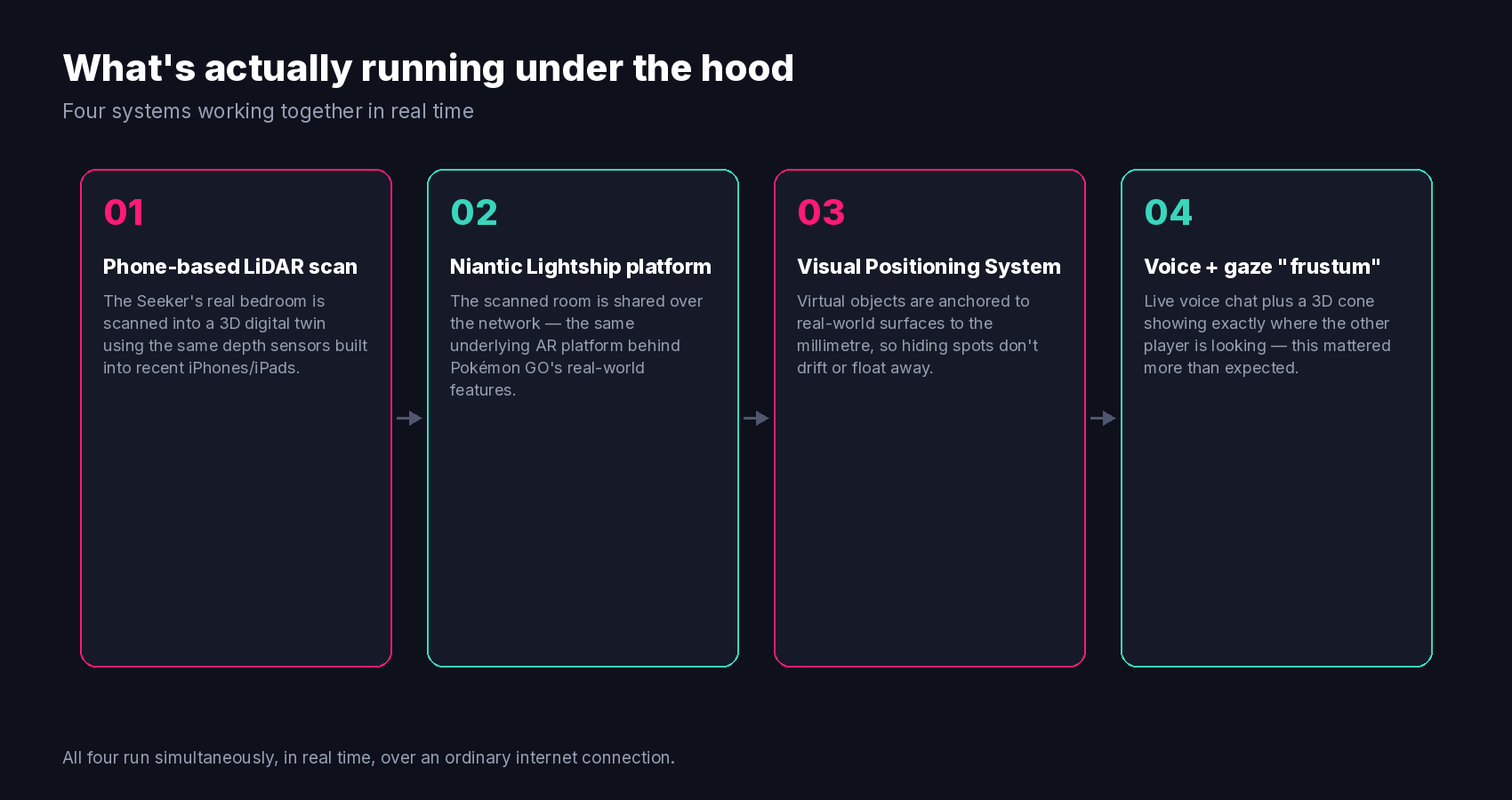
The Seeker's real bedroom gets turned into a 3D digital twin using a phone-based LiDAR scan — the same depth-sensing technology in recent iPhones and iPads, built on Niantic's Lightship platform (yes, the same underlying tech behind Pokémon GO's AR features). That scanned room gets sent to the Hider, who can then reach into it from anywhere with an internet connection. Everything they both see is kept in sync in real time over the network, down to the exact millimetre, using a Visual Positioning System that anchors virtual objects to real-world surfaces so they don't drift or float away from where they were placed. On top of that sits real-time voice chat, and a "frustum" — a little 3D cone showing exactly where the other player is standing and looking, which turned out to matter a lot more than we expected.
What actually happened when real people played it
We ran this with 60 participants, comparing the AR remote version against a normal, same-room version of hide-and-seek, and measured engagement, immersion, how people communicated, and — my favourite part — exactly where they chose to hide things.
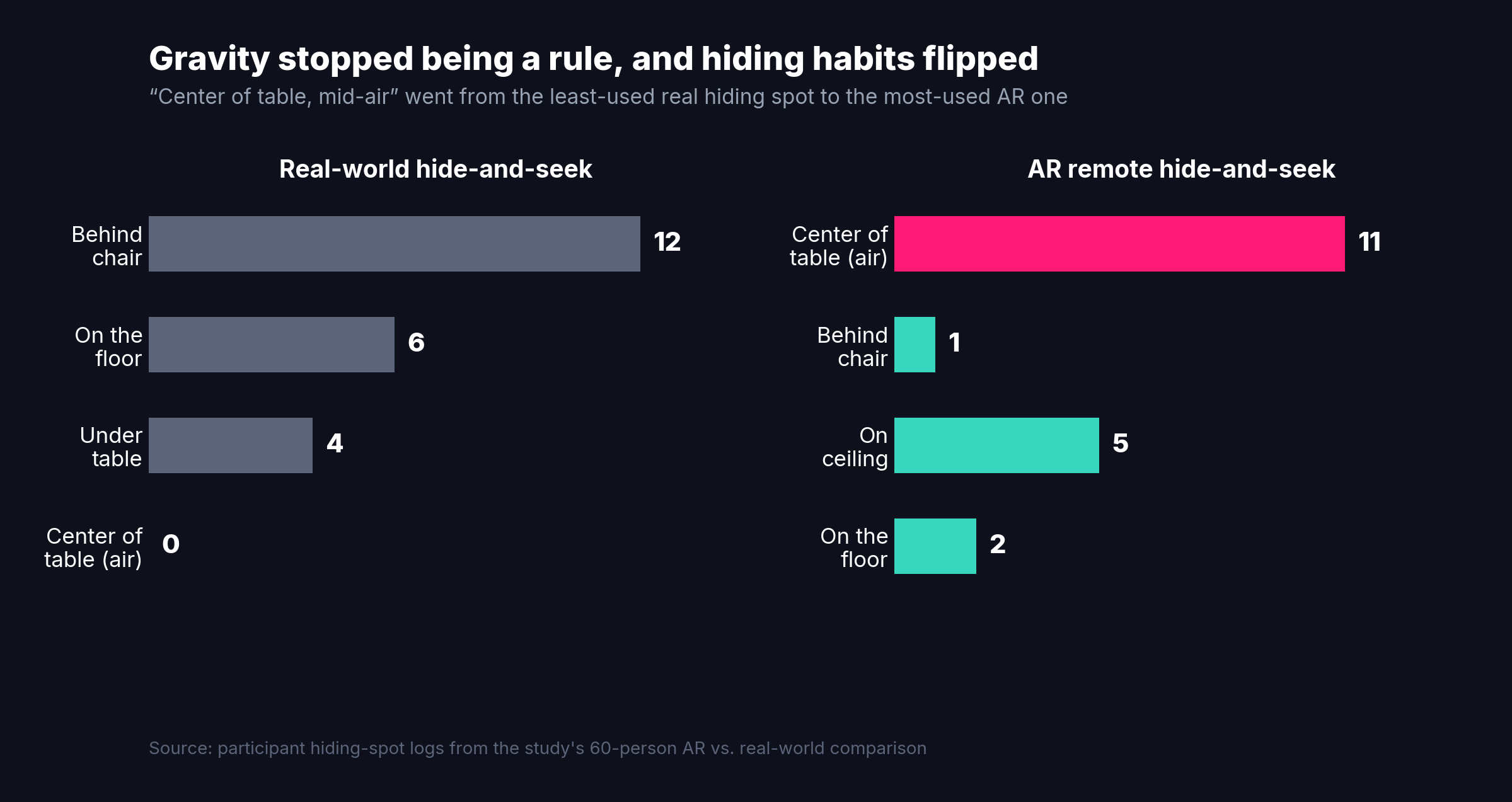
The hiding spots told the most interesting story of the entire study. In the real, physical version of the game, people hid things where you'd expect: behind chairs, mostly — that single spot got picked twelve times. Almost nobody used the empty space above a center table, because, well, there's nothing there to hide behind. In the AR version, that completely inverted. The center of a table, floating in mid-air, got picked eleven times — something that is physically meaningless in the real world became one of the most popular hiding spots the moment gravity stopped being a rule. People hid things on ceilings. They hid things in the middle of open air. Watching the eye-tracking data, we could see players' gaze shifting upward far more often in AR — they'd learned, within minutes, to stop searching like the real world and start searching like a video game.
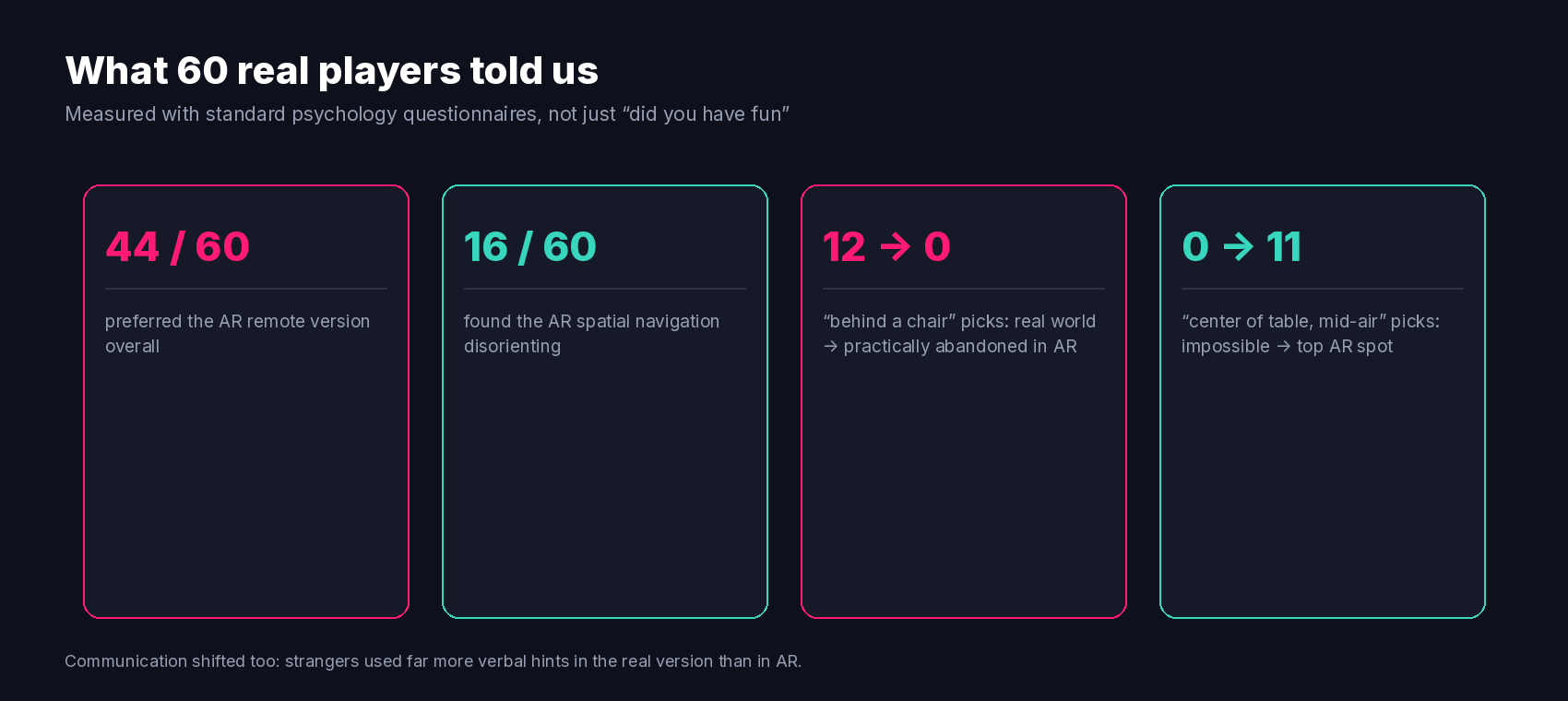
On top of that: 44 of the 60 participants said they preferred the AR version overall. People reported higher engagement and a stronger sense of reward on standard psychology questionnaires we used to measure this properly, not just "did you have fun." And interestingly, communication changed too — strangers paired together used a lot more verbal "hot and cold" hints in the real-world version than in AR, where the visual frustum showing the other player's position and gaze did a lot of that communicating for them, silently.
It wasn't universally better, and I want to be upfront about that rather than only telling you the flattering part. Sixteen participants specifically told us the AR navigation was disorienting — lining up a virtual room with a real one takes a moment to learn, and getting that alignment wrong is the single biggest usability problem in this entire field, mine included. Some people also just missed the physical, tangible feeling of real hide-and-seek, and no amount of clever software replaces that completely. Good research tells you what doesn't work as honestly as what does.
So what's this actually good for?
Beyond a genuinely fun way to prank your flatmate from another country, the design lessons from this study point at something bigger, and it's the part of my thesis I'm most excited to keep building on:
- Remote presence that feels like presence. Showing someone's gaze direction and position in 3D, not just their voice, measurably deepened how connected people felt to a partner they couldn't physically see. That's directly useful for remote family connection, remote mentoring, and remote care work.
- AR unlocks decisions physics won't allow. The instant people stopped being bound by gravity and collision, they explored space completely differently — more creatively, more playfully, and by some measures more engaged. That's a genuinely useful design principle for anyone building training simulations, remote inspection tools, or education software, not just games.
- Alignment and orientation are still the hard problem. If you're building anything in this space, the unglamorous work of making a virtual room line up precisely with a real one is where most of the value — and most of the frustration — actually lives.

I'm Yasas — a PhD researcher in augmented and virtual reality at HIT Lab NZ, University of Canterbury. I write about this research, and the AR/VR field more broadly, in plain language over on my personal site.
Visit yasassri.me →If any of this is the kind of thing you find genuinely interesting rather than just academically interesting — building things that connect people across real physical distance, AR, game design, or human-computer interaction research generally — I write and post about it more often, in plainer language than a journal ever allows, over on my own site.