

Here's a number worth sitting with for a second: 48% of hiring managers at mid-to-large companies say they'd rather put money into AI tools than hire and train a recent graduate. That's not a fringe opinion from one contrarian survey — it shows up, in one form or another, across nearly every major labour-market report published in 2026.
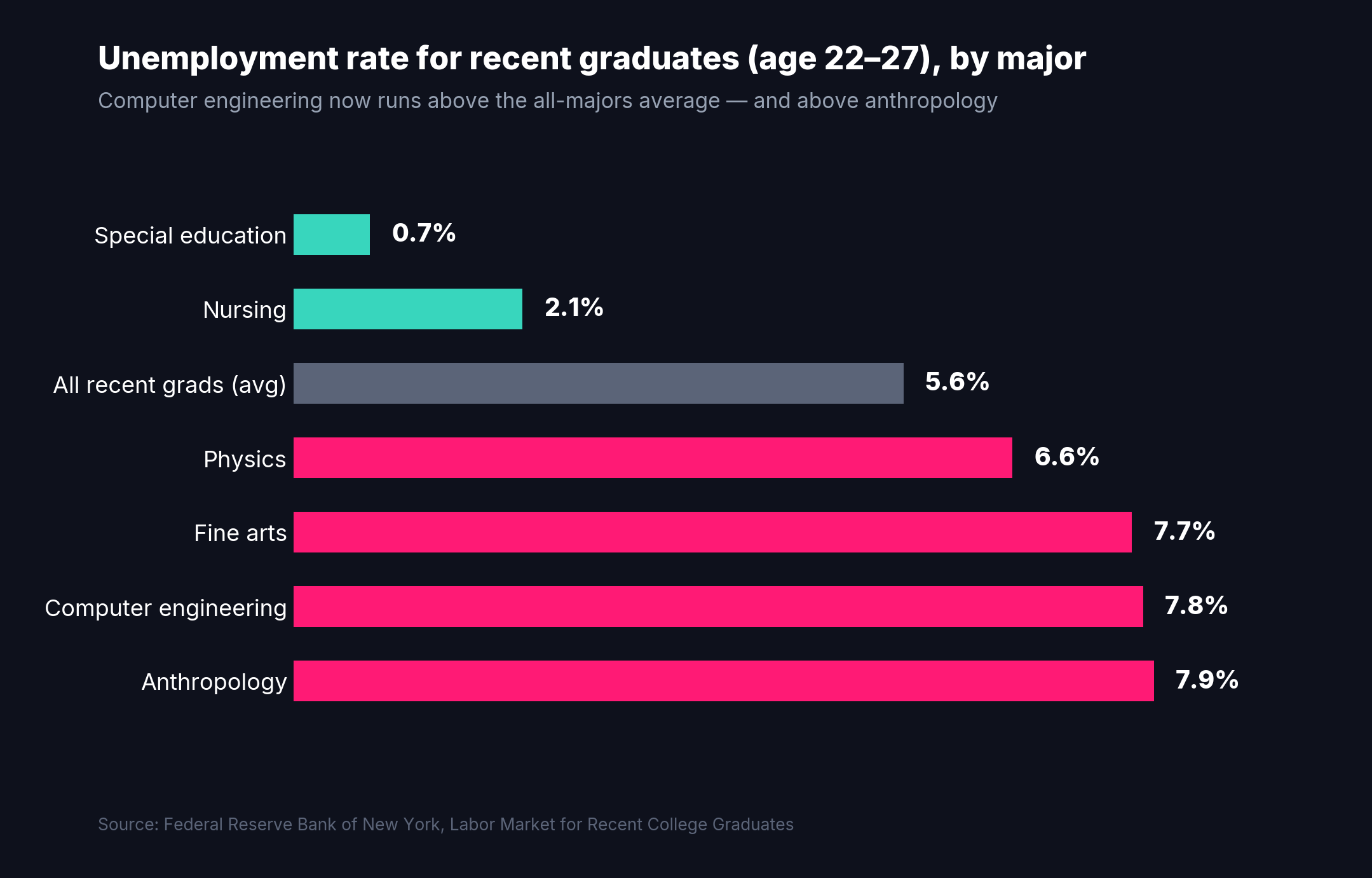
48% of hiring managers say they'd rather invest in AI tools than hire a recent grad, and entry-level job postings requiring AI skills nearly doubled in a year. But the wage premium for postgraduate degrees still holds, sponsorship offers for international students have collapsed from 10.9% to 2.6% of postings since 2023, and unemployment now varies wildly by field — nursing at 2.1%, computer engineering at 7.8%. The degree isn't dead. What it needs to prove has changed.
If you're currently doing a postgraduate degree, or weighing whether to start one, that statistic is probably the exact thing keeping you up at night. So this is a straight look at what the 2026 data actually says — not the panicked version, not the "don't worry, everything's fine" version, but what's actually happening to entry-level hiring, whether a master's or PhD still pays off financially, and which fields are holding up better than others.
What's actually happening to entry-level hiring right now
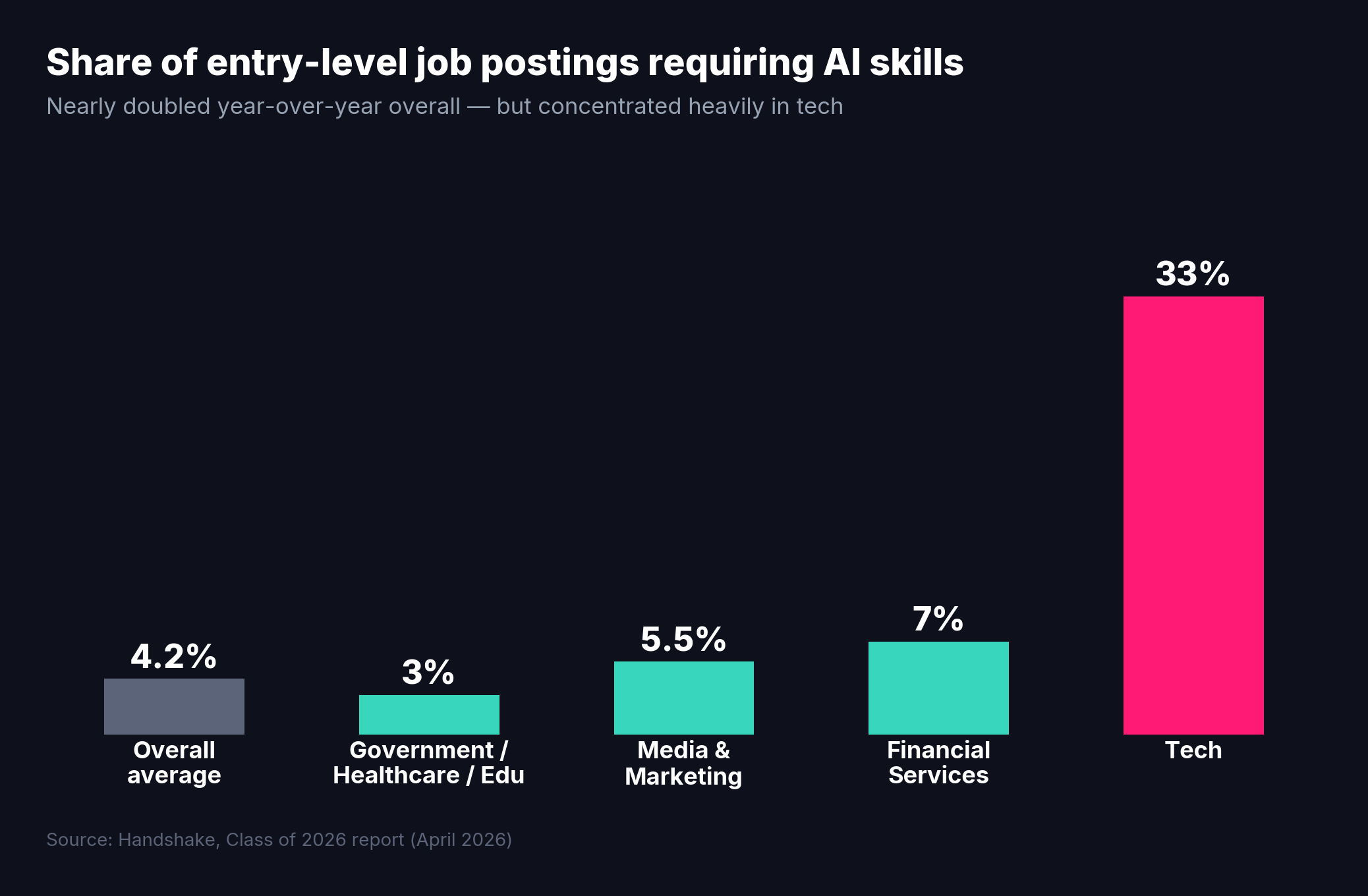
Start with the demand side. According to Handshake's Class of 2026 report, a survey of over 1,200 graduating seniors across roughly 500 institutions, 4.2% of full-time job postings now explicitly reference AI skills — nearly double the share from a year earlier. That number isn't evenly spread: in tech postings it's around 33%, in financial services about 7%, in media and marketing roughly 5.5%, and in government, healthcare, and education it's still close to 3%, up from almost nothing two years ago. Separately, NACE's spring 2026 employer survey put the "entry-level roles requiring AI skills" figure even higher — nearly a third of postings, close to triple the rate from just the previous fall.
At the same time, overall entry-level postings are down roughly 2% year-over-year and about 12% below pre-pandemic levels, per the same Handshake data. Put those two trends together — fewer entry-level jobs overall, a fast-growing share of them expecting AI fluency — and you get a genuinely harder market to break into, not an imagined one.
The unease isn't just anecdotal either. In that same survey, 62% of Class of 2026 seniors said they felt pessimistic about their career prospects, up from 46% two years earlier, and about half cited AI anxiety specifically as a top concern, up from a third in 2024.
The research digging into why is where it gets more interesting than a simple vibes check. A Stanford Digital Economy Lab analysis of payroll data through mid-2026 found that employment for AI-exposed workers aged 22–25 has fallen increasingly below its expected trend — a gap that widened from 15% in mid-2025 to 19% a year later — while experienced workers in the same fields show no comparable gap. A separate Harvard working paper, analysing tens of millions of workers across hundreds of thousands of firms, found that after a company adopts generative AI tools, junior hiring drops relative to companies that haven't adopted them, while senior headcount stays roughly flat. The mechanism in both cases isn't mass layoffs — it's quieter than that. Companies just stop opening as many junior positions, particularly for the kind of well-documented, "codifiable" tasks — routine coding, first-draft writing, basic data pulls — that AI tools now handle reasonably well.
The case against panicking
Here's where it gets genuinely contested, because not everyone reading the same underlying trend reaches the same conclusion. A separate analysis by Ramp's Economics Lab and Revelio Labs, covering over 21,000 US employers, found that companies with the heaviest AI investment actually grew their entry-level headcount by 12% over two years — specifically the firms using more advanced tools like coding agents and custom integrations, not just a basic chatbot subscription. One marketing agency cited in that reporting, Brainlabs, grew its junior staff from 19 to 64 people between late 2023 and early 2026, a 237% increase, with its CEO arguing explicitly that AI-literate juniors let a first-year strategist do work that used to require a team of five.
IBM has been one of the loudest counterexamples in public: its CHRO said in early 2026 the company was tripling entry-level hiring, including for software development roles that AI is supposedly best at replacing — with junior staff instead being pushed toward customer-facing and complex problem-solving work rather than routine coding.
PwC's 2026 Global AI Jobs Barometer, built from more than a billion job postings across 27 countries, adds useful nuance here. It splits roles into "professionalized" work — requiring judgment, credentials, and expertise — versus "democratized" work that's routine and easy to standardize. Professionalized roles have grown roughly twice as fast and seen wage growth about 40% faster than democratized ones since AI adoption accelerated. Within entry-level roles specifically, the ones now demanding senior-style skills like judgment and leadership grew 35% since 2019, while more routine entry-level roles shrank about 10% over the same period.
The honest read: both things are true simultaneously. AI is compressing the routine end of entry-level work while, in some firms and some fields, expanding demand for juniors who can operate AI tools well and add judgment on top. Which side of that divide you land on has a lot to do with what you're studying and how you use your time in a program — more on that below.
So does the degree itself still pay off?
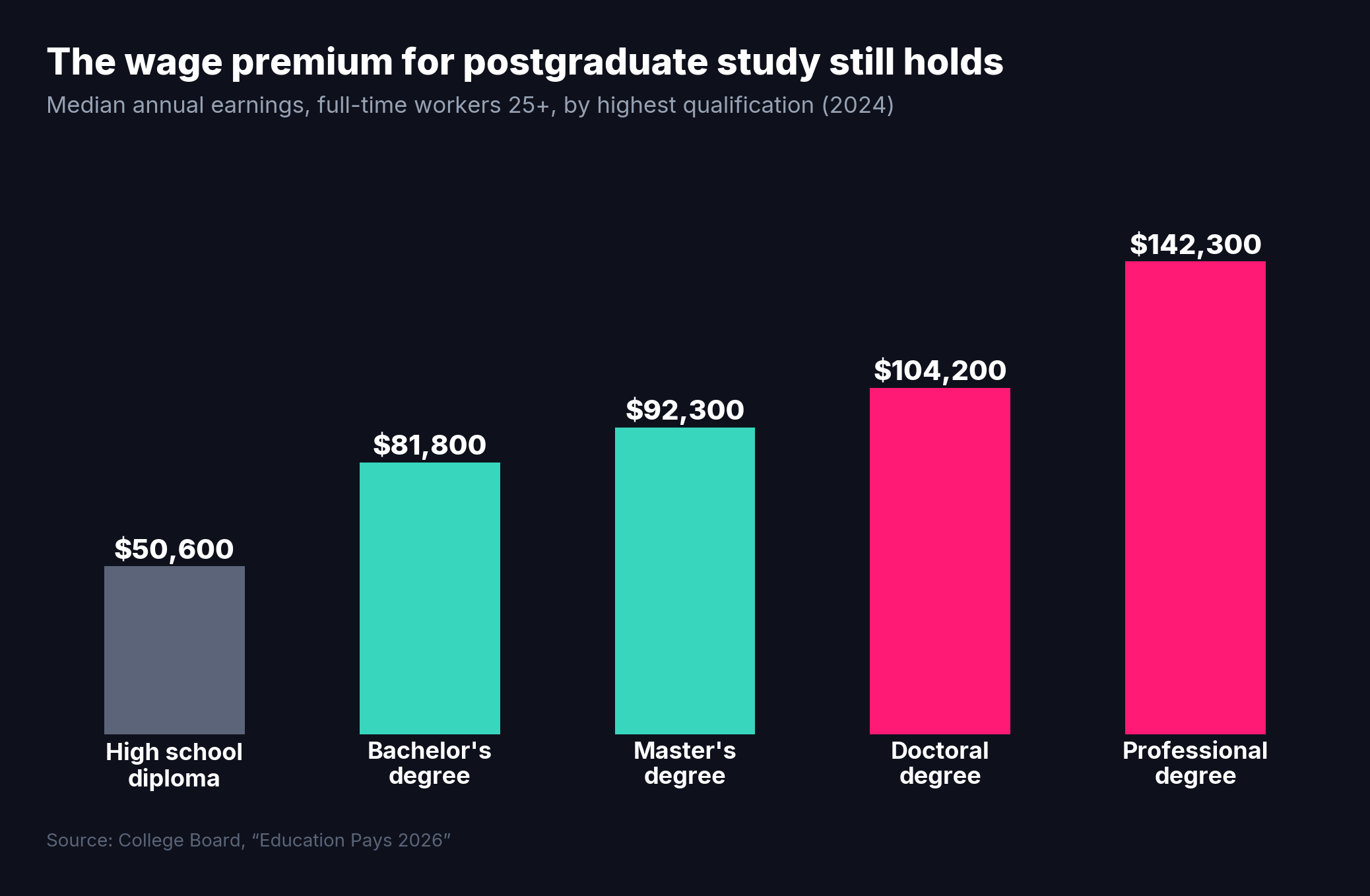
Strip out the AI headlines for a moment and look at the underlying wage data. The College Board's 2026 "Education Pays" report, using 2024 full-time earnings data, puts median annual earnings at $50,600 for a high school diploma, $81,800 for a bachelor's degree, $92,300 for a master's degree, $104,200 for a doctoral degree, and $142,300 for a professional degree such as law or medicine. Unemployment follows the same pattern in reverse: 4.3% for high-school-only workers versus 2.6% for those with a bachelor's degree or higher.
A Lumina Foundation–Gallup survey of nearly 6,000 degree holders, published in mid-2026, found that 71% said their education was worth what they paid for it, and 93% said they'd choose the same degree again given the choice. On the AI question specifically, 79% said it was "not too" or "not at all" likely their job would be eliminated by AI within five years — though that same survey also found just over half felt only "somewhat" prepared to compete as AI use spreads further, which is a more honest signal than either the doom or the reassurance headlines alone.
Worth flagging clearly: that survey covers degree holders broadly, not postgraduate students specifically, and it isn't focused on international students. Which brings up the part of this that matters most if you're reading this from outside the country where you're studying or planning to study.
Why this hits international postgraduate students differently
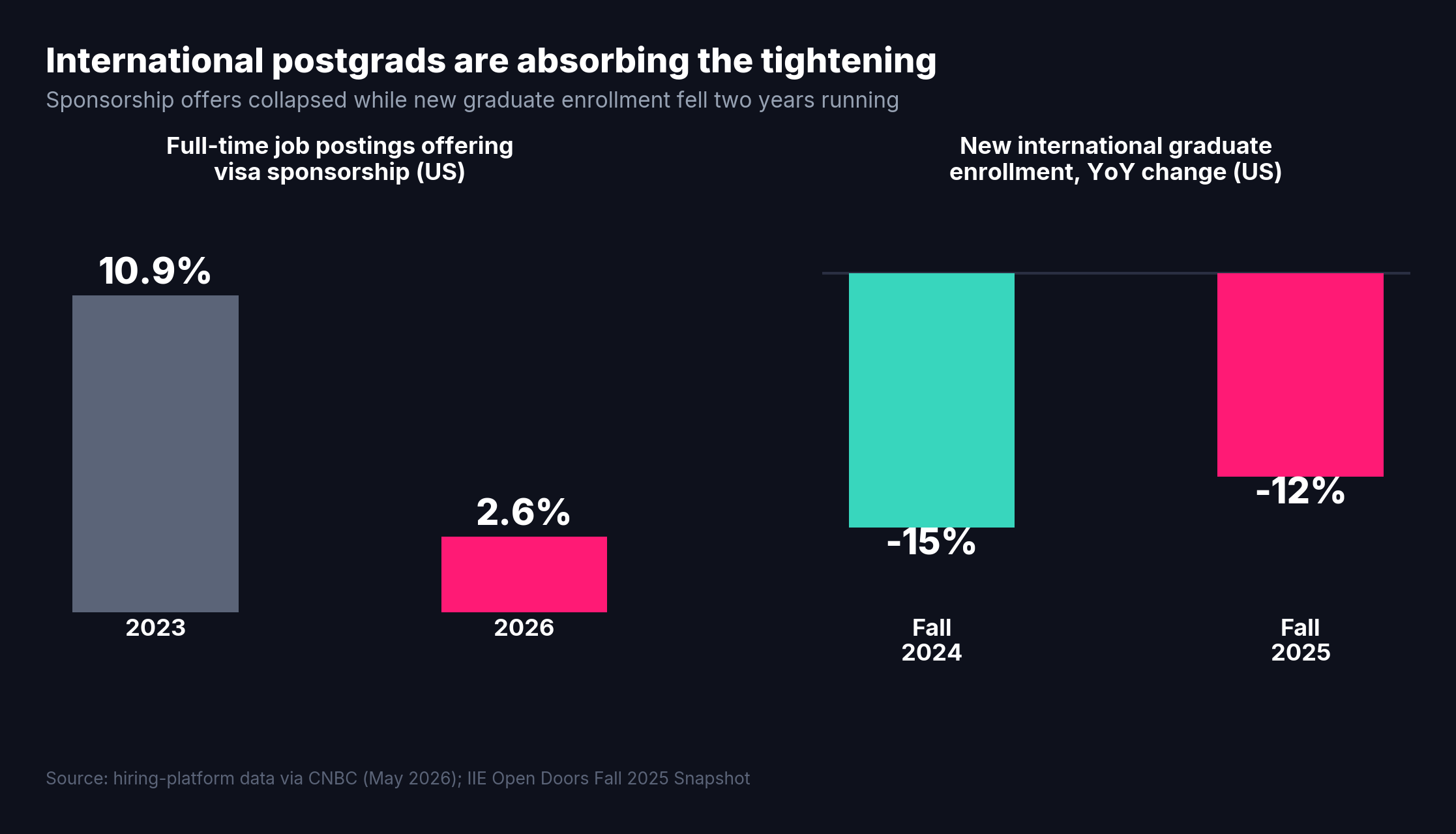
This is the part of the AI-and-jobs story that general career coverage tends to skip, and it's arguably the more urgent one if you're an international student. According to the Institute of International Education's Fall 2025 snapshot of over 800 US institutions, new international enrollment dropped 17% that year. New graduate-level enrollment specifically fell 12% — while new undergraduate enrollment actually rose 2% over the same period. That graduate-level pullback isn't a one-year blip either: the year before, new international graduate enrollment had already fallen 15% while new undergraduate enrollment grew 5%. Two years running, it's postgraduate students specifically absorbing the decline.
The employer side of the equation has tightened just as sharply. Reporting drawing on hiring-platform data found that the share of full-time job postings explicitly offering visa sponsorship fell from 10.9% in 2023 to just 2.6% in 2026 — a genuine collapse, not a gradual drift. Layer on a new $100,000 H-1B filing fee introduced in late 2025 and a proposed 21–33% increase to H-1B minimum salary requirements floated in early 2026, and the practical cost of an employer taking a chance on sponsoring an international graduate has risen sharply in a very short window.
None of this means international postgraduate study has stopped making sense — plenty of graduates are still landing strong outcomes, and OPT (Optional Practical Training) participation among international students actually rose 14% over the same period, suggesting many are staying and working rather than leaving immediately. But it does mean the old assumption — "a postgrad degree abroad more or less guarantees a sponsored job afterward" — needs retiring. Budget for a longer, more uncertain job search after graduation than you might have a few years ago, and treat visa sponsorship as something you'll need to actively compete for, not something that follows automatically from the degree itself.
|
🎓 Future-proof your fundamentals Worried about AI eating entry-level roles? Build the skills that don't get automated. The durable skill is understanding why a system behaves the way it does — not just calling a framework. My Computer Organization & Architecture Masterclass covers CPU design, memory hierarchies, and performance from the ground up. Enroll Now — Use Code PROMO26 →Limited-time discount for ReadClub readers. |
Which fields are actually holding up — and which aren't
This is probably the single most useful thing the 2026 data can tell you, because "is AI taking jobs" is really the wrong question. The better one is: which jobs, and which degrees lead to them.
Data from the Federal Reserve Bank of New York on recent college graduates (ages 22–27) tells a genuinely counterintuitive story. Unemployment for special education graduates sits at just 0.7%, nursing at 2.1% — both comfortably below the all-majors average of roughly 5.6%. Meanwhile computer engineering graduates are running at 7.8% unemployment and physics at 6.6%, both now above humanities majors like anthropology (7.9%, admittedly still high) that used to be the stereotypical "risky" choice. Computer science specifically has seen its unemployment rate roughly double since 2022, a sharp reversal of a decade of "just learn to code" advice.
The World Economic Forum's Future of Jobs Report projects a net gain of 78 million jobs globally by 2030 (170 million created against 92 million displaced), but with roughly 40% of existing job skills expected to change along the way. The fields it flags as fastest-growing skew toward roles that are hard to fully codify: nursing, secondary teaching, skilled trades, and specialists in AI, data, and renewable energy. The fields it flags as fastest-shrinking — cashiers, administrative assistants, and, notably, graphic designers — tend to be roles built around producing a fairly standardized output, which is exactly the kind of task generative AI has gotten good at.
The pattern holding across nearly every dataset in this space: fields built on tacit, hands-on, relationship-heavy expertise — healthcare, skilled trades, hands-on engineering disciplines, education — are proving far more AI-resilient than fields built on producing documentable, codifiable output, even when that output used to command a premium (software development being the clearest example of a field that flipped from "safe bet" to "increasingly contested" in the space of about three years).
What universities are actually doing about it
Institutions aren't sitting still, and some of the responses are a genuinely useful signal for what "a degree that holds up" is starting to look like. The University of Chicago Law School piloted removing devices from core classes and requiring oral defenses of written work, arguing explicitly that doing things "the hard way" is how the reasoning skill actually gets built. NYU Stern built an AI-conducted oral examination system to test whether students can defend their own analysis rather than just submit polished AI output. Brown University moved a economics midterm back into an in-person, no-device format after a take-home version produced a suspiciously high average — the in-person retest average dropped by nearly half.
The common thread across these changes is a shift in what's actually being assessed: not whether you can produce a polished answer (AI can usually help with that part), but whether you can explain your reasoning, defend an assumption under questioning, and take responsibility for a conclusion when it's challenged. One useful way to frame it, from a marketing professor writing about this shift in 2026: college is worth its cost in the AI era only if it develops graduates who can interpret and defend machine-shaped conclusions, not just execute them.
So, is it worth it?
The honest answer is: it depends heavily on what you study, how you use the time, and what you're optimizing for — which is a less satisfying answer than a clean yes or no, but it's the one the data actually supports.
The wage and employment data still clearly favours postgraduate qualifications over stopping at high school or even a bachelor's alone. The AI disruption is real, but it's concentrated in specific, identifiable places — routine, codifiable, easily-standardized work — rather than spread evenly across every field. And the fields showing the most strain right now (software development being the headline example) are, not coincidentally, the ones that were oversubscribed as "safe" choices for the better part of a decade.
If there's one practical takeaway that shows up consistently across the career-advice coverage from 2026: build genuine fluency in using AI tools well rather than avoiding them, but treat that fluency as table stakes, not a differentiator on its own — because employers increasingly assume it. What actually seems to separate graduates who land strong outcomes from those who don't is the ability to explain and defend judgment calls an AI helped them reach, plus the soft skills — communication, collaboration, adaptability under ambiguity — that show up again and again in employer surveys as the thing they can't get from a language model.
Frequently asked questions
Is it still worth doing a master's degree in 2026?
For most fields, the wage and employment data still says yes — median earnings and employment rates both rise with education level. The bigger question isn't whether to do a postgraduate degree, but which field, and whether the program genuinely builds judgment and defensible skills rather than just content knowledge.
Which postgraduate fields are safest from AI disruption right now?
Based on 2026 unemployment and hiring data, healthcare fields (especially nursing), education, and hands-on engineering and trades-adjacent disciplines are holding up comparatively well. Fields built around producing standardized digital output — including, somewhat surprisingly, entry-level software development — are seeing more strain than they did a few years ago.
Is it harder for international students to get sponsored jobs after graduating now?
Yes, measurably. The share of US job postings offering visa sponsorship fell from roughly 11% in 2023 to under 3% in 2026, alongside new, higher H-1B filing costs. This doesn't mean sponsorship is impossible, but it does mean it needs to be actively planned for and competed for rather than assumed.
Should I avoid studying computer science because of AI?
The data doesn't support a blanket "avoid it" conclusion — CS unemployment, while higher than it used to be, is still a functioning career path, and demand for AI-literate technical talent remains real. What's changed is that CS is no longer the automatic "safe" choice it was treated as for the past decade, so it's worth going in with realistic expectations and a plan to specialize rather than assuming the degree alone guarantees an outcome.
What can I actually do to improve my odds as a postgraduate student right now?
The advice that shows up most consistently across 2026 employer surveys: build a track record of solving real problems with AI tools (not just using them, but being able to explain what worked and what didn't), invest deliberately in communication and collaboration skills, and choose coursework or programs that require you to defend your reasoning rather than just submit finished output.
This article is general information based on publicly available labour-market, wage, and enrollment data and reporting as of August 2026, cited from sources including the College Board, the Federal Reserve Bank of New York, the World Economic Forum, PwC, Handshake, NACE, IIE, and reporting from CNBC, Forbes, Bloomberg, and Inside Higher Ed. It is not career, financial, or immigration advice and isn't tailored to your individual circumstances, field, or country. Labour markets and visa policies change quickly — verify current data and rules directly with primary sources before making study or career decisions.


