

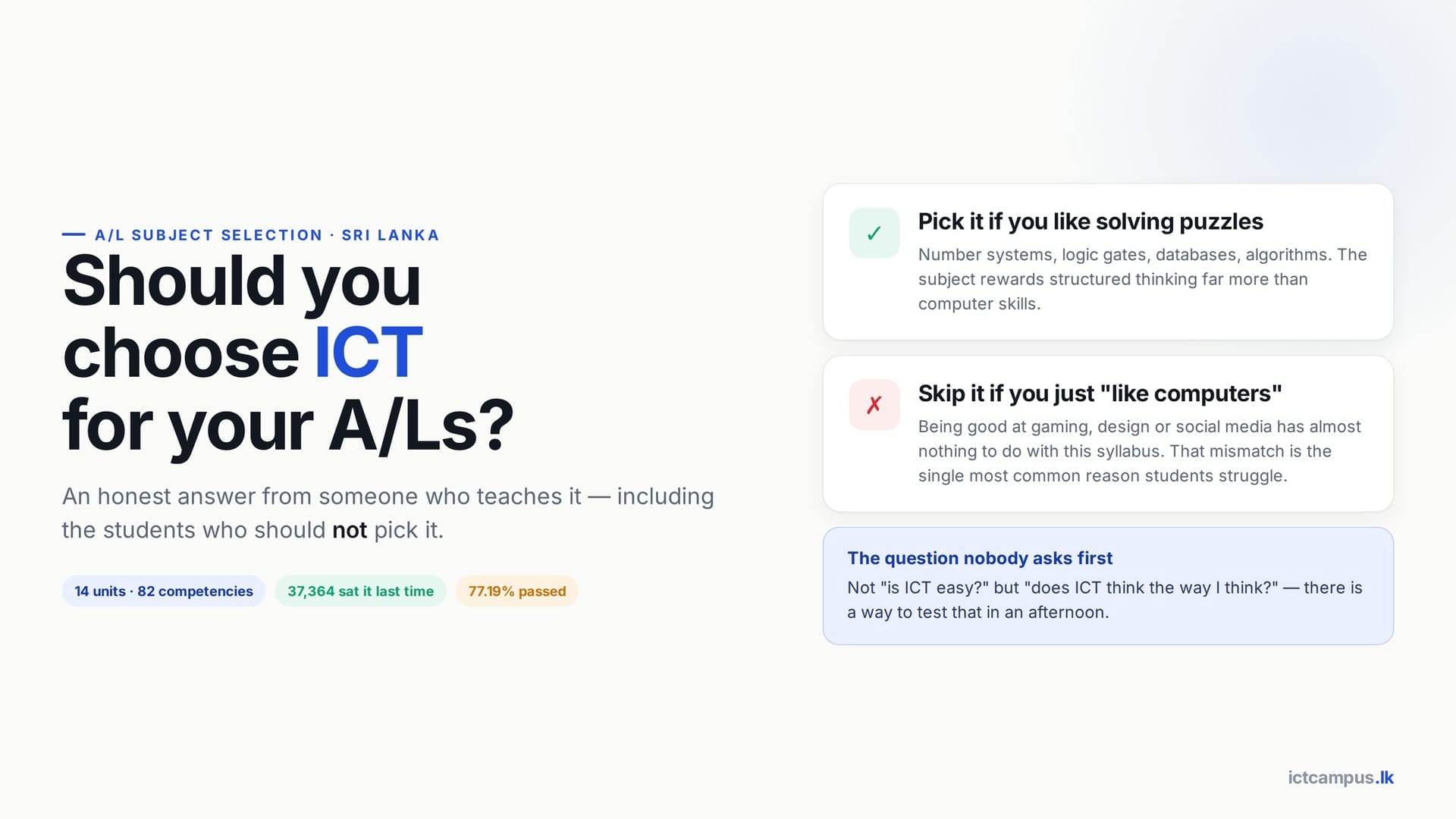
Every tuition advertisement in the country will tell you to choose ICT. Almost none of them will tell you who shouldn't. This article does both.
The 2026 A/L examination finished this week. Which means that across the country, a new batch of students is now sitting with a subject selection form and one particular question: should I take ICT?
You will get plenty of confident answers. Your relatives will say IT has jobs. A class advertisement will say ICT is easy marks. Someone will tell you it's the future.
All of that is a bit true and none of it answers your question, because the question is not "is ICT a good subject?" It is "is ICT a good subject for me?" — and those have completely different answers.
I teach this subject. I also have a PhD in a computing field and spent years as a software engineer before that. So let me give you the version I give students who ask me privately, including the part that costs me students.
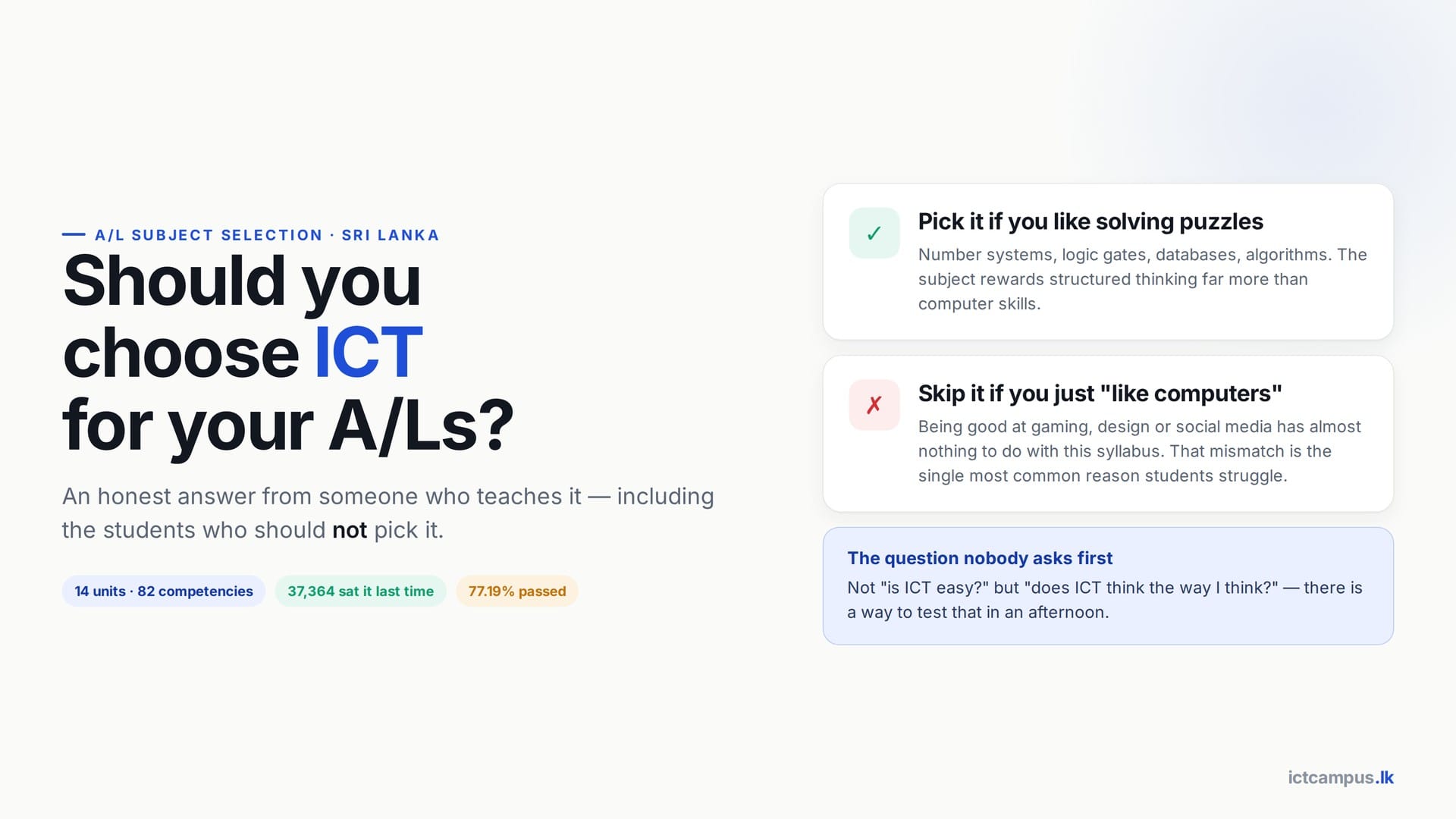
First: A/L ICT is not what most students think it is
This is the single most important thing on this page, so let's deal with it before anything else.
Most students who choose ICT (තොරතුරු හා සන්නිවේදන තාක්ෂණය) choose it because they like computers. They are good with phones. They play games, they edit videos, maybe they know a bit of design. It feels like a natural fit.
Then they open the syllabus and find binary arithmetic, logic gates and database normalisation.
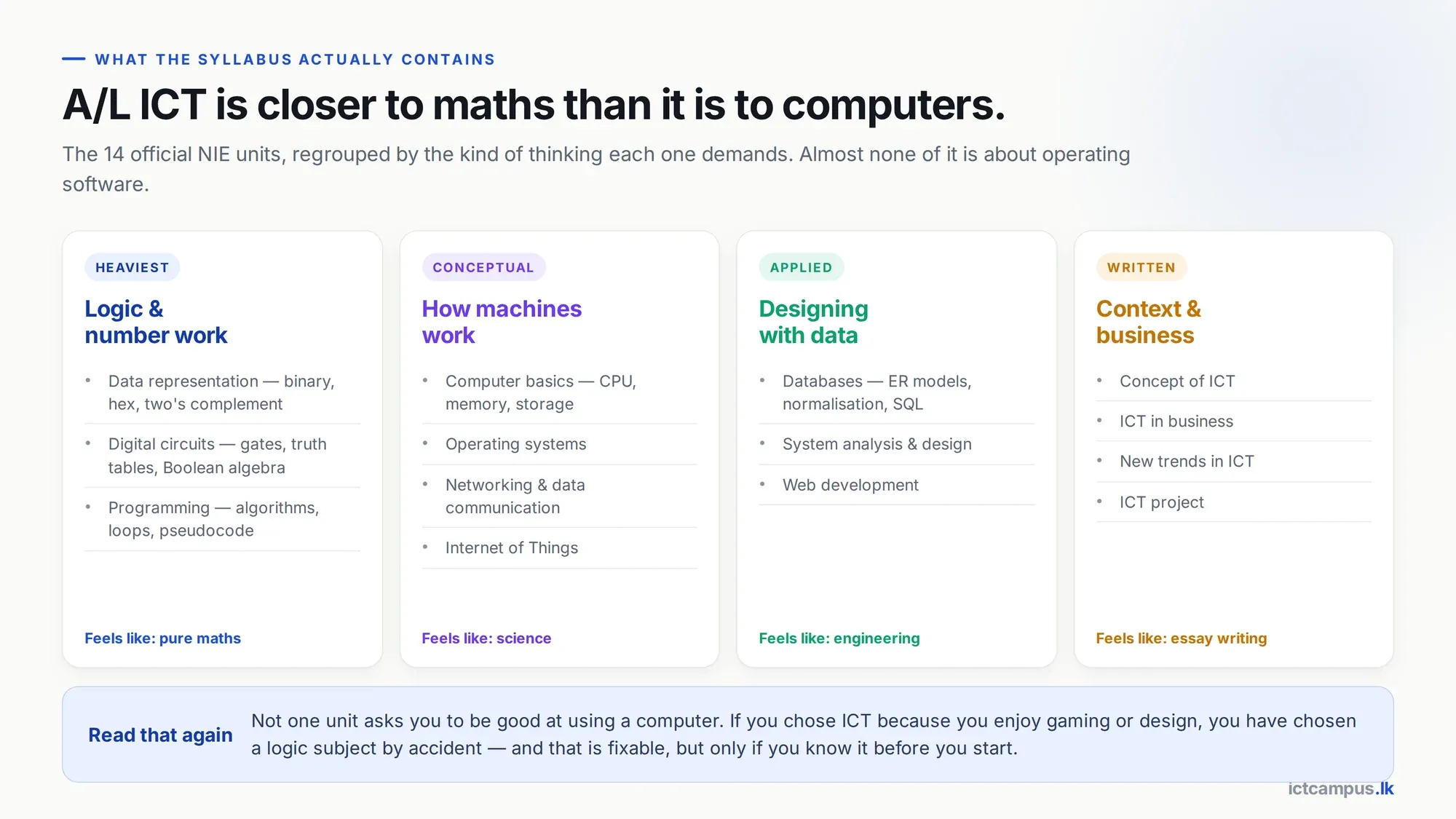
Look carefully at that grouping. The 14 official NIE units break down into four kinds of thinking, and the heaviest one is not computing — it is logic and number work. Two's complement. Truth tables. Boolean algebra. Algorithms and pseudocode.
Not one unit in the syllabus asks whether you are good at using a computer.
This is not a warning to stay away. It is a warning to choose with the right information. Students who go in expecting "computer class" and find pure logic tend to lose confidence in the first term, and confidence is very hard to get back in Grade 13. Students who go in knowing it is a logic subject usually do fine.
If you want to see the full unit list before you decide, it's laid out competency by competency on the ICT Campus syllabus page — all 14 units and 82 competency levels, free to browse without signing up.
Second: the pass rate is lying to you (sort of)
Somebody will tell you that ICT has a high pass rate. They are right. At the most recent A/L with published subject-level results, 37,364 students sat ICT and 77.19% passed.
That sounds encouraging. It is also almost useless as a decision-making number.
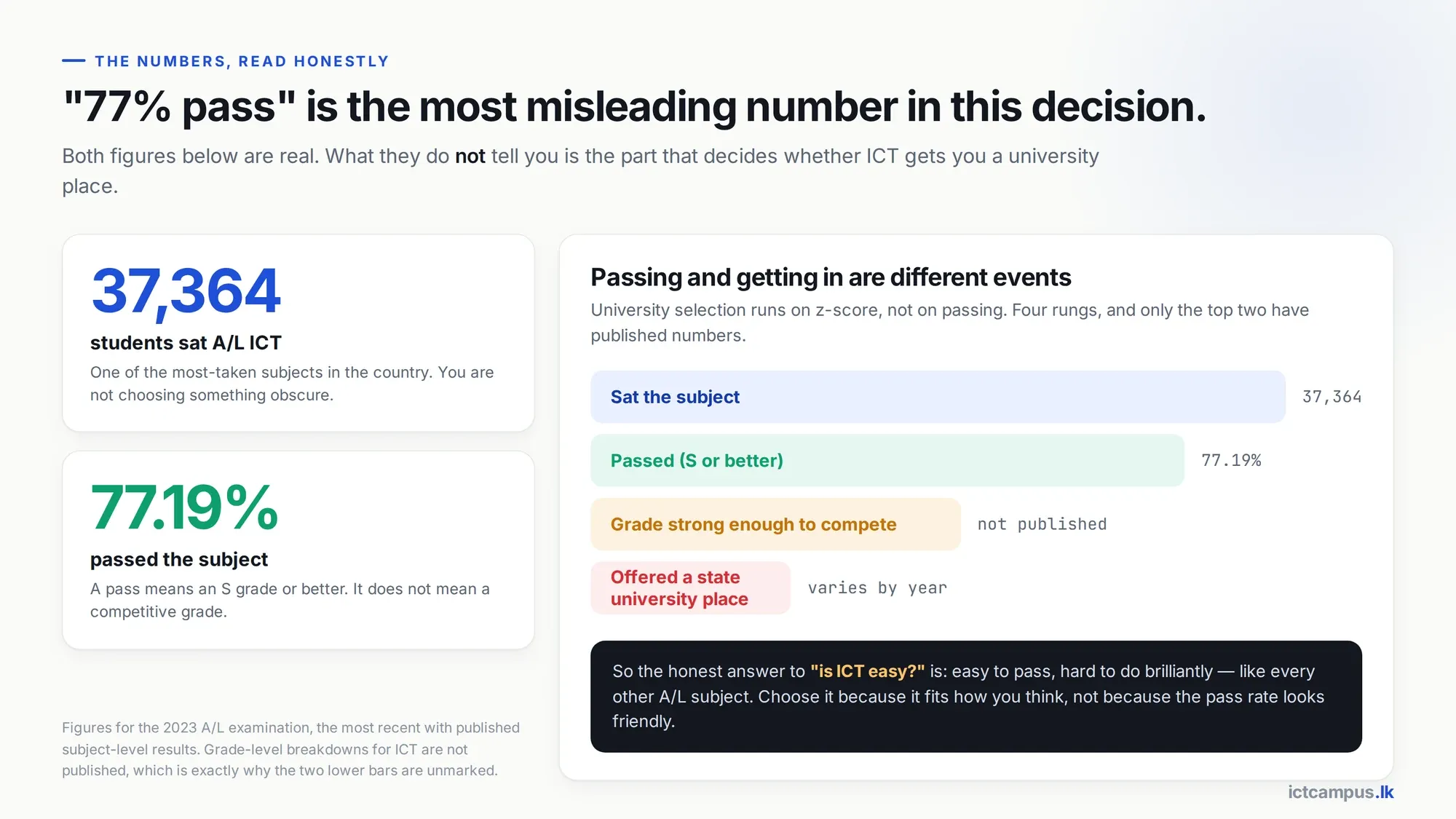
Here is why. A "pass" in the A/L means an S grade or better. But nobody enters a state university on an S grade. University selection runs on your z-score — a ranking against every other student in your stream — not on whether you cleared a pass mark.
So the four rungs look like this: you sit the subject, you pass it, you get a grade strong enough to compete, and then you're offered a place. Only the top two rungs have published numbers. The bottom two — the ones that actually decide your future — vary every year and are not published by subject.
The honest answer to "is ICT easy?" is therefore: easy to pass, hard to do brilliantly. Exactly like every other A/L subject. Anyone who tells you it's an easy A is selling you something.
Third: an honest fit check
Neither of these lists is about being clever. They are about whether the way you naturally enjoy thinking matches what the examiner rewards.
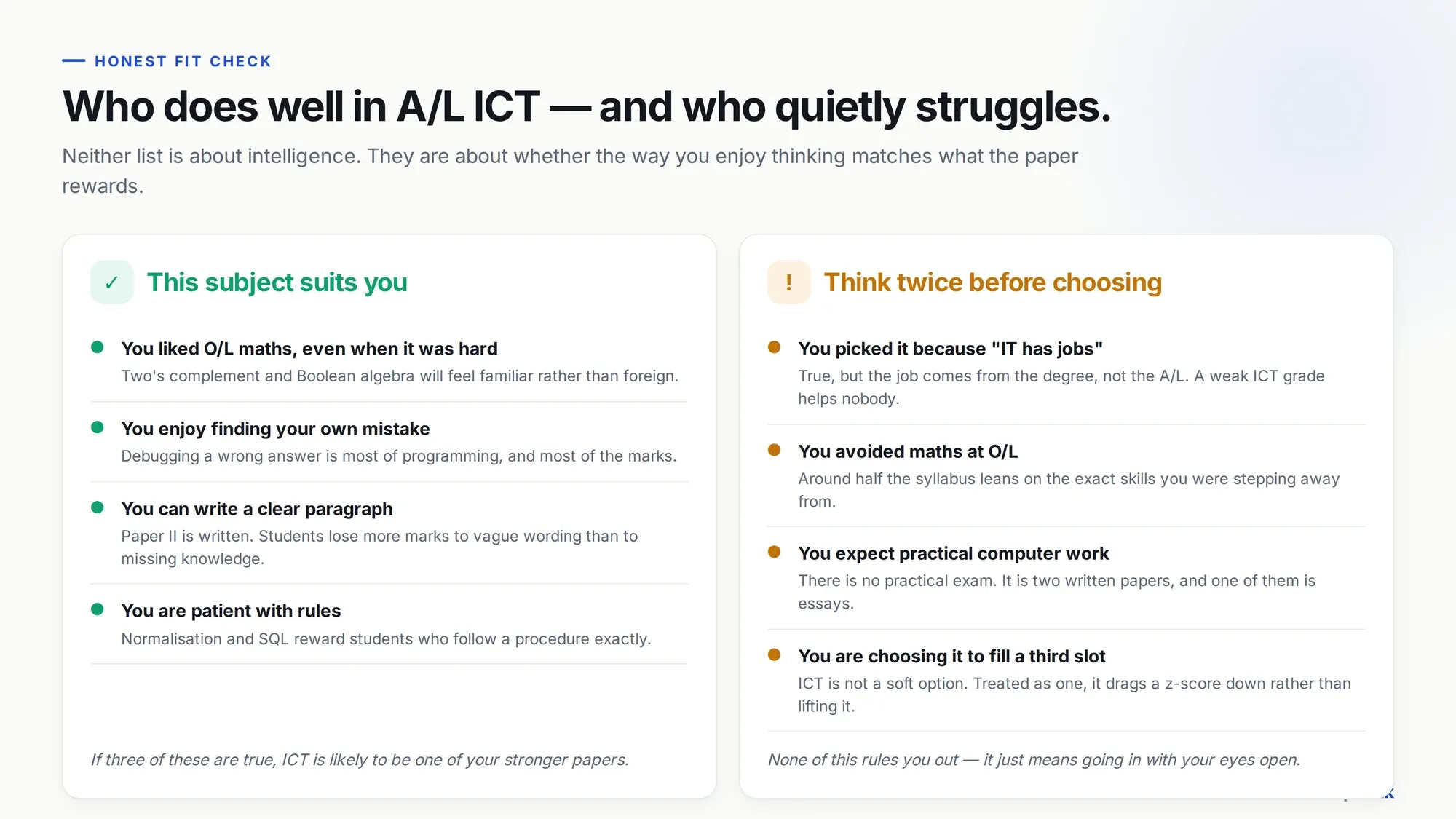
Notice the fourth item on the right-hand list, because it is the one I see most often: choosing ICT to fill a third subject slot. ICT is not a soft option. Treated as one, it pulls a z-score down instead of lifting it.
The test you can do this afternoon
Reading about a subject tells you very little. Doing twenty minutes of it tells you almost everything. So before you commit two years, try these three things. You need paper and a pen. That's all.
1. Convert the number 45 into binary. Then convert 1101 back into decimal. If you have never done this, search it, spend ten minutes learning the method, and try again with 73.
2. Draw a truth table. Two inputs, A and B. Write out every combination of 0 and 1, and work out the output for A AND B, then for A OR B. Four rows. That's it.
3. Write the steps to find the largest of three numbers. Not code — just numbered steps in plain English, precise enough that someone could follow them without asking you a single question.
Now the important part. How did that feel?
If it was satisfying — if getting the right answer felt good and getting it wrong made you want to find the mistake — that feeling is what A/L ICT is, repeated for two years. You will probably enjoy it and do well.
If it felt tedious and pointless, please take that seriously. It does not get more exciting later. It gets more of the same, faster, and with marks attached.
You can try more of these on the free past paper section — real questions, no account needed.
Where ICT can actually take you
Now assume you've done the test and it went well. What does the subject open up?
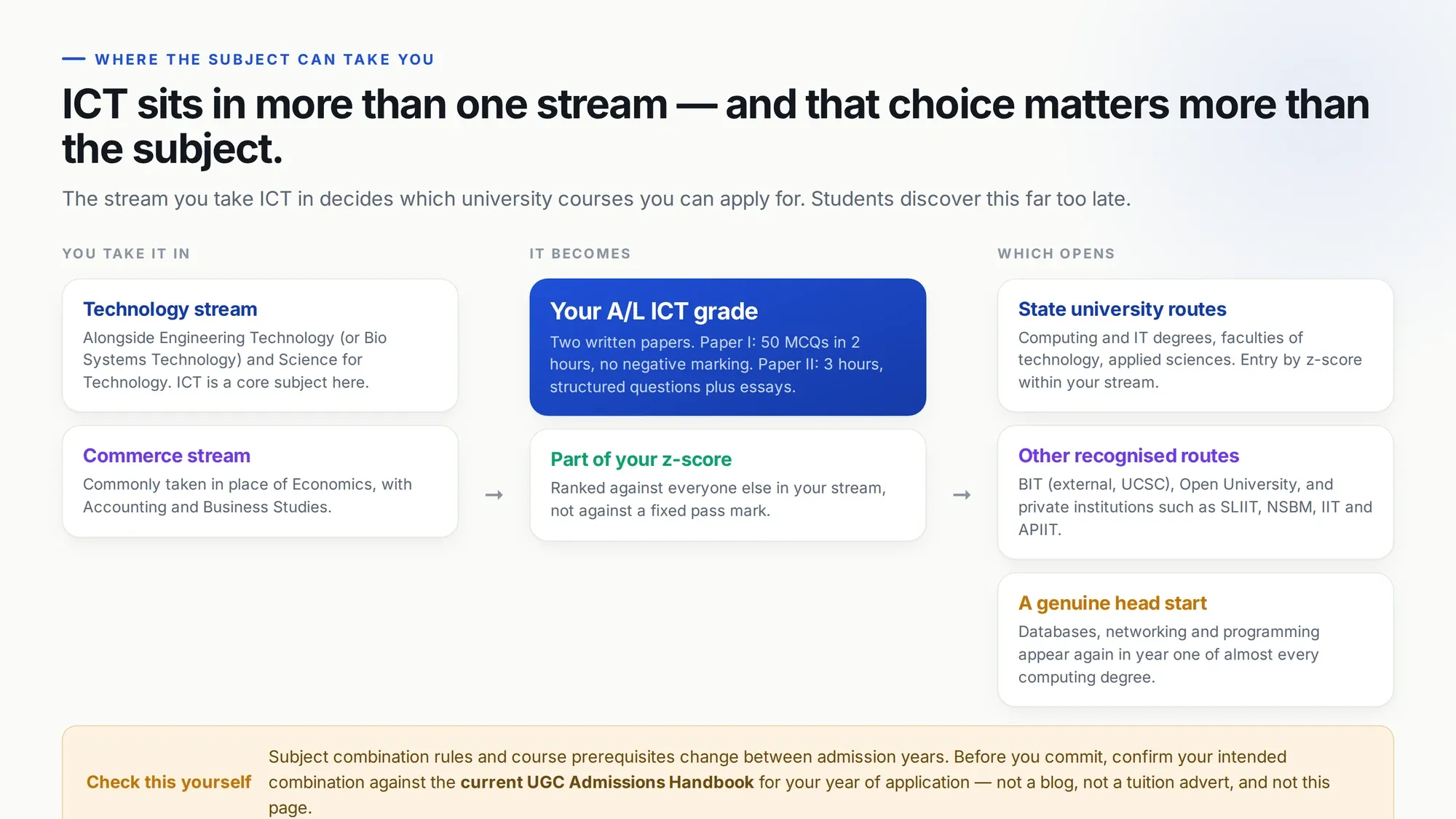
The most important thing on that diagram is on the left, and students consistently underestimate it: the stream you take ICT in matters more than the fact that you took ICT.
ICT in the Technology stream (තාක්ෂණවේදය), sitting alongside Engineering Technology and Science for Technology, points you at a different set of university courses than ICT in the Commerce stream. Both are legitimate. They are not interchangeable, and you cannot easily change your mind in Grade 13.
One more thing, and I want to be very direct about it: combination rules and course prerequisites change between admission years. Do not take a final decision from this article, from a tuition advertisement, or from a friend's older brother. Confirm your intended combination against the current UGC Admissions Handbook for your year of application. It is free and it is the only source that actually governs your application.
What the exam actually looks like
Worth knowing before you choose, because it surprises people:
- Paper I — 2 hours, 50 multiple choice questions, answer all of them. There is no negative marking, which means you should never leave a blank. A guess is worth more than an empty box, always.
- Paper II — 3 hours. Part A is structured questions and you answer all of them. Part B is essays and you choose which to answer.
- There is no practical exam. You will not be marked on using a computer. Both papers are written, with a pen.
That last point catches a lot of students. If you were imagining a subject where you sit at a machine and build things, this is not that subject — at least not at the exam.
Three mistakes students make after choosing ICT
If you do pick it, these are the three things that separate the students who get an A from the students who are equally capable and get a C.
1. Leaving programming until Grade 13. Programming and algorithms cannot be crammed. They are a skill, like playing an instrument — you need reps spread over months, not a marathon in the last term. Start early even when it feels slow.
2. Memorising instead of practising. You can memorise the definition of normalisation. You cannot memorise your way through normalising an unfamiliar table under time pressure. The exam consistently rewards students who have done the thing over students who have read about the thing.
3. Ignoring how Paper II is marked. This is the biggest one, and the most fixable. Marks in Part A and B are awarded against command words — "describe" wants something different from "explain", and "distinguish between" wants something different again. Students who know the content and write the wrong shape of answer lose marks they had genuinely earned. I've written up how each command word is marked, with model answers, in the free command words guide.
So — should you choose it?
Here is the short version.
Choose ICT if you enjoyed O/L maths even when it was difficult, you like finding your own mistakes, you can write a clear paragraph, and the afternoon test above felt good rather than tedious.
Think harder if you're picking it because IT has jobs, because you like computers, or because you need a third subject and it looks manageable. Those three reasons produce most of the students who regret the choice in Grade 13.
And if you're still genuinely unsure after all that, the useful move is not to read another article. It is to sit through two or three real lessons on actual syllabus content and see how your brain responds. That costs you an evening and tells you more than a month of asking people.
Try it before you decide
I teach A/L ICT online at ICT Campus — all 14 NIE units, Sinhala medium and English, taught live and recorded. The notes, past papers, command word guides and unit breakdowns are permanently free, no account required. Live classes are Rs 2,500 a month with the first 7 days free and no card needed to start.
If you're deciding on subjects right now, use the free material first. Read a unit, try a past paper, and see how it feels before you spend a rupee.
Browse the free notes and past papers at ictcampus.lk →
Enrollment for the 2027 A/L cohort is open now — read the full announcement: ICT Campus Launches Sri Lanka's Live, Island-Wide A/L ICT Class for the 2027 Cohort.
Frequently asked questions
Is A/L ICT easy?
It is easier to pass than many A/L subjects — 77.19% of the 37,364 students who sat it at the most recent A/L passed. But passing is not the same as scoring well. University entry depends on your z-score, which ranks you against other students, not on clearing a pass mark. ICT is easy to pass and hard to do brilliantly, like every other A/L subject.
Do I need to be good at maths to do A/L ICT?
You do not need to take maths as a subject, but you need to be comfortable with mathematical thinking. Data representation (binary, hexadecimal, two's complement), digital circuits (logic gates, Boolean algebra) and programming all use the same kind of reasoning as O/L maths. Students who actively disliked O/L maths often find the heaviest units of ICT difficult.
Which stream can I take ICT in?
ICT is a core subject in the Technology stream, taken with Engineering Technology (or Bio Systems Technology) and Science for Technology. It is also commonly taken in the Commerce stream, often in place of Economics. The stream you choose affects which university courses you can later apply for, so confirm your intended combination against the current UGC Admissions Handbook for your year of application.
Is there a practical exam for A/L ICT?
No. A/L ICT is assessed by two written papers. Paper I is 2 hours with 50 multiple choice questions and no negative marking. Paper II is 3 hours, with structured questions in Part A and essay questions in Part B. You are never marked on operating a computer.
What can I study after A/L ICT?
A/L ICT supports applications to state university computing and IT degrees, faculties of technology and applied sciences, subject to your z-score and stream. Other recognised routes include the BIT external degree from UCSC, the Open University, and private institutions such as SLIIT, NSBM, IIT and APIIT. Databases, networking and programming from the A/L syllabus reappear in the first year of most computing degrees.
Is there negative marking in A/L ICT Paper I?
No. Paper I has 50 multiple choice questions with no negative marking, so you should never leave an answer blank. An informed guess costs nothing and an empty box guarantees zero.
Sources
- Performance of candidates at the A/L examination, The Morning — ICT candidate numbers and pass rate.
- 2026 GCE A/L timetable — examination period 10 August to 5 September 2026.
- Department of Examinations (doenets.lk) and the UGC Admissions Handbook — the authoritative sources for exam structure and university entry requirements.
- NIE A/L ICT syllabus, unit by unit — ICT Campus.
Dr Yasas Sri Wickramasinghe teaches A/L ICT at ICT Campus. He holds a PhD in Human Interface Technology from the University of Canterbury, has taught ICT for over a decade, and previously worked as a technical lead and senior software engineer.
Related reading: After A/L ICT Results: The Sri Lanka Degree & Career Guide — what happens after the exam, and the same guide in Sinhala.


