

The question I get asked most by A/L ICT students isn't about Python, or subnetting, or why a NAND gate is called universal. It's this one, usually sent late at night:
"Sir, what Z-score do I need for IT?"
It's a fair question, and the honest answer is a little annoying. It depends on which degree, which university, which district you apply from, and how tens of thousands of other students do on the same papers as you.
But "it depends" isn't much use when you're seventeen and trying to decide how hard to push this year. So I went through the University Grants Commission's own cut-off tables for the last eight rounds and pulled out what matters to an ICT student. This is what I found, and what I'd do with it if I were sitting A/L ICT in 2027.
The short version
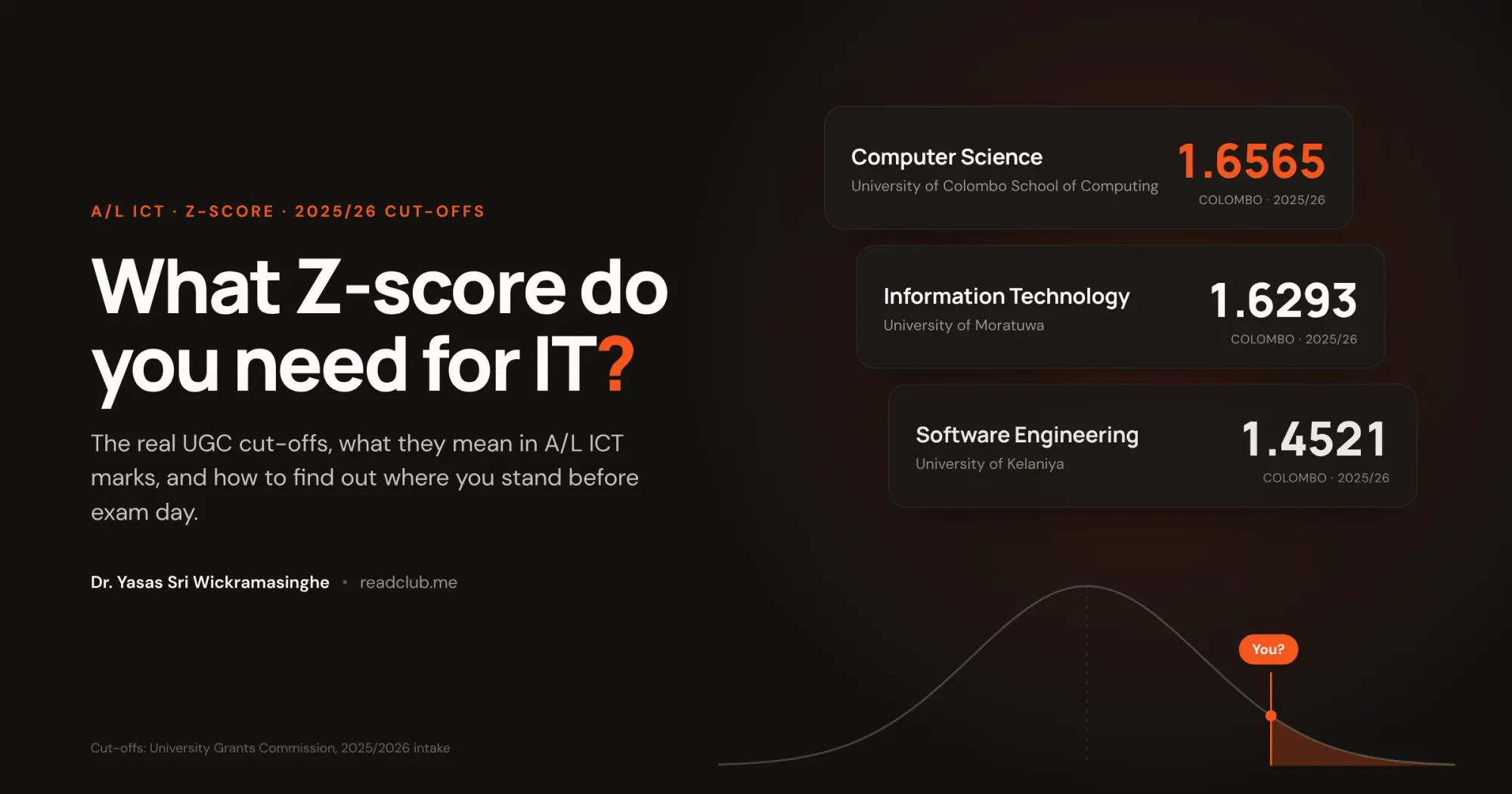
- Last round (the 2025/26 intake), Computer Science at UCSC needed a Z-score of 1.6565 in Colombo district. IT at Moratuwa needed 1.6293, Software Engineering at Kelaniya 1.4521, and Information Systems at UCSC 1.7912.
- The district matters as much as the degree. IT at Moratuwa ranged from 1.2123 in Polonnaruwa to 1.7024 in Matara in the same year.
- A Z-score of 1.6 in a subject means finishing ahead of roughly 95 out of every 100 students who sat it.
- Nobody can turn your raw marks into a Z-score before results. What you can measure, months earlier, is where you rank.
සිංහලෙන් කෙටියෙන්
Z-score එක කියන්නේ ඔයාට ලැබුණ marks ගාන නෙවෙයි. ඒ subject එක ලියපු අනිත් හැමෝටම වඩා ඔයා කොච්චර ඉස්සරහින්ද කියන එක. පහුගිය round එකේ (2025/26) කොළඹ district එකට UCSC Computer Science cut-off එක 1.6565යි, Moratuwa IT 1.6293යි. Z-score 1.6ක් කියන්නේ exam hall එකේ ළමයි 100න් 95කට විතර වඩා ඉස්සරහින් ඉන්න එක. ඉතින් exam එකට කලින් ඔයා අනිත් අයට සාපේක්ෂව කොහෙද ඉන්නේ කියලා දැනගන්න එක තමයි වැදගත්ම දේ.
First, what a Z-score actually is
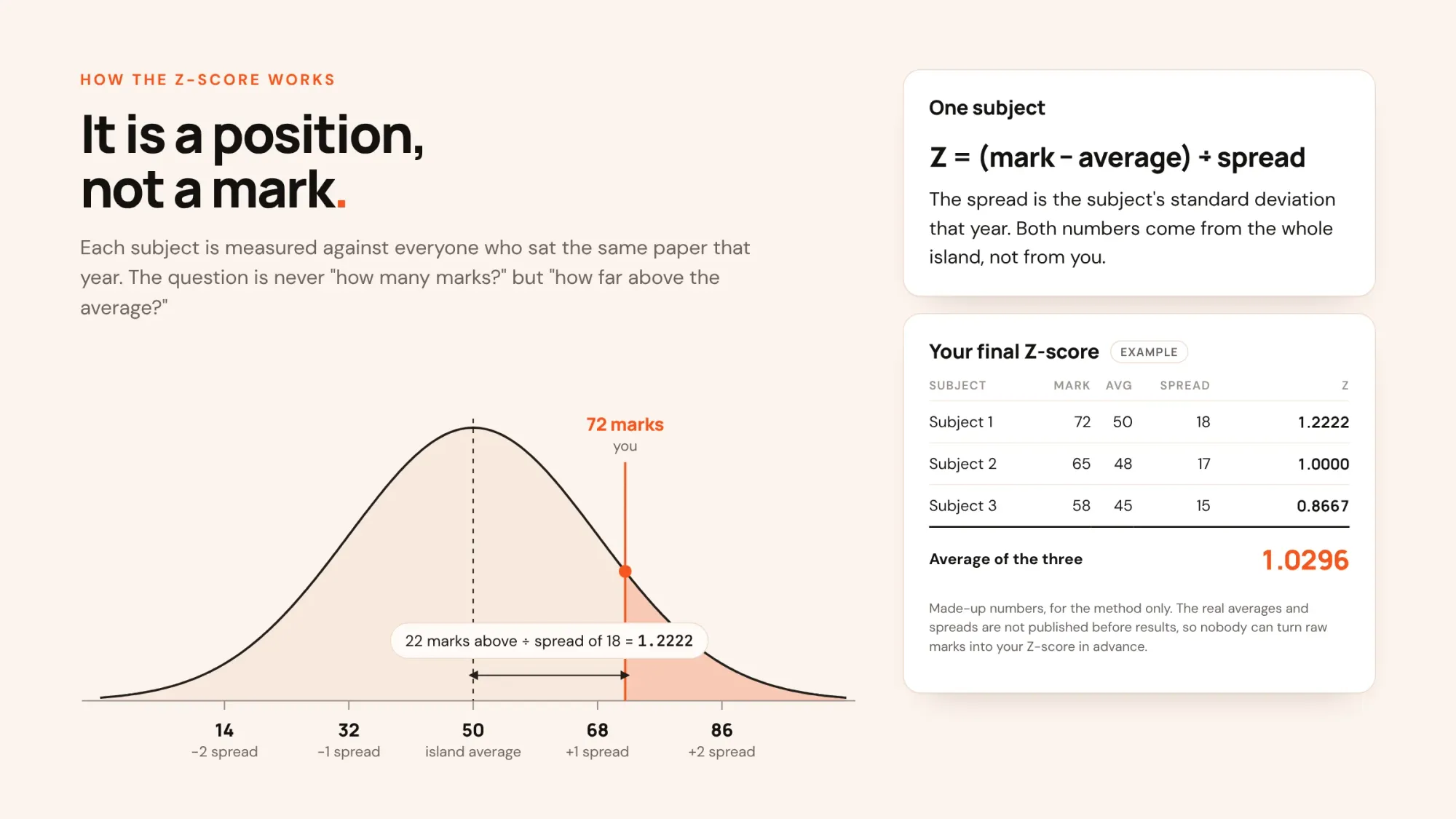
Most students think of the Z-score as a kind of total. It isn't. It's a position.
For each subject, your mark is compared with the island-wide average for that paper, and the difference is divided by the spread of marks that year (the standard deviation). The answer says how far above or below the middle you finished. Do that for all three subjects, average the three numbers, and you have the Z-score printed on your results sheet, to four decimal places.
Two things follow from this, and both matter more than they look.
First, the same mark can give a different Z-score in a different year. A 72 in a hard year is worth more than a 72 in an easy one.
Second, nobody can convert your raw marks into a Z-score before the results come out, because the averages and spreads aren't published in advance. The online "Z-score calculators" that ask for your marks are guessing those numbers. If you want the arithmetic laid out step by step, I wrote a plain explainer on how the A/L Z-score is calculated.
The real cut-offs for IT and computing degrees (2025/26)
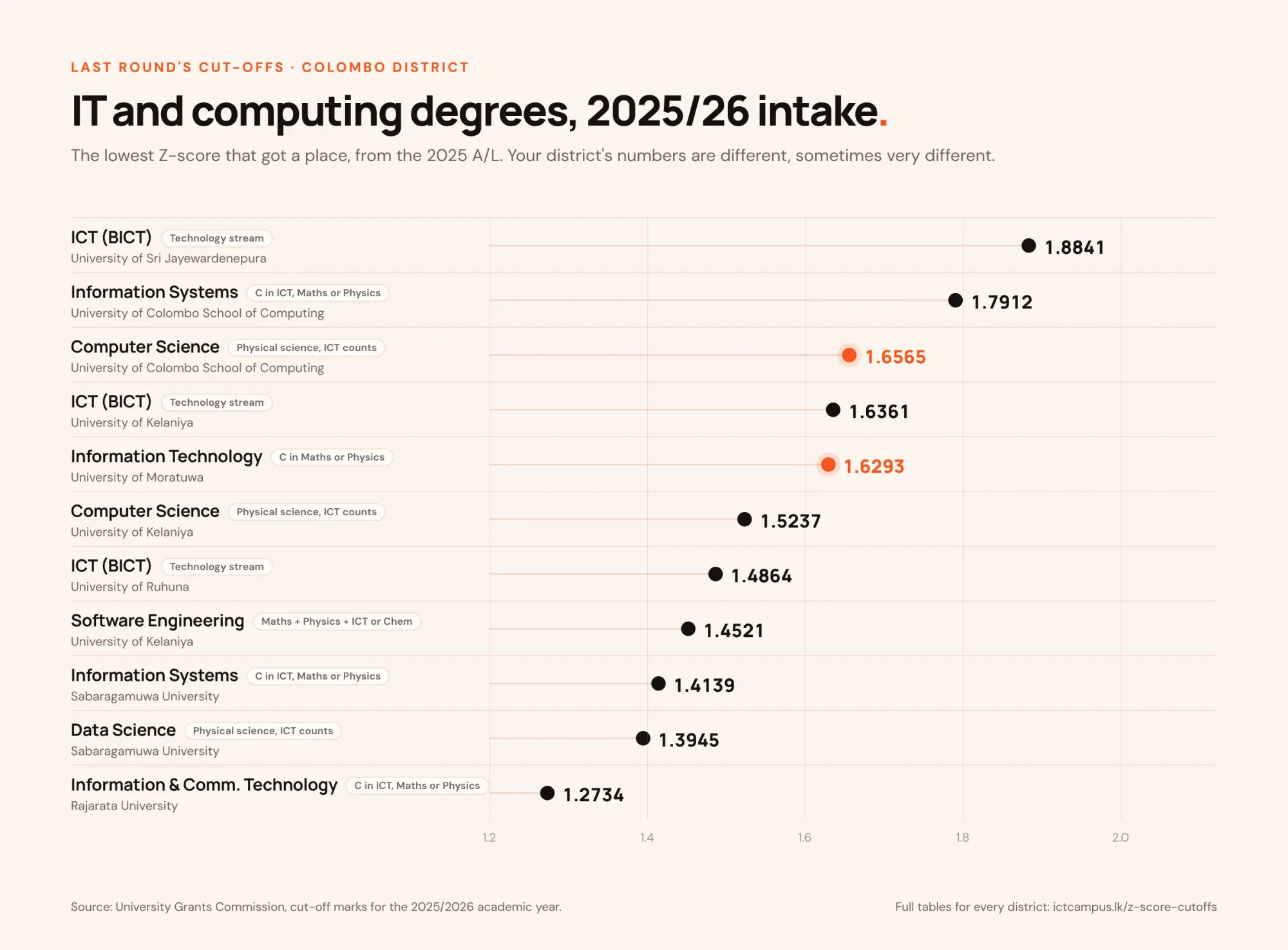
Here are last round's numbers. They're for the 2025/26 intake, based on the 2025 A/L after re-scrutiny, and they're for Colombo district because that's the one people ask me about most.
| Degree and university | Cut-off |
|---|---|
| ICT (BICT) University of Sri Jayewardenepura | 1.8841 |
| Information Systems University of Colombo School of Computing | 1.7912 |
| Computer Science University of Colombo School of Computing | 1.6565 |
| ICT (BICT) University of Kelaniya | 1.6361 |
| Information Technology University of Moratuwa | 1.6293 |
| Computer Science University of Kelaniya | 1.5237 |
| ICT (BICT) University of Ruhuna | 1.4864 |
| Software Engineering University of Kelaniya | 1.4521 |
| Information Systems Sabaragamuwa University of Sri Lanka | 1.4139 |
| Data Science Sabaragamuwa University of Sri Lanka | 1.3945 |
| Information and Communication Technology Rajarata University of Sri Lanka | 1.2734 |
A few things jumped out when I went through the full tables.
Your district changes everything. Information Technology at Moratuwa needed 1.6293 in Colombo. The same degree, in the same year, needed 1.2592 in Nuwara Eliya and 1.7024 in Matara. That isn't a rounding error. It's the difference between comfortably in and not close. Look up your own district, not your cousin's in Colombo. Every course and every district is listed on the Z-score cut-off pages, straight from the UGC's tables.
A good ICT result can be the key subject. Information Systems at UCSC, and the ICT degrees at Rajarata and Vavuniya, ask for at least a C in Combined Maths, Physics or ICT, plus S passes in two other subjects (and credit passes in English and Maths at O/L). A lot of students don't realise ICT alone can meet that requirement.
Technology stream students have their own route. The BICT degree, offered at nine universities, takes ICT together with SFT and ET or BST. Sri Jayewardenepura was the most competitive last round at 1.8841 in Colombo. Ruhuna was 1.4864 and Uva Wellassa 1.4152.
In the physical science stream, ICT counts, but maths still leads. Computer Science needs at least a C in Combined Maths, Physics or Higher Maths, and ICT can be one of your other two subjects. Software Engineering at Kelaniya wants Combined Maths, Physics, and ICT or Chemistry. Moratuwa's IT degree needs a C in a maths subject or Physics.
Requirements change from year to year, so read the current UGC handbook before you decide anything (it's linked at the end). And if you're still deciding whether to take ICT at all, I wrote an honest guide to choosing A/L ICT, including who shouldn't.
Why last year's number isn't your number
A cut-off is simply the Z-score of the last student who got in. It moves with how many people applied, how well everyone did, how many places there were, and the order students listed their preferences in.
Here's one course, from one district, over eight rounds:
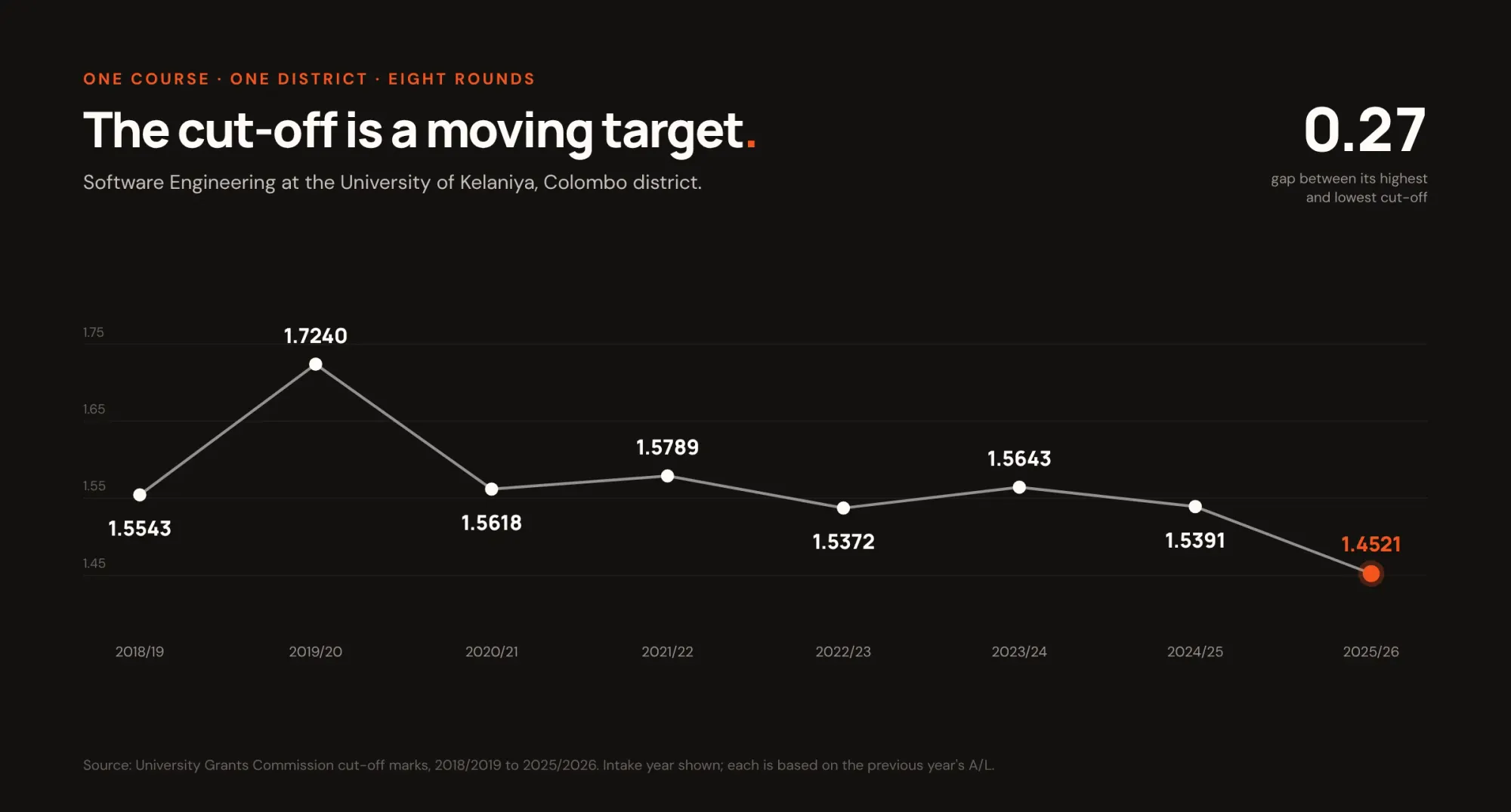
It jumped to 1.7240 for the 2019/20 intake and fell to 1.4521 last round. If you'd planned around either number, you'd have been out by a long way. What I tell students is simple: write down the cut-off for the last three rounds, in your district, and aim above the highest of the three. For Software Engineering at Kelaniya in Colombo, that means aiming above 1.5643, not 1.4521.
So what does 1.6 mean for your ICT marks?
This is where most advice goes vague, so let me be as concrete as I honestly can.
I can't tell you that 75 marks equals 1.6. Nobody can, for the reason above. What I can tell you is what 1.6 means as a position. If a subject's marks follow the usual bell shape, a Z-score of 1.6 puts you ahead of roughly 95 out of every 100 students who sat that paper.
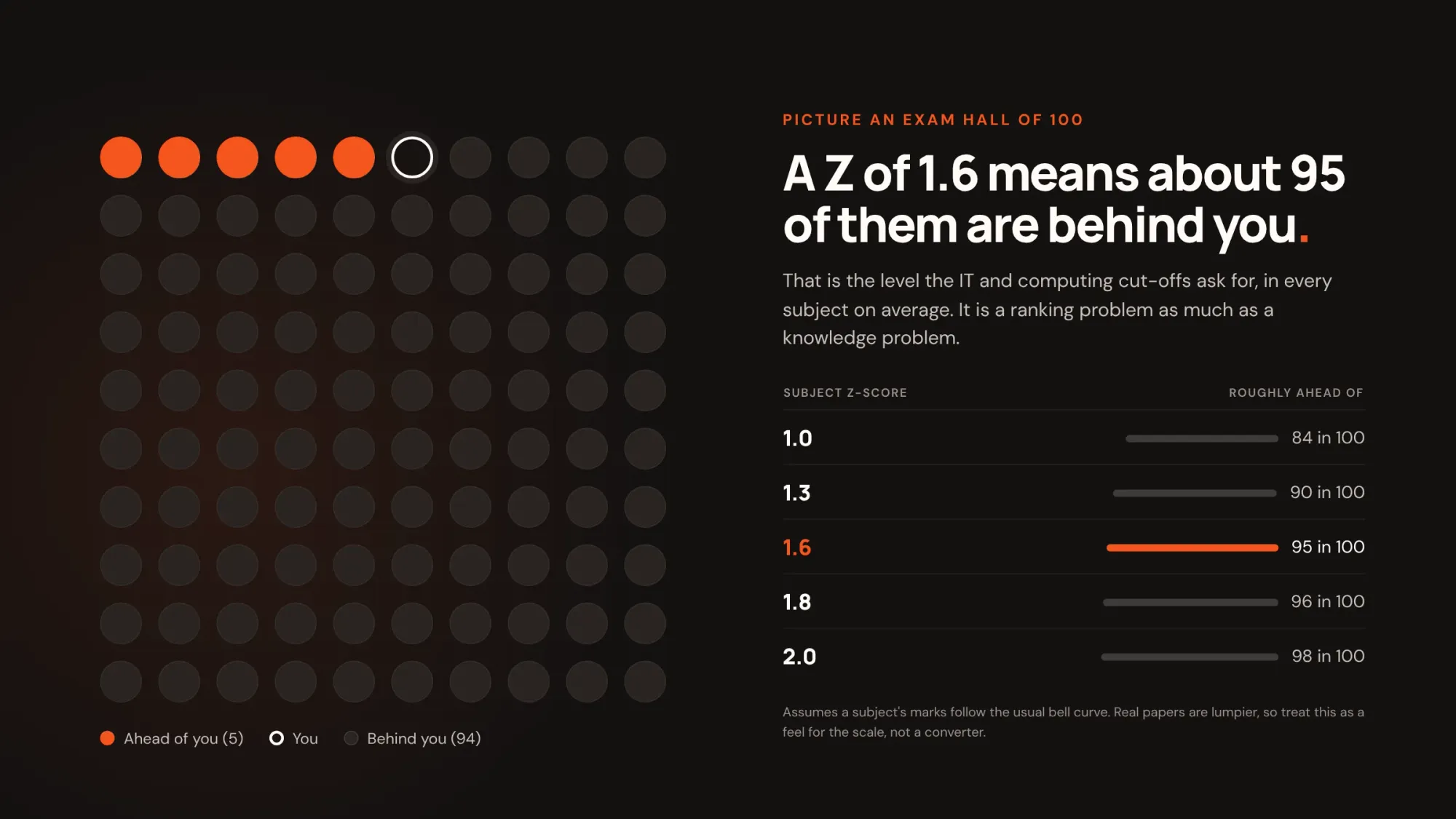
Because your final Z-score is the average of three subjects, you don't need 1.6 in every one. A very strong ICT result can pull up a weaker subject, and the reverse is true too. But averaged out, most of the IT cut-offs above are asking you to finish somewhere in the top five to eight percent.
That changes how you should practise. "Good at ICT" isn't the target. Better at it than nearly everyone else sitting it is. And the marks that separate those two groups are rarely in the topics students worry about.
In Paper I, 50 multiple-choice questions in two hours, the gap is usually a handful of questions that look easy and aren't. Try these two from the 2027 predicted paper before you open the answers.
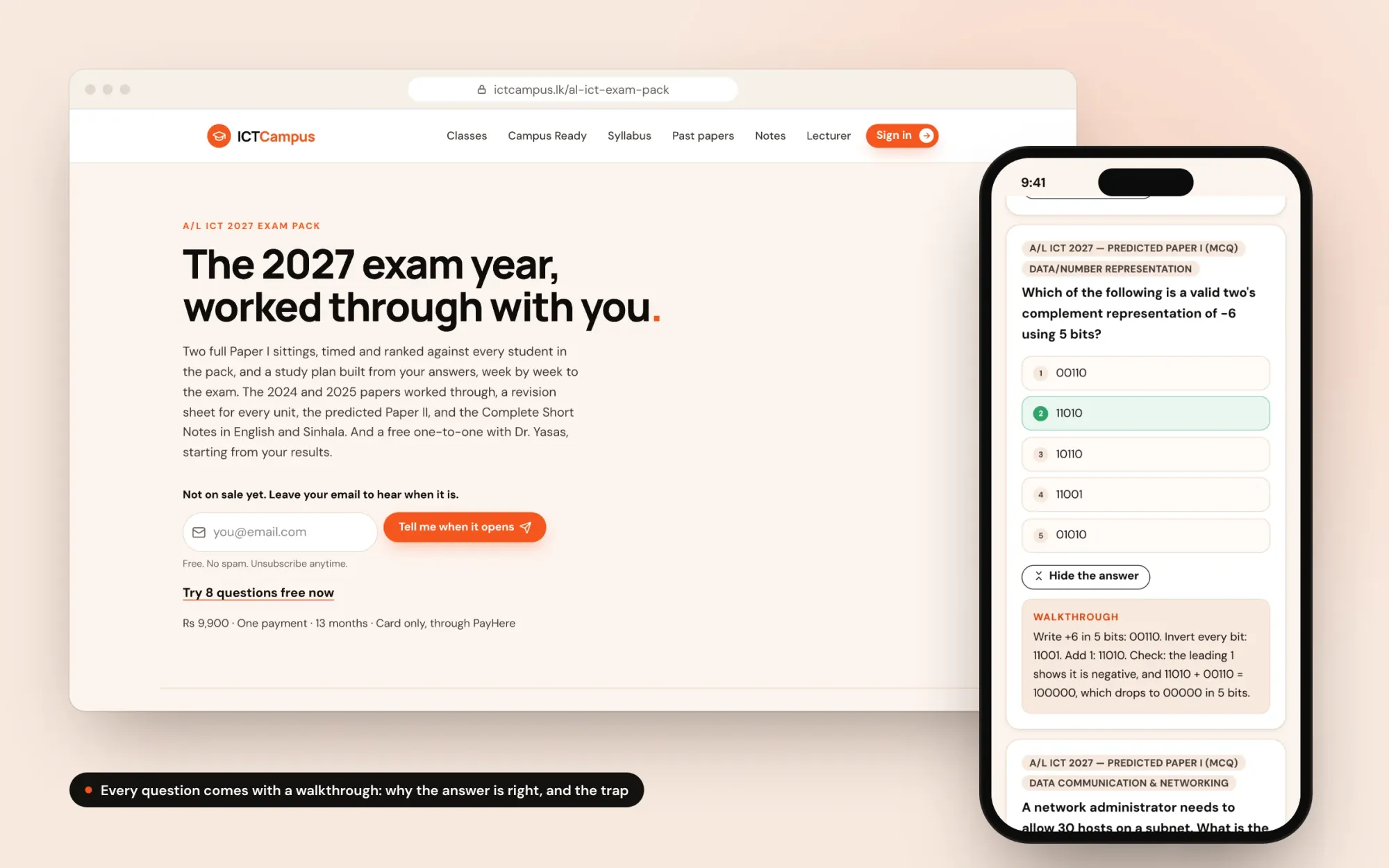
1. Which of the following is a valid two's complement representation of −6 using 5 bits?
(1) 00110 (2) 11010 (3) 10110 (4) 11001 (5) 01010
Show the answer
(2) 11010. Write +6 in 5 bits: 00110. Invert every bit: 11001. Add 1: 11010. Option (4) is the trap: it's only the inverted step, the one's complement.
2. A network administrator needs to allow 30 hosts on a subnet. What is the minimum subnet mask (in CIDR notation) that satisfies this?
(1) /24 (2) /26 (3) /27 (4) /28 (5) /30
Show the answer
(3) /27. A /27 leaves 5 bits for hosts: 2⁵ = 32 addresses. Take away the network and broadcast addresses and you have exactly 30 usable hosts. A /28 gives only 14.
Paper II is a different animal: three hours plus ten minutes of reading time, four compulsory structured questions in Part A, and four essays out of six in Part B. This is where good students quietly lose ten or fifteen marks by writing correct answers that don't hit the marking points. It's a separate skill, and it only improves when you check your answers against real marking schemes.
The one thing you can measure before exam day
Here's the problem with all of the above. The Z-score is a ranking, but almost nothing a student does during the year tells them where they rank.
A school term test ranks you against your class. A tuition paper ranks you against the people in that hall. A past paper done at home ranks you against nobody. Then results day arrives and you find out, for the first time, where you stood against the whole country.
That gap is the reason I built the A/L ICT 2027 Exam Pack the way I did. It works in a fixed order: papers first, then a plan, then a person.
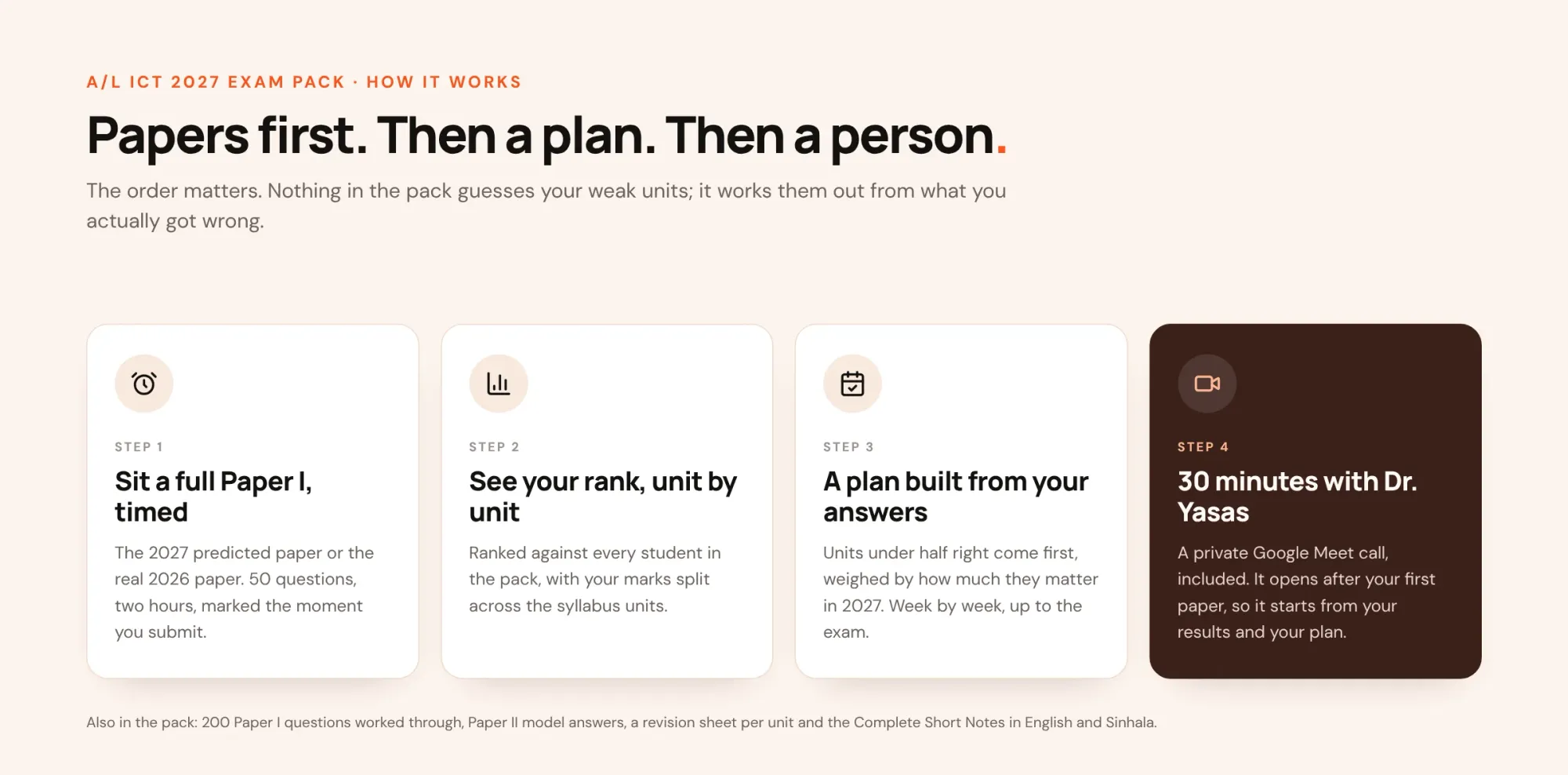
The heart of it is two full Paper I sittings, timed at two hours like the real thing: the 2027 predicted paper and the actual 2026 paper. The clock runs on the server, so refreshing the page doesn't buy you time, and your answers save as you go, so a phone that dies on question 48 still gets marked. The paper is marked the moment you submit, and you're ranked against every student who has the pack. Only your first attempt is ranked, so the number means something.
Here's what that looks like from a demo student's account, halfway through the 2027 predicted paper and then straight after submitting it:
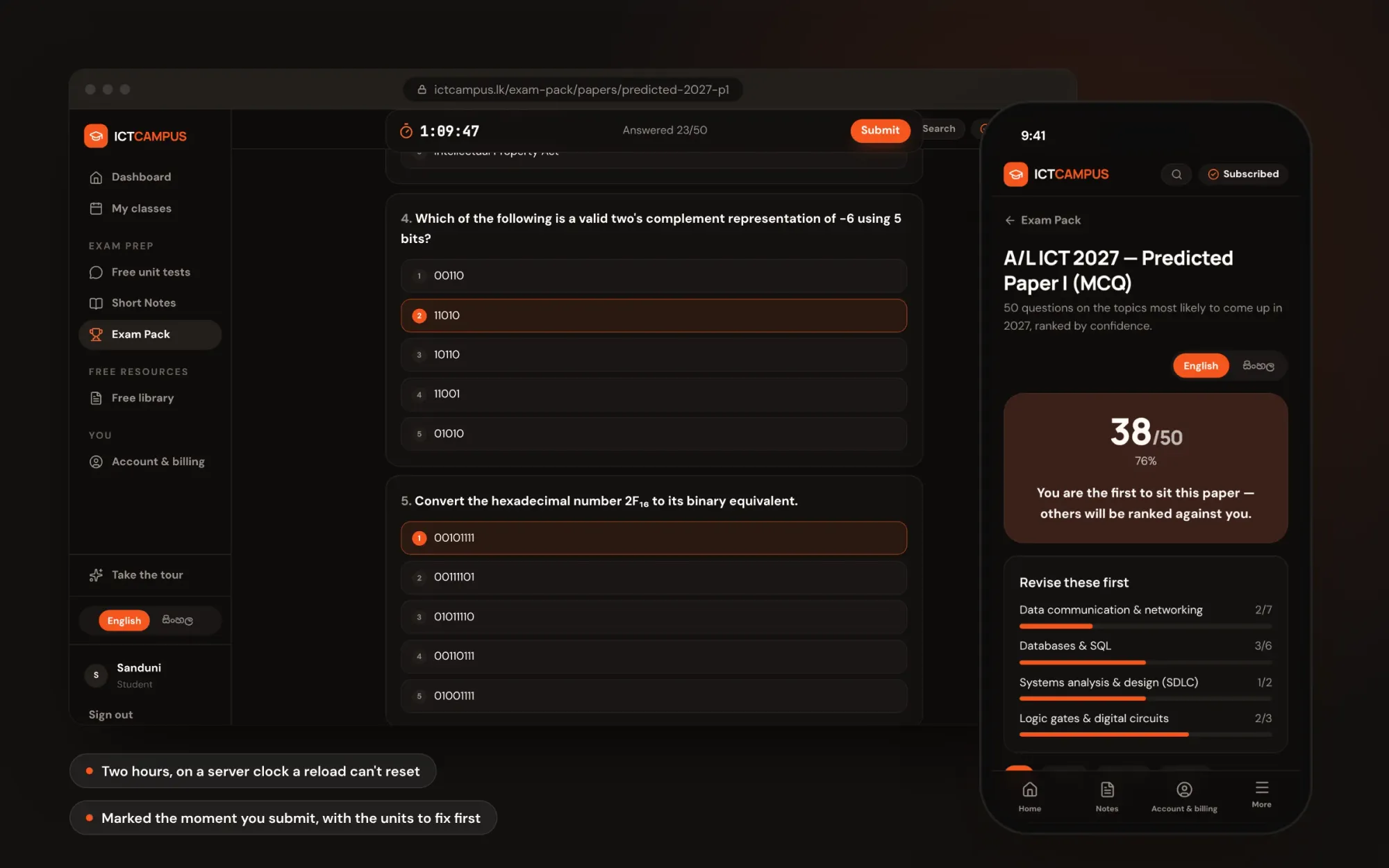
Notice what the result screen leads with. Not the score, the units. This student got 38 out of 50, which feels fine, until you see 2 out of 7 on data communication and networking. That's the kind of gap a Z-score punishes and a total hides.
Then the pack does the part I care about most. It reads your answers unit by unit, finds the units costing you the most marks, weighs them by how much they're likely to matter in 2027, and lays out a week-by-week plan from now to the exam. Anything you got less than half right goes first.
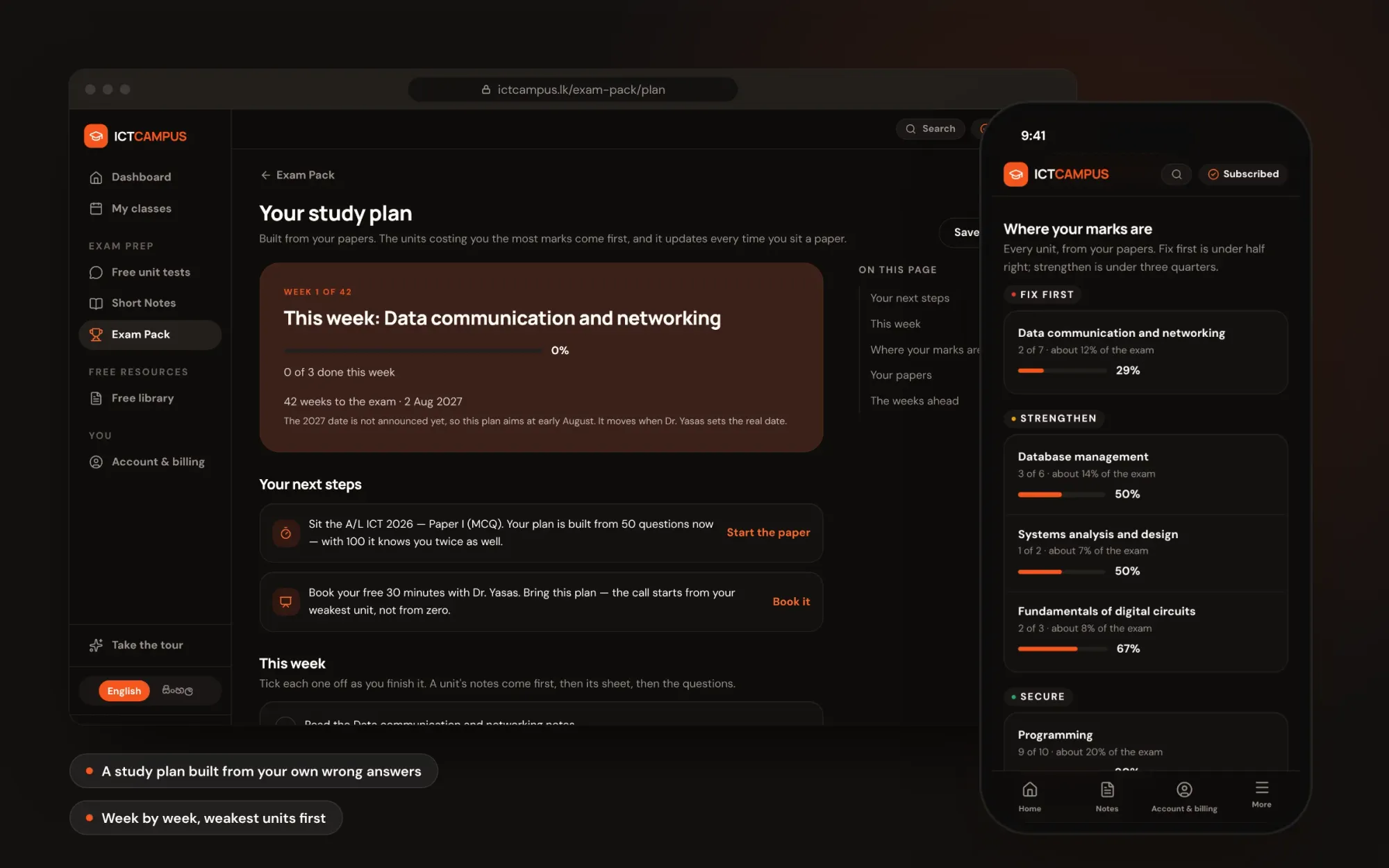
After your first paper you can book a free 30-minute call with me on Google Meet, straight from the app. It only opens after a paper on purpose. I'd rather spend those thirty minutes on your actual results than on "where should I start?"
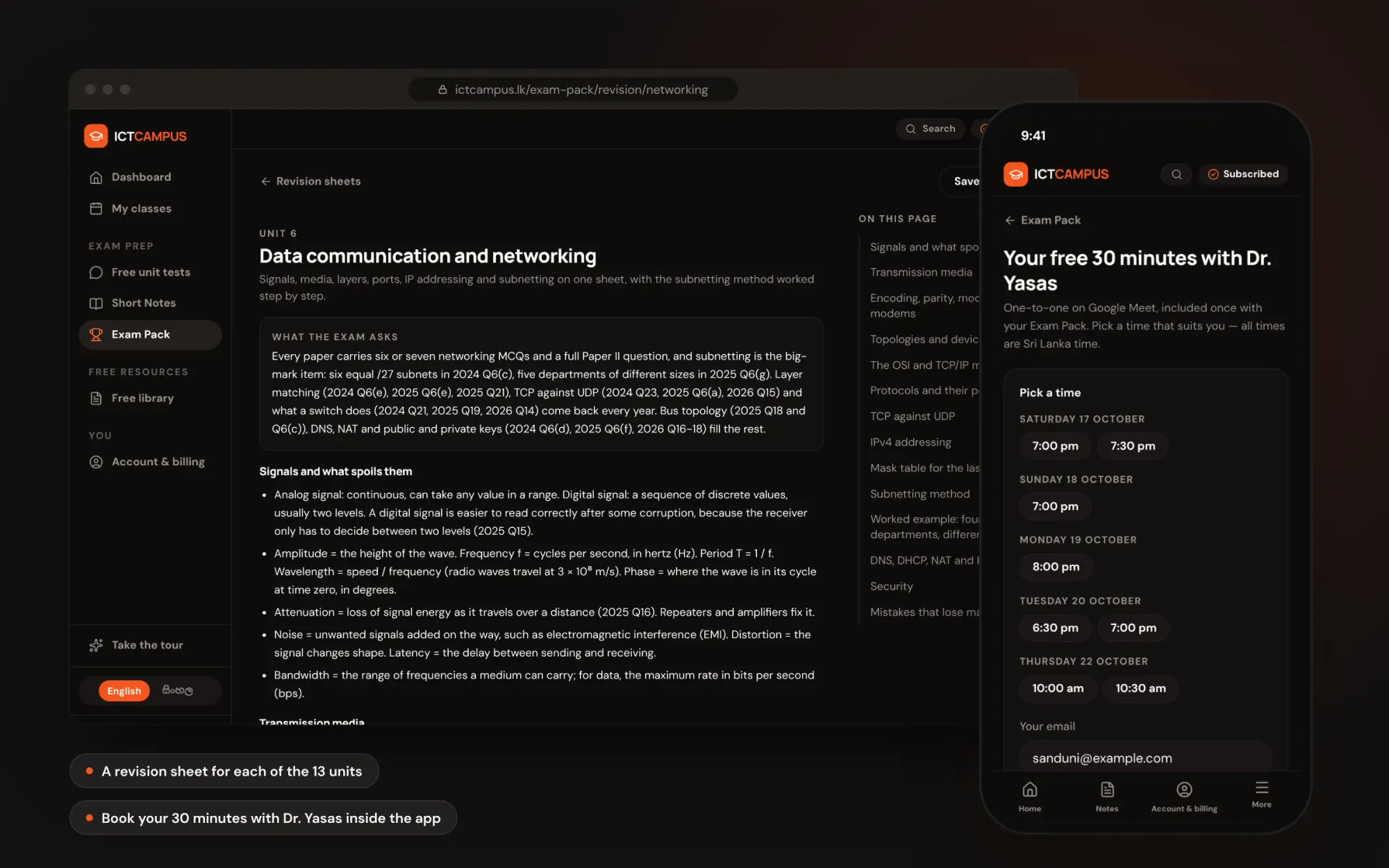
Everything else in the pack is there to support that loop:
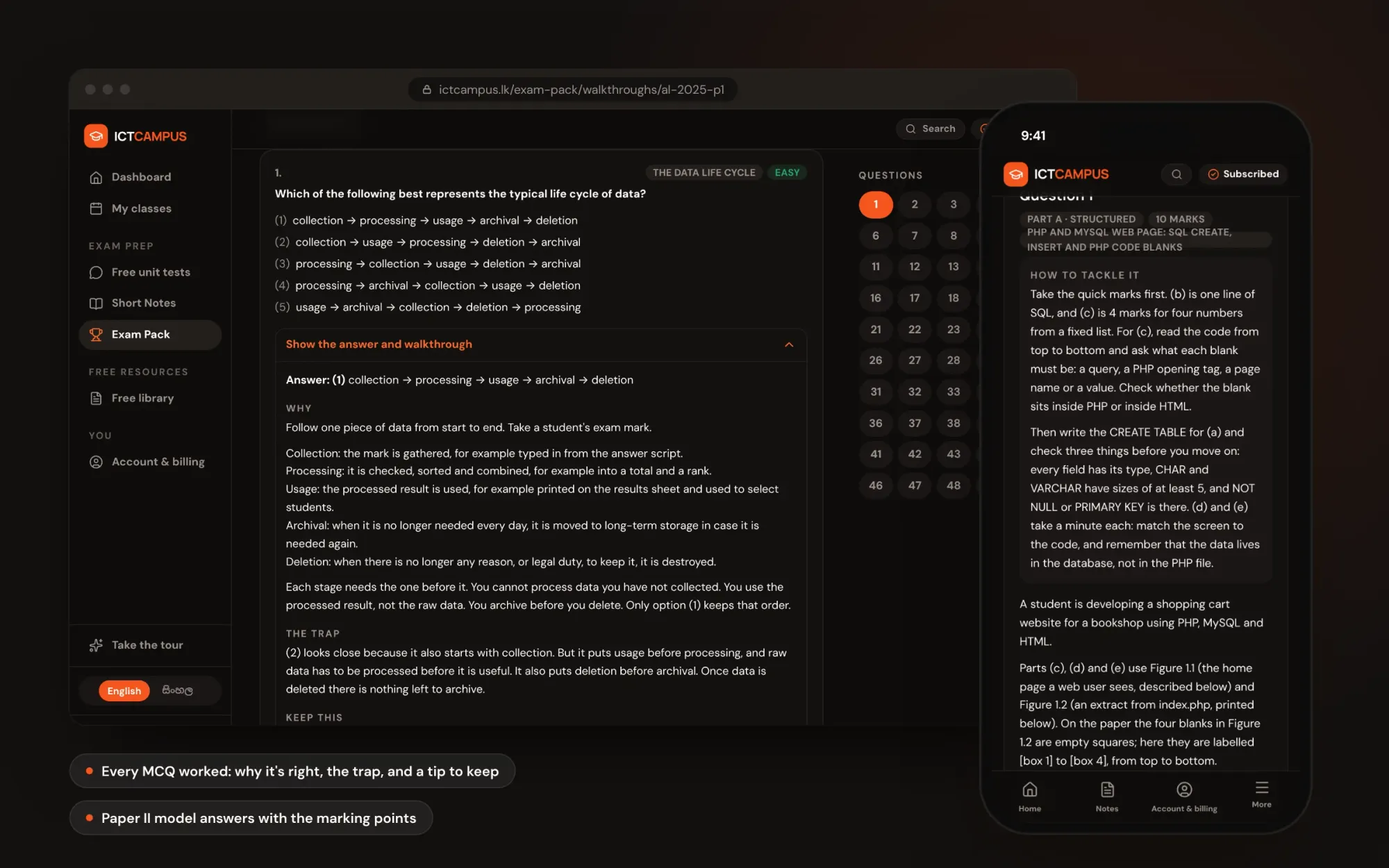
- 200 Paper I questions worked through, from the 2027 predicted, 2026, 2025 and 2024 papers, each with why the answer is right, the trap in the option that catches people, and a tip to keep
- Model answers for the 2024 and 2025 Paper IIs, with the marking points behind every mark, plus a predicted 2027 Paper II with its mark scheme
- A revision sheet for each of the 13 examined units, and an exam-day plan that times both papers minute by minute
- The Complete Short Notes: every examined lesson in English and Sinhala, with each unit drawn on one page as a mind map
- Print-ready PDFs of every paper with your name on them, for when you'd rather sit it on paper at home
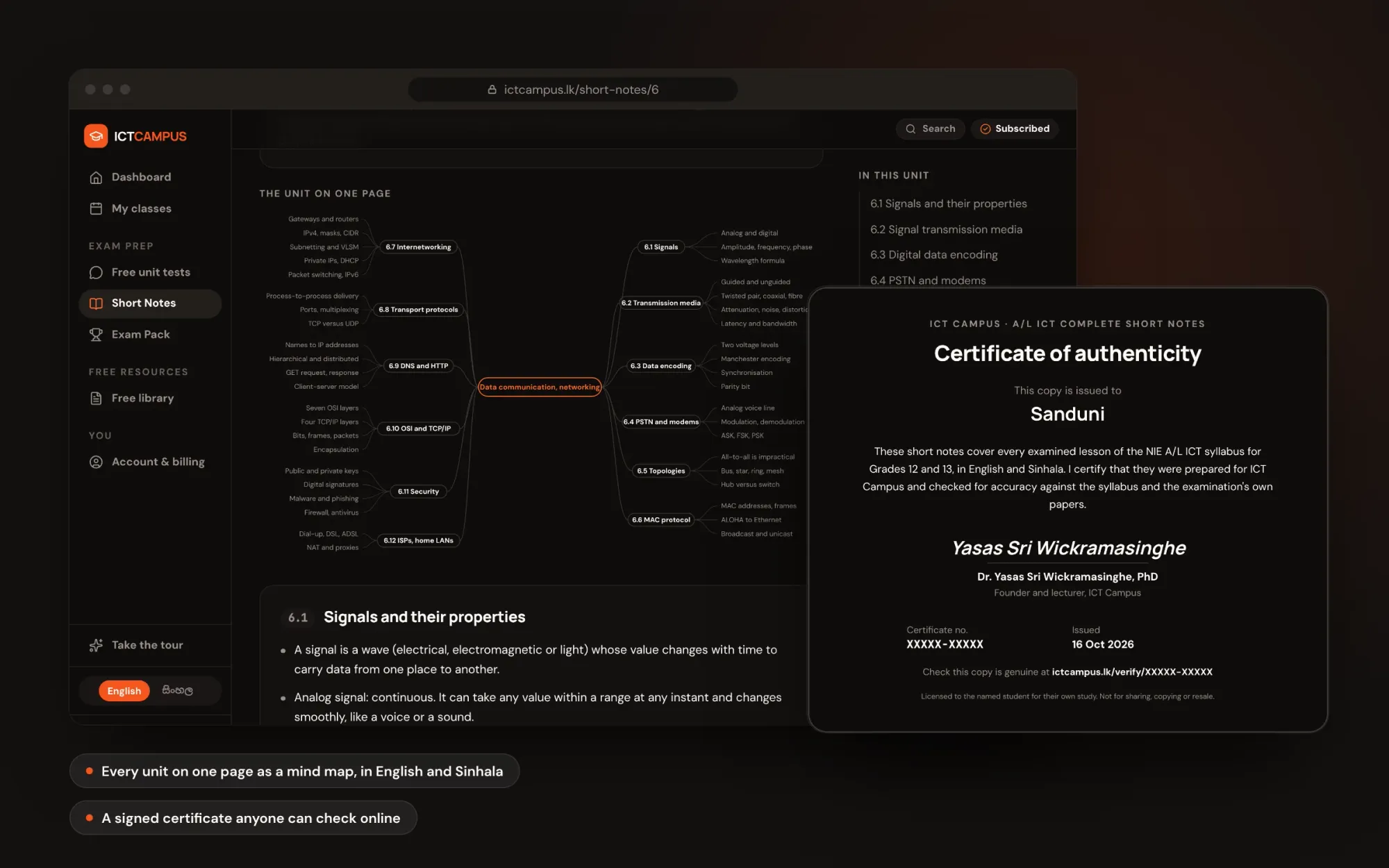
It's Rs 9,900, paid once by card through PayHere, and it's yours for 13 months.
A word about the "predicted paper", because that phrase gets abused every year in Sri Lanka. It isn't the real 2027 paper. Nobody has that before the exam, whatever a poster on a lamp post says. It's a pattern analysis of 25 past papers and the syllabus weighting, ranked by confidence, with the reasoning behind every question shown. The 2026 paper in the pack is the real one.
As I write this, the pack isn't on sale yet. You can leave your email on the Exam Pack page to hear the day it opens, and try eight of its questions there now, answers and walkthroughs included, for free.
What it looks like on a normal evening
I care about how a study tool feels. If it feels like a folder of PDFs, students open it twice. So the student dashboard on ICT Campus opens on a picture of the Nine Arch Bridge near Ella, with a train crossing it.
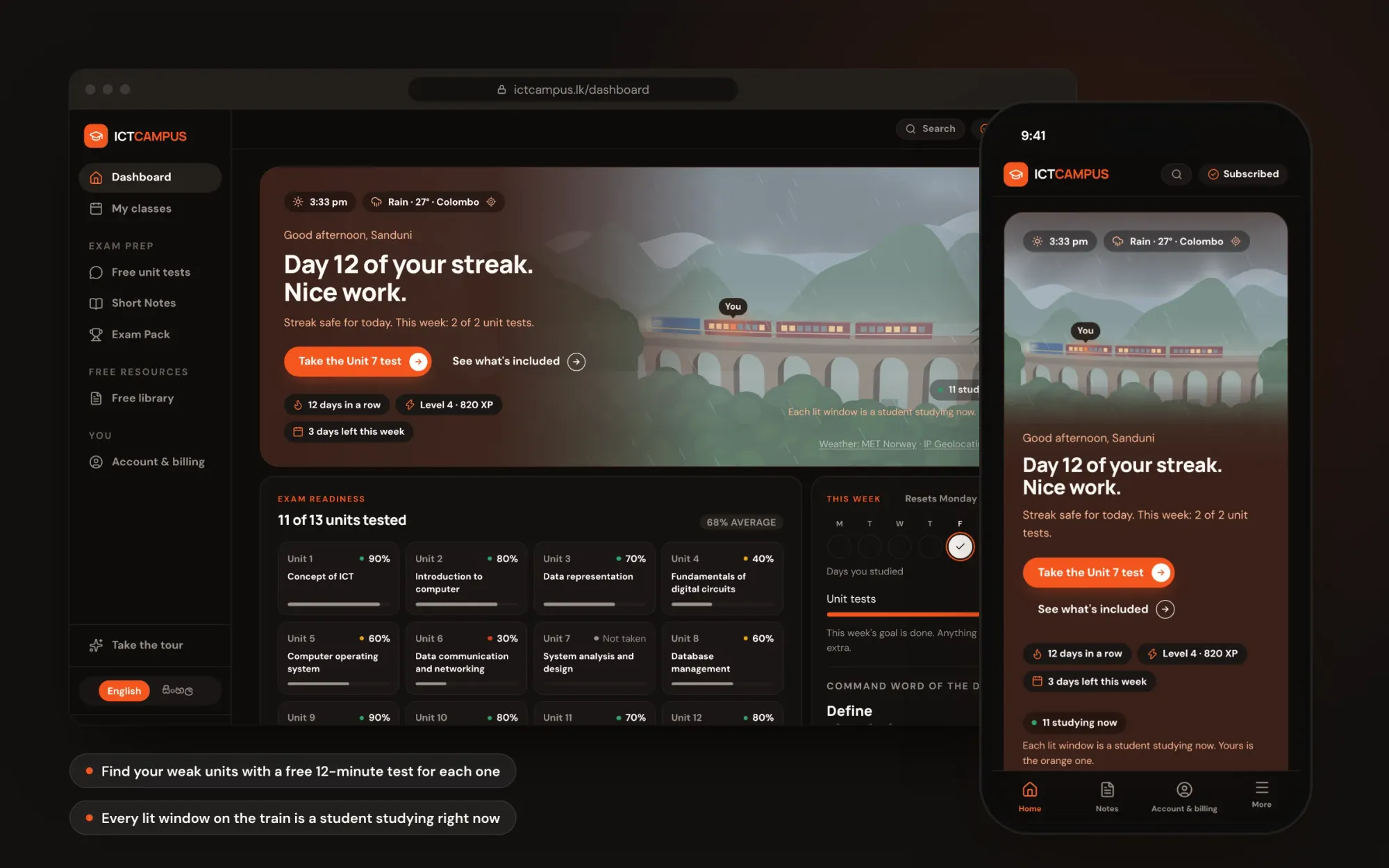
Every lit window on that train is a student studying right now. Once you've studied that day, one window turns orange and says "You". The sky is the real sky over wherever you are: dusk at dusk, and if it's raining in Kandy, it's raining on the bridge. It's a small thing. But studying alone at ten at night feels different when you can see you're not the only one on the train.
Under the picture is the part that does the work: every unit of the syllabus with your best score from the free unit tests, so the weak ones are obvious at a glance, and a weekly goal that resets every Monday. There's an English and Sinhala switch on every screen.
Free tools worth using, whether or not you buy anything
You don't have to pay for anything to start. All of these are free on ICT Campus:
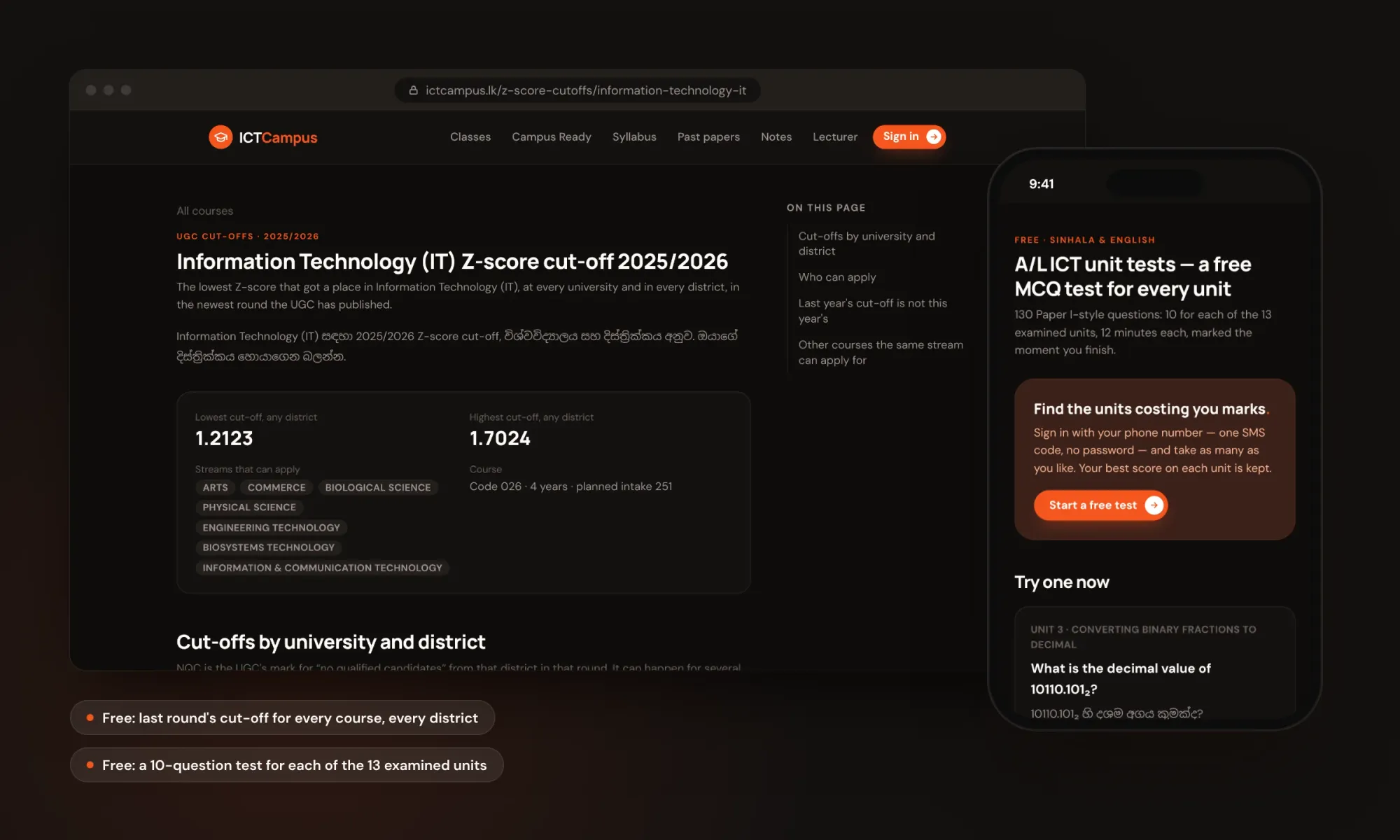
- Z-score cut-offs for every course, university and district, from the UGC's own tables
- What is a Z-score? The method, step by step, with a worked example
- A/L ICT unit tests: 10 questions for each of the 13 examined units, 12 minutes each, in Sinhala and English
- A/L ICT past papers, with a guide to using them properly
- The full A/L ICT syllabus, unit by unit
- A revision plan, especially useful if you're repeating
If I were sitting A/L ICT in 2027
Here's what I'd actually do, in this order.
- Pick three degrees you'd genuinely be happy doing. Look up the last three rounds for your own district and write down the highest cut-off. That's your target, not last year's figure.
- Check you're eligible. Read the requirements for each degree in the UGC handbook and make sure your subject combination qualifies before you plan around it.
- Take every free unit test once, this month. Don't revise first. You want an honest picture of where you are, not a flattering one.
- Write down your three weakest units and spend the next month on those, not on the ones you enjoy.
- Sit one full Paper I under real conditions. Two hours, no phone. Then go through every wrong answer until you understand the trap, not just the right option.
- Start Paper II properly. Write full answers, then mark them against an official marking scheme. Be strict with yourself.
- Find out where you rank, against other students and not just against the answer key. Then repeat steps 4 to 6 with the new list.
None of that needs a particular class or a particular product. It needs you to know where you stand, early enough to do something about it.
If you're curious where an ICT degree can lead once you're in, I've written about that too: A/L ICT, degrees and careers in Sri Lanka.
Frequently asked questions
What Z-score do I need for IT at the University of Moratuwa?
For the 2025/26 intake, the cut-off for Information Technology at Moratuwa was 1.6293 in Colombo district. It ranged from 1.2123 in Polonnaruwa to 1.7024 in Matara, so check your own district. You also need at least a C in Combined Maths, Higher Maths, Maths or Physics.
What is the Z-score cut-off for Computer Science at UCSC?
1.6565 in Colombo district for the 2025/26 intake. Gampaha was 1.6588, Kurunegala 1.6652 and Kandy 1.6684. Computer Science needs at least a C in Combined Maths, Physics or Higher Maths, and ICT can be one of the other two subjects.
Can I get into a computing degree with A/L ICT?
Yes. Information Systems at UCSC and the ICT degrees at Rajarata and Vavuniya accept a C in ICT, with S passes in two other subjects and credit passes in English and Maths at O/L. Technology stream students can apply for the BICT degree at nine universities. In the physical science stream, ICT counts towards Computer Science, Software Engineering and Data Science alongside maths and physics.
Can I calculate my Z-score from my marks before results?
No. A Z-score depends on each subject's island-wide average and standard deviation for that year, and those aren't published before results. Calculators that take raw marks are guessing them. You can, however, find out where you rank against other students before the exam.
Why is the cut-off different in every district?
Many university places are allocated district by district, so each district has its own competition and its own cut-off. That's why the UGC publishes one cut-off per course, per university, per district.
Is the A/L ICT 2027 predicted paper the real paper?
No. Nobody has the real paper before the exam. The predicted paper on ICT Campus is a pattern analysis of 25 past papers and the syllabus weighting, with the reasoning behind each question shown. The 2026 paper in the Exam Pack is the real one.
Is there a free A/L ICT test online?
Yes. ICT Campus has a free 10-question test for each of the 13 examined units, 12 minutes each, in Sinhala and English, marked as soon as you finish.
What is in the A/L ICT 2027 Exam Pack?
Two timed, ranked Paper I sittings, a study plan built from your answers, 200 Paper I questions worked through, Paper II model answers and a predicted Paper II, revision sheets for all 13 units, the Complete Short Notes in English and Sinhala, printable PDFs, and a free 30-minute consultation. It costs Rs 9,900, paid once by card, for 13 months.
Sources
- University Grants Commission, cut-off marks (Z-scores) for university admission, 2025/2026, based on the 2025 A/L after re-scrutiny
- University Grants Commission, cut-off marks for the 2018/2019 to 2024/2025 academic years, published at ugc.ac.lk
- University Grants Commission, courses of study and admission requirements, 2025/2026
- Department of Examinations, A/L ICT question papers and marking schemes, for the paper structure
I'm Dr. Yasas Sri Wickramasinghe. I teach A/L ICT through ICT Campus, which I built, so weigh what I say about the Exam Pack with that in mind. The cut-off numbers in this article are the UGC's, and every one of them is free to look up. I was a lecturer at the University of Moratuwa, I'm now a senior lecturer in New Zealand, and my PhD is in Human Interface Technology from the University of Canterbury.


